Residential garden lighting is more than choosing an attractive fixture—it is a technical decision that affects safety, visibility, wind resistance, and the visual rhythm of an outdoor space. The right pole configuration determines how light spreads across pathways, patios, planting beds, and perimeter zones while helping prevent glare and light trespass. This guide explains how mounting height, luminaire orientation, tenon compatibility, wind-load considerations, and common pole styles influence performance. For buyers, designers, and project teams, understanding these variables makes it easier to specify durable, efficient, and visually balanced garden lighting solutions with confidence.
How to Frame Residential Garden Light Pole Configurations
Establishing the correct residential garden light pole configurations is critical for balancing landscape aesthetics, safety, and photometric efficiency. Unlike commercial high-mast lighting, residential installations typically operate within a mounting height range of 0.8 meters to 3.0 meters. At these elevations, the physical geometry of the pole and the luminaire mounting style directly dictate light distribution patterns, shadow casting, and the overall architectural harmony of the outdoor space.
Professionals approach these configurations by analyzing the specific footprint of the property, calculating the required lumen density, and selecting pole architectures that integrate seamlessly with existing hardscapes. A strategic configuration minimizes light trespass while maximizing the utility of outdoor living areas.
How Light Pole Configurations Affect Visual Hierarchy
Visual hierarchy in landscape lighting relies on establishing distinct layers of illumination: ambient, task, and accent lighting. The configuration of the light pole—whether it supports a single prominent fixture or multiple directional heads—determines the focal points within the garden. A well-designed configuration typically targets a 3:1 luminance contrast ratio between focal points and the surrounding ambient landscape, ensuring that pathways or architectural features stand out without causing visual fatigue.
By manipulating pole height and fixture orientation, designers can guide the observer’s eye through the property. Shorter bollard configurations keep the visual weight grounded along walkways, while taller 2.5-meter to 3.0-meter poles with decorative brackets draw the gaze upward, defining the perimeter and highlighting the verticality of mature trees or structural facades.
Key Terms for Residential Garden Light Poles
Navigating garden lighting requires familiarity with industry-standard terminology. The ‘luminaire’ refers to the complete lighting unit, including the lamp, housing, and optical components. The ‘tenon’ is the cylindrical mounting point at the top of the pole; standard residential tenon sizes typically feature a 2.375-inch or 3-inch outer diameter (O.D.), which dictates luminaire compatibility.
Another critical metric is the Effective Projected Area (EPA), which calculates the surface area of the pole and luminaire exposed to wind. Even in residential settings, selecting a configuration with a wind load rating that exceeds local maximum wind speeds (often baseline tested at 90 to 120 mph) is essential to prevent structural failure over the installation’s lifespan.
Common Residential Garden Light Pole Configurations
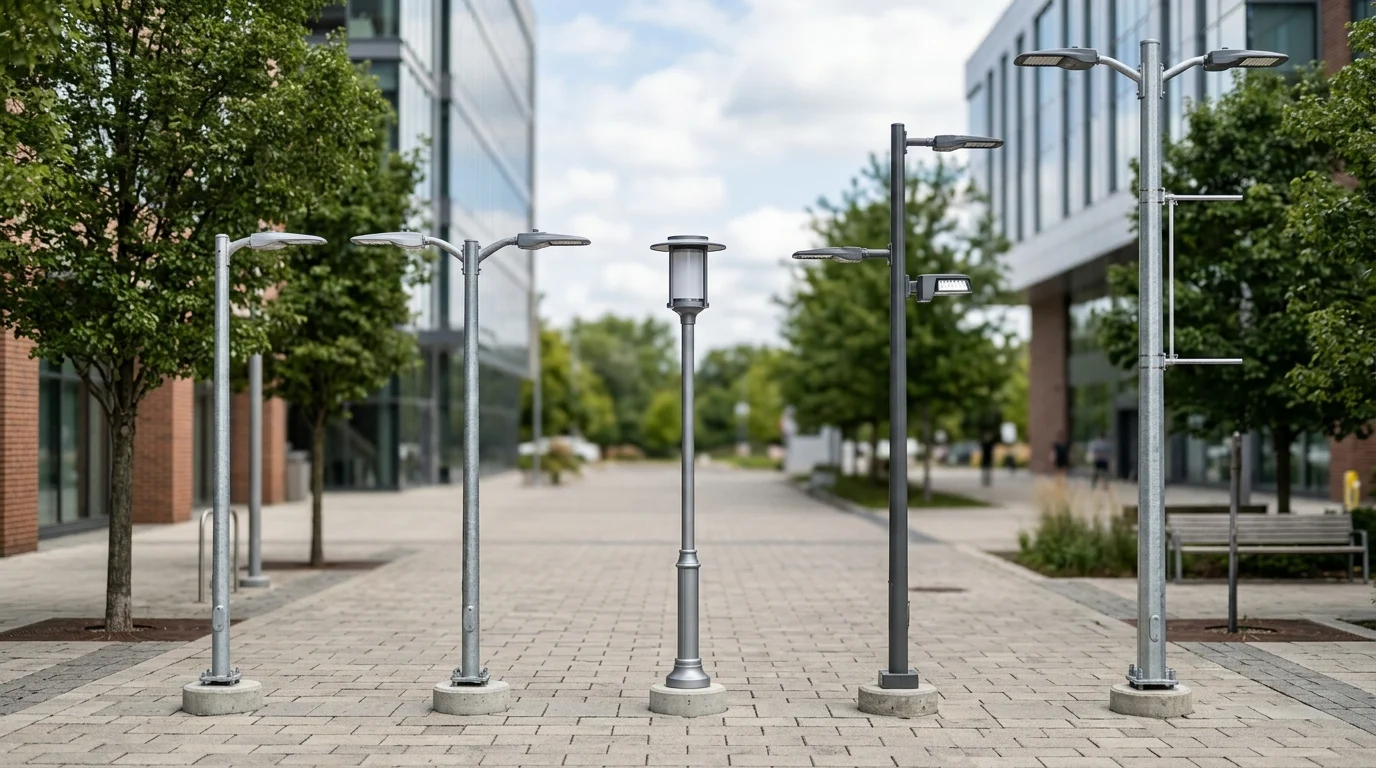
The physical arrangement of luminaires on a pole defines its operational capabilities. Residential garden light pole configurations are highly modular, allowing property owners and landscape architects to select setups that align with the specific spatial demands of driveways, patios, and dense garden beds.
Single-Head, Twin-Head, Multi-Head, and Bollard-Style Poles
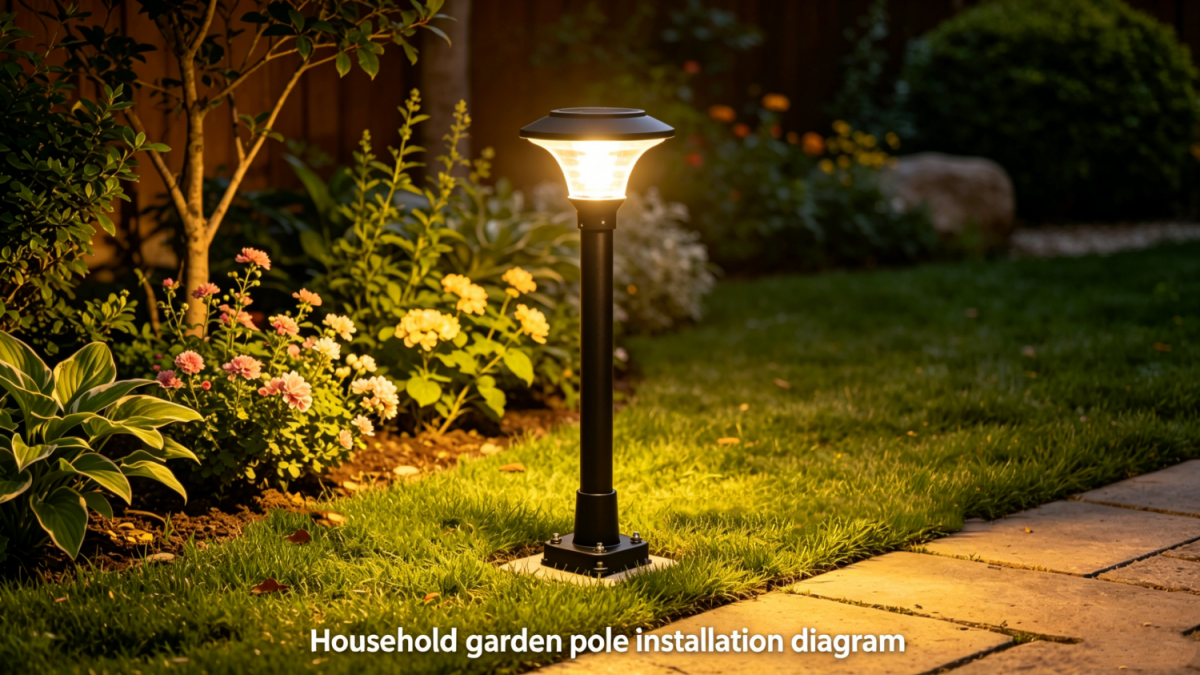
Bollard-style poles are the shortest configuration, typically ranging from 0.8m to 1.2m in height, designed specifically for low-level pathway and boundary illumination. Single-head poles feature a single post-top luminaire, offering 360-degree ambient lighting ideal for isolated patio spaces.
For larger areas, twin-head configurations mount two fixtures on a single pole, usually offset at 180 degrees for bidirectional pathway lighting or 90 degrees for corner illumination. Multi-head setups, supporting three or more luminaires, are reserved for expansive estate courtyards where high lumen output is required from a single structural footprint.
Fixed, Adjustable, Bracket-Mounted, and Decorative Options
Beyond the number of heads, the mounting mechanism heavily influences functionality. Fixed options secure the luminaire in a static position, relying entirely on the internal optics (such as louvers or reflectors) to direct light. Adjustable configurations utilize articulating knuckles or slip-fitters, allowing a 0 to 90-degree vertical tilt to aim light precisely at architectural features or tree canopies.
Bracket-mounted poles utilize side-tenon arms to extend the luminaire away from the pole’s center axis, which is useful for clearing overhanging foliage. Decorative options integrate ornate scrollwork or fluted pole shafts, serving as daytime architectural elements even when the luminaires are unpowered.
Configuration Comparison Table
Selecting the optimal arrangement requires comparing the photometric capabilities and spatial requirements of each pole type.
| Configuration Type | Typical Mounting Height | Effective Illumination Radius | Primary Residential Application |
|---|---|---|---|
| Bollard | 0.8m – 1.2m | 1.5m – 2.5m | Pathway and low-level boundary demarcation |
| Single-Head Post | 2.0m – 3.0m | 4.0m – 6.0m | General ambient lighting for patios and lawns |
| Twin-Head (180°) | 2.5m – 3.5m | 6.0m – 8.0m (bidirectional) | Central garden intersections and driveways |
| Multi-Head (3+) | 3.0m – 4.0m | 8.0m+ (omnidirectional) | Large estate courtyards and focal centerpieces |
Technical Specifications for Reliable Garden Light Poles
Reliability in outdoor lighting is intrinsically linked to technical specifications. A robust residential garden light pole configuration must balance optical performance with mechanical durability and electrical efficiency to withstand continuous environmental exposure.
Height, Spacing, Lumen Output, Beam Angle, and Color Temperature
A standard rule of thumb for residential pathways is maintaining a 4:1 spacing-to-mounting-height ratio to ensure uniform coverage without excessive light overlap. Lumen output for these applications varies strictly by configuration: bollards typically require 300 to 800 lumens, while taller 3-meter poles demand 1,500 to 3,000 lumens to achieve adequate ground-level foot-candles.
Beam angle selection, categorized by IES distribution types (e.g., Type III for asymmetric perimeter lighting or Type V for 360-degree circular spreads), ensures light is directed precisely where needed. Furthermore, color temperature (CCT) in residential gardens is generally restricted to the 2700K to 3000K range, which minimizes blue-light emission and preserves the natural rendering of foliage.
Materials, Coatings, and Ingress Protection
Material selection dictates both the aesthetic longevity and structural integrity of the pole. Extruded aluminum is the industry standard due to its high strength-to-weight ratio and natural corrosion resistance. To prevent UV degradation and oxidation, premium poles feature a polyester powder coating applied at a thickness of 3 to 5 mils.
Ingress Protection (IP) ratings are non-negotiable for the luminaire heads attached to these poles. A minimum rating of IP65 is required to protect against dust and low-pressure water jets from garden sprinklers, while IP67-rated fixtures are recommended for configurations installed in low-lying areas prone to temporary flooding or heavy snow accumulation.
Wired, Low-Voltage, Solar, and Hybrid Power Systems
Powering these configurations involves choosing between line-voltage, low-voltage, solar, or hybrid systems. Traditional wired systems operating at 120V or 240V offer maximum lumen output but require extensive trenching. Low-voltage systems (12V/24V) are safer and easier to install in existing landscapes, utilizing step-down transformers.
Solar configurations have advanced significantly, with top-tier models integrating monocrystalline panels boasting greater than 20% efficiency and LiFePO4 batteries that offer 2,000+ charge cycles. Hybrid systems combine low-voltage wiring with solar backups, ensuring uninterrupted illumination during extended periods of heavy cloud cover or localized power grid failures.
Compliance and Procurement Considerations
Procuring and installing residential garden light poles requires strict adherence to safety codes, environmental standards, and quality assurance protocols. Overlooking compliance can result in hazardous installations, municipal fines, and premature system failure.
Electrical Codes and Dark-Sky Considerations
Navigating the regulatory landscape is a mandatory phase of procurement. The National Electrical Code (NEC) stipulates strict burial depths for outdoor wiring; for instance, PVC conduit must be buried at least 18 inches below grade, whereas direct burial cables require a 24-inch depth to prevent accidental severing during landscaping.
Alongside electrical safety, Dark-Sky compliance is increasingly mandated by municipal ordinances. This requires luminaires to feature a BUG (Backlight, Uplight, Glare) rating that specifies a U0 (zero uplight) value. Configurations must utilize fully shielded fixtures to ensure they do not contribute to light pollution or trespass across property lines.
Supplier Documentation and Quality Checks
Sourcing reliable hardware necessitates reviewing supplier documentation. Reputable manufacturers should provide ISO 9001 certification and ensure their products carry UL or ETL safety listings. For LED components, buyers must request LM-79 and LM-80 photometric reports to verify lumen maintenance and color stability claims.
Quality checks should also involve auditing the supplier’s warranty terms and historical defect rates. Tier-one lighting manufacturers typically maintain a defect rate threshold of less than 1% and offer a minimum 5-year warranty on both the structural pole components and the integrated LED drivers.
Step-by-Step Site Survey Process
A comprehensive site survey mitigates installation risks. The first step is assessing soil composition to determine the appropriate footing; standard 3-meter poles generally require a concrete base poured to a minimum compressive strength of 3,000 PSI, extending below the local frost line.
The survey must also map underground utilities to avoid striking water or gas lines during excavation. Finally, for wired configurations, technicians must calculate voltage drop—especially for low-voltage runs exceeding 100 feet—to ensure that the furthest luminaire on the circuit receives adequate power without dimming.
How to Choose the Best Residential Garden Light Pole
Finalizing the ideal residential garden light pole configuration is an exercise in balancing upfront constraints with long-term performance. Decision-makers must evaluate how different materials and mounting styles align with their specific environmental conditions and architectural vision.
Decision Matrix for Aesthetics, Performance, and Budget
Evaluating the trade-offs between different pole materials and configurations requires a structured approach. The following decision matrix outlines the primary considerations for residential applications.
| Material / Configuration | Upfront Cost Index | Maintenance Frequency | Expected Lifespan | Aesthetic Impact |
|---|---|---|---|---|
| Extruded Aluminum (Powder-Coated) | Moderate ($$) | Low | 20+ Years | High (Modern/Transitional) |
| Cast Iron / Steel | High ($$$) | Moderate (Rust prevention) | 25+ Years | High (Classic/Ornate) |
| Fiberglass / Composite | Low to Moderate ($) | Very Low | 15–20 Years | Moderate (Utilitarian) |
| Low-Voltage Bollard System | Low ($) | Moderate (Cable checks) | 10–15 Years | Subtle / Minimalist |
Practical Selection Recommendations
When finalizing a purchase, prioritize lifecycle cost over initial expenditure. For example, opting for a premium powder-coated aluminum pole might command a 30% higher upfront cost compared to standard painted steel, but it effectively eliminates the need for rust remediation and extends the functional lifespan by 10 to 15 years.
Furthermore, standardizing the tenon sizes across the property is highly recommended. Utilizing a universal 2.375-inch tenon allows property owners to upgrade or replace luminaire heads in the future without the need to uproot and replace the entire pole structure, ensuring the garden lighting system remains adaptable to evolving technological standards.
Key Takeaways
- Keep most residential garden light poles within the 0.8m to 3.0m mounting-height range to balance visibility, scale, and landscape aesthetics.
- Use bollard-style poles at 0.8m to 1.2m for low-level pathway, boundary, and garden-bed illumination.
- Match the luminaire to the pole tenon, commonly 2.375-inch or 3-inch outer diameter, to ensure mounting compatibility.
- Check effective projected area and wind-load ratings against local wind conditions, especially for multi-head or decorative configurations.
- Apply a 3:1 luminance contrast ratio between focal points and surrounding ambient areas to create hierarchy without visual fatigue.
- Choose single-head, twin-head, or multi-head configurations based on whether the area needs ambient coverage, bidirectional lighting, or targeted accents.
Frequently Asked Questions
What height is best for residential garden light poles?
Most residential garden poles range from 0.8m to 3.0m. Bollards at 0.8m–1.2m suit pathways, while 2.5m–3.0m poles work better for perimeter lighting, patios, and taller landscape features.
How do I choose between single-head and twin-head poles?
Use single-head poles for 360-degree ambient light in small patios or garden zones. Choose twin-head poles for bidirectional paths, corners, or wider areas where two controlled beams reduce the number of poles needed.
Why does tenon size matter for garden light poles?
The tenon is the cylindrical mounting point at the pole top. Common residential sizes include 2.375-inch and 3-inch outer diameters, and matching the tenon to the luminaire ensures proper fit, safety, and long-term stability.
What wind rating should a residential garden pole have?
Select a pole and fixture configuration with wind-load capacity above local maximum wind speeds. Many designs are evaluated around 90 to 120 mph baselines, but final selection should account for the site and fixture EPAs.
How can pole configuration reduce light trespass?
Proper height, fixture orientation, and head count help aim light toward usable areas instead of neighboring properties. Lower bollards, shielded luminaires, and controlled beam angles are effective for residential boundary and pathway lighting.