Introduction
Anchor bolt design governs how an aluminum pole transfers wind, weight, and vibration into its concrete foundation, so small detailing choices can decide whether the base remains stable or becomes the system’s weak point. Because aluminum poles are lighter and more flexible than steel, their base connections must handle higher deflection demands, concentrated overturning forces, and strict alignment requirements. This article explains the key design factors behind bolt size, embedment, spacing, base plate interaction, and common failure modes, giving readers a practical framework for evaluating stability, durability, and code-aligned performance before moving into calculations and connection details.
Why Anchor Bolt Design Matters for Aluminum Poles
The structural integrity of an aluminum pole system relies fundamentally on the foundation connection. As municipalities and developers increasingly transition from traditional steel to aluminum for its corrosion resistance and typical 50% weight reduction, managing the flexibility of these structures becomes paramount. Because structural aluminum alloys, such as 6063-T6, exhibit a lower modulus of elasticity (roughly 10,000 ksi) compared to carbon steel, these poles experience significantly greater deflection under lateral wind loads. This inherent flexibility concentrates immense overturning moments at the base plate, making the anchor bolt design for poles the most critical failure point in the entire assembly.
Definition and Structural Role
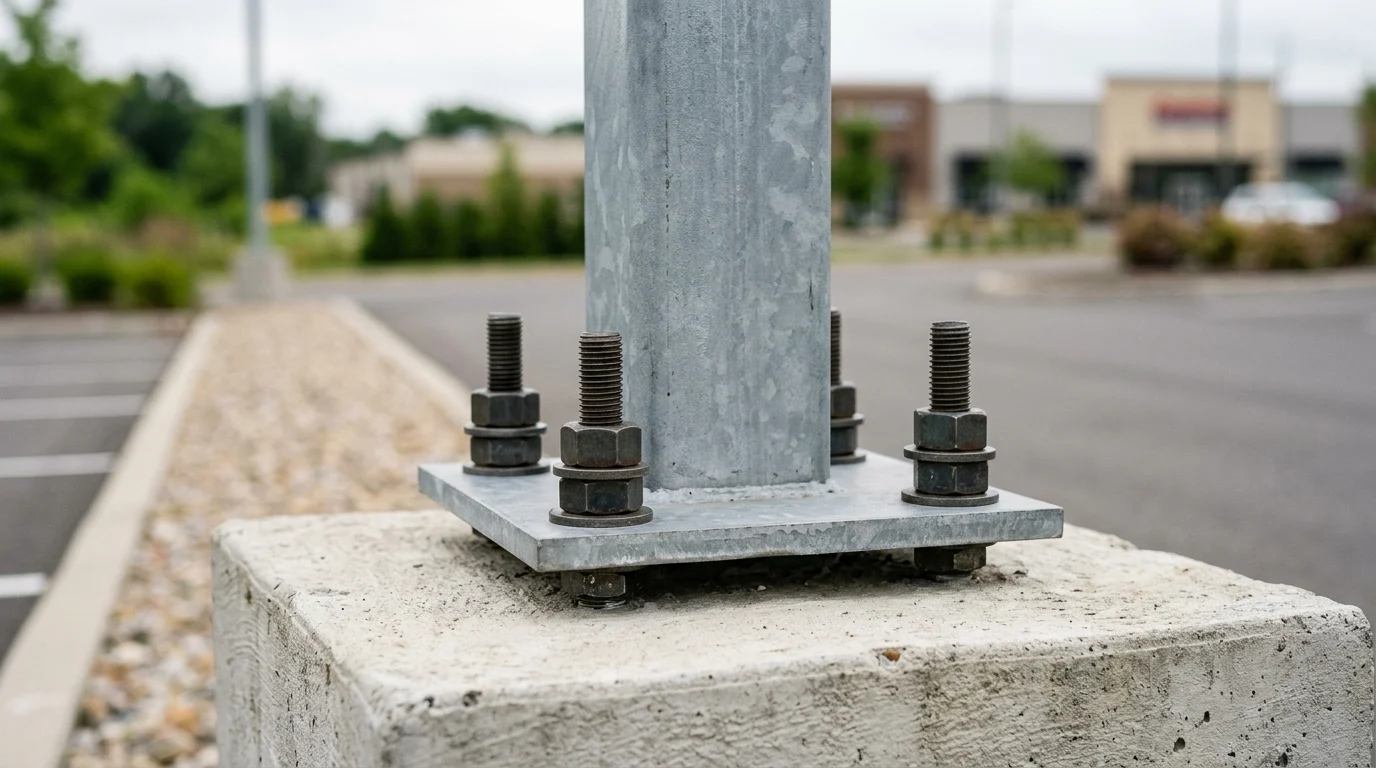
Anchor bolts serve as the primary structural bridge, transferring axial compression, shear forces, and bending moments from the luminaire or traffic structure directly into the concrete foundation. In high-mast or heavy-duty infrastructure applications, an optimized anchor bolt design for poles prevents catastrophic base failures under extreme weather conditions. These cast-in-place or post-installed elements must maintain rigid vertical alignment while counteracting dynamic wind pressures that can easily exceed 130 mph in ASCE 7-22 defined coastal zones. The bolts essentially lock the base plate to the footing, ensuring that the cantilevered pole acts as a unified structural system rather than an isolated column.
Load Paths, Failure Modes, and Site Conditions
Load paths in aluminum pole assemblies are highly susceptible to fatigue caused by vortex shedding, galloping, and natural wind gusts. Unlike steel, aluminum has no defined fatigue limit, meaning cyclic loading over decades will eventually cause wear if stresses are not properly managed at the base connection. Common failure modes include anchor bolt yielding, thread stripping under cyclic tension, and concrete breakout. Concrete breakout typically occurs when edge distances are less than 6 times the nominal bolt diameter, leading to a conical fracture in the foundation. Site conditions, such as local soil bearing capacity and regional seismic design categories, dictate the required embedment depth and bolt circle diameter to ensure the load path remains unbroken during peak environmental stress events.
How to Specify Anchor Bolt Design for Poles
Precision in specifying anchor bolt parameters ensures that the connection can withstand calculated fatigue loads over a typical 50-year design life. Structural engineers must carefully align the bolt specifications with both the geometry of the aluminum base plate and the specified compressive strength of the foundation concrete, which usually ranges from 3,000 to 4,000 psi. Furthermore, base plate thickness must be evaluated alongside bolt yield strength to prevent prying action, a phenomenon that can artificially amplify the tensile forces acting on the bolts during severe wind events.
Key Design Variables
Key design variables include the bolt circle diameter (BCD), embedment depth, projection length above the concrete, and nominal bolt diameter. Standard commercial lighting poles typically utilize bolt diameters ranging from 0.75 inches to 1.25 inches, while high-mast or heavy traffic applications may require diameters exceeding 2.25 inches to resist massive overturning moments. The embedment depth must be precisely calculated to develop the full tensile capacity of the steel bolt before a concrete cone failure can occur.
| ASTM F1554 Grade | Yield Strength (ksi) | Tensile Strength (ksi) | Typical Pole Application |
|---|---|---|---|
| Grade 36 | 36 | 58 – 80 | Pedestrian & standard street lighting |
| Grade 55 | 55 | 75 – 95 | Traffic signals & medium-height masts |
| Grade 105 | 105 | 125 – 150 | High-mast lighting & heavy cellular towers |
Material Selection, Corrosion Control, and Code Compliance
Material selection must aggressively address the risk of galvanic corrosion, a primary concern when mating an aluminum base plate with steel hardware. Hot-dip galvanizing per ASTM A153 provides a standard protective zinc coating with a minimum thickness of 2.0 mils to prevent rapid oxidation. For highly corrosive coastal or industrial environments, Type 316 stainless steel bolts are frequently specified, despite a cost premium. Furthermore, the overall design must comply strictly with ACI 318 Chapter 17 for concrete anchorage and AASHTO LTS-6 specifications. These codes mandate that the combined shear and tension interaction on the bolt group does not exceed defined utilization ratios, which are strictly capped at 1.0 to ensure a robust safety factor.
How to Evaluate and Implement Anchor Bolt Design
Translating engineered specifications into field realities requires strict quality control during both procurement and the physical installation phases. Evaluating the correct hardware configuration upfront minimizes on-site alignment issues, reduces contractor rework, and limits long-term maintenance liabilities for municipalities and facility owners. Proper execution of the anchor bolt design directly impacts the lifecycle cost of the pole infrastructure, as poorly installed bolts are the leading cause of premature structural leaning and vibration-induced fatigue.
Comparing Standard and Custom Options
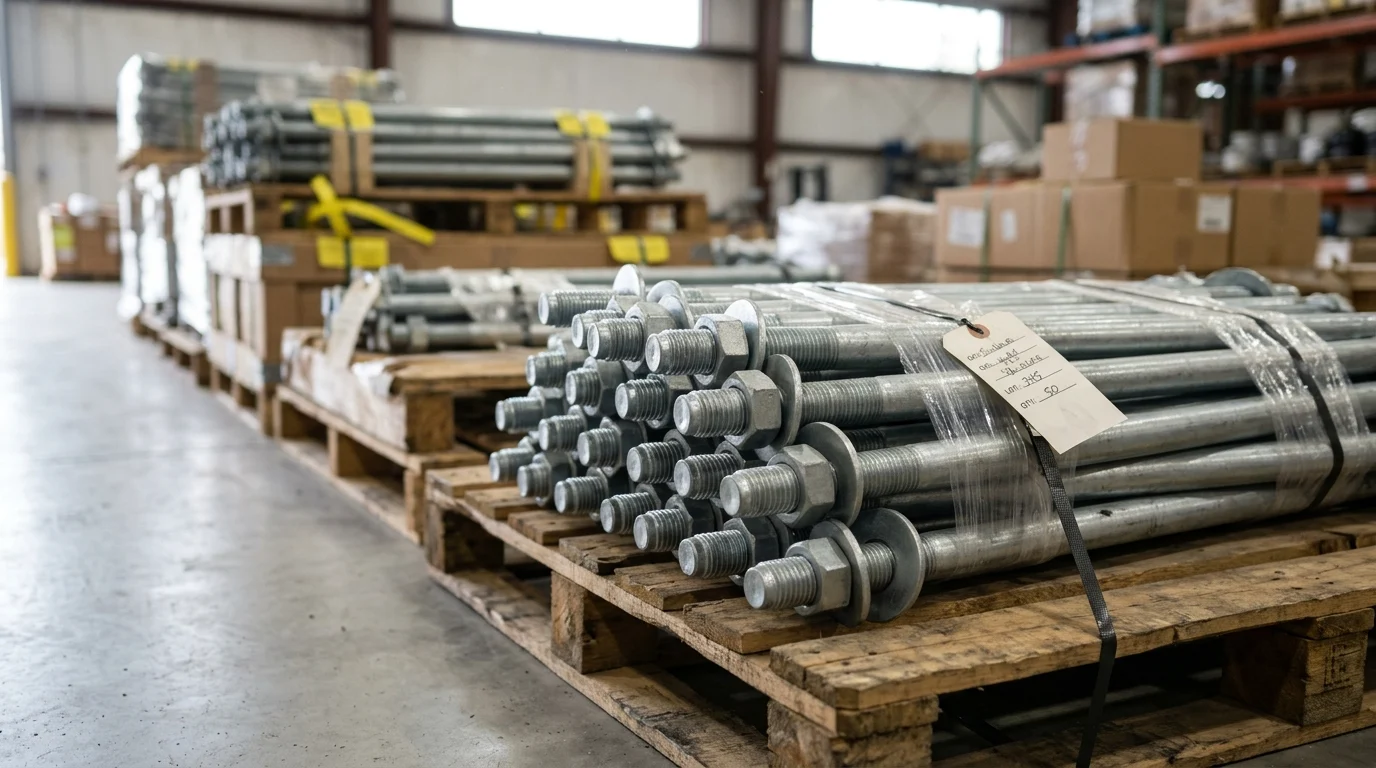
Engineers must evaluate whether standard L-bend anchor bolts or custom straight bolts with embedded anchor plates are most appropriate for the project. L-bend bolts are highly cost-effective and readily available for standard 0.75-inch to 1-inch diameters, relying entirely on the 90-degree hook for pullout resistance. However, for high-capacity applications requiring Grade 105 steel or diameters above 1.5 inches, straight bolts equipped with heavy hex nuts and bearing plates provide superior pullout resistance and mitigate the risk of localized concrete crushing. While custom plate-anchored bolts offer demonstrably better structural performance under heavy loads, they typically increase procurement lead times by 3 to 5 weeks and carry a 20% to 40% cost premium compared to off-the-shelf L-bend variants.
Specification, Inspection, and Installation Steps
Successful field implementation requires rigorous adherence to installation tolerances. Using rigid templates during the concrete pour ensures the bolt circle diameter and projection lengths match the base plate precisely. Post-installation inspections should verify that the hardware is plumb and that the correct torque is applied to the nuts, securing the aluminum pole against dynamic environmental loads for its full intended lifespan.
Key Takeaways
- The most important conclusions and rationale for Anchor Bolt Design for Poles
- Specs, compliance, and risk checks worth validating before you commit
- Practical next steps and caveats readers can apply immediately
Frequently Asked Questions
Why is anchor bolt design more critical for aluminum poles?
Aluminum poles deflect more than steel, so higher base moments concentrate at the anchor bolts. A proper design reduces bolt fatigue, thread damage, and concrete breakout.
What anchor bolt details should I provide for a quote or drawing review?
Send pole height, load type, wind speed, base plate size, bolt circle, bolt diameter, projection, embedment, and concrete strength. Morelux can review these and support technical drawings.
Which ASTM F1554 bolt grade is commonly used for pole projects?
Grade 36 often suits pedestrian or standard lighting, Grade 55 fits traffic poles, and Grade 105 is used for high-mast or heavy-duty applications. Final selection should follow project loads and code checks.
How can I reduce concrete breakout risk at the pole foundation?
Use adequate embedment depth, maintain proper edge distance, and match the bolt layout to the footing size and concrete strength. Avoid undersized foundations in high-wind or seismic areas.
Can Morelux help with customized anchor bolt layouts for infrastructure projects?
Yes. Morelux supports custom aluminum and steel pole projects with engineer assistance, technical drawings, and fast quotations, helping buyers align pole bases and anchor bolt patterns with project requirements.