Introduction
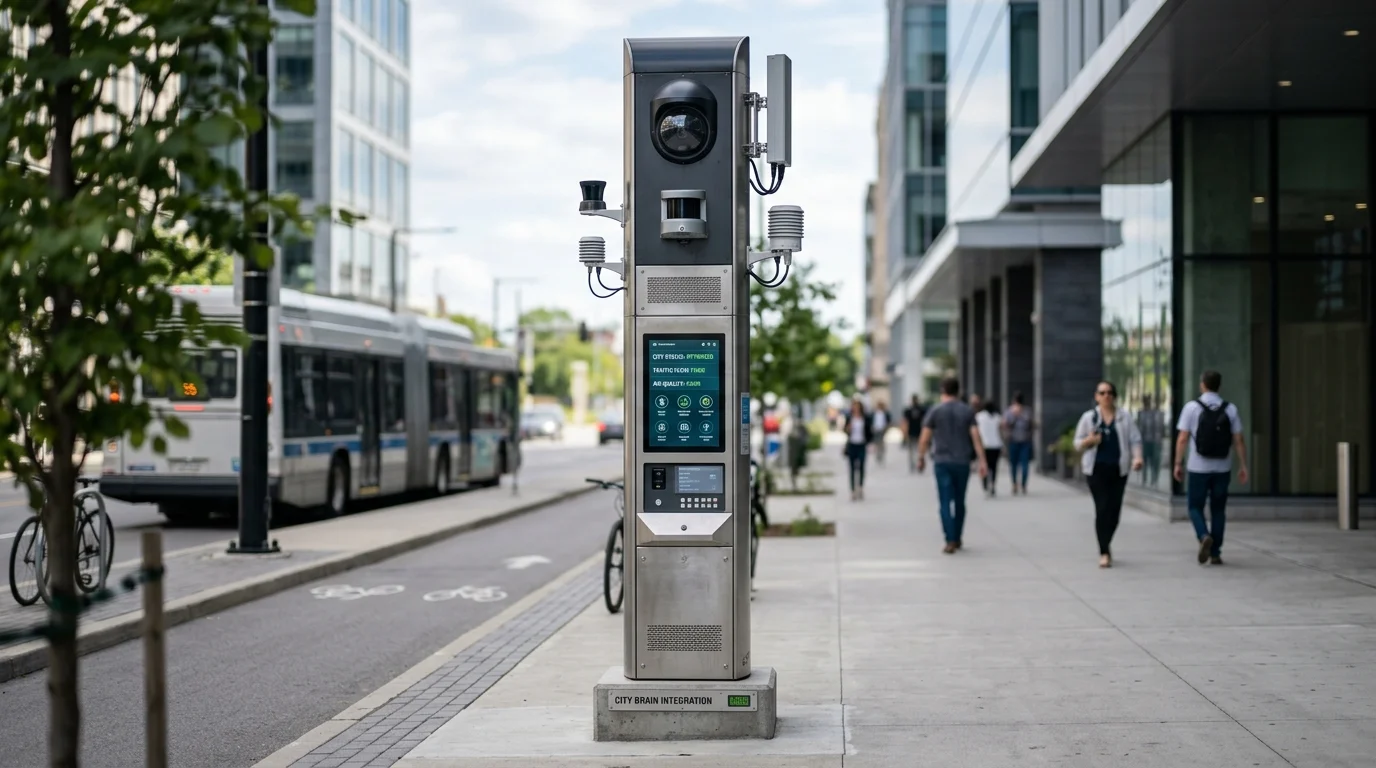
As cities connect lighting, traffic systems, sensors, and communications networks, the City Brain Integration Pole has emerged as a practical way to bring these functions into one coordinated urban node. Rather than treating each device as a separate installation, this approach supports shared infrastructure, real-time data exchange, and tighter integration with centralized control platforms. The discussion that follows outlines the main integration paths behind these poles, showing how they reduce physical duplication, improve operational efficiency, and enable coordinated services such as environmental monitoring, intelligent transport, public safety, and adaptive street management.
Why the City Brain Integration Pole Matters
The rapid urbanization and digitalization of municipal infrastructure have elevated the City Brain Integration Pole from a conceptual smart lighting fixture to a critical node in urban data orchestration. These poles serve as the physical manifestation of a “City Brain”—a centralized artificial intelligence platform that processes urban data in real-time. By consolidating disparate edge devices into a unified structural and network framework, these integration poles form the foundational grid required for autonomous transit, environmental monitoring, and dynamic public safety networks.
Strategic drivers and cross-domain value
Strategic drivers for deploying these unified poles revolve around maximizing cross-domain data utility while minimizing physical infrastructure sprawl. Traditionally, municipalities deployed separate poles for street lighting, traffic cameras, 5G micro-base stations, and environmental sensors. Consolidating these functions into a single integration pole reduces street-level visual clutter and infrastructure footprint by up to 45%. Furthermore, cross-domain value is realized when data from one sensor (e.g., optical cameras detecting traffic congestion) triggers automated responses in another domain (e.g., dimming streetlights in unoccupied zones or alerting V2X networks).
Commercial and operational pressures
Municipalities and infrastructure operators face severe commercial and operational pressures that necessitate a shift away from siloed deployments. Maintaining disparate networks results in duplicated power drops, redundant fiber trenching, and multiplied maintenance contracts. Migrating to a City Brain Integration Pole architecture can lower overall operational expenditures (OPEX) by 30% to 40% annually. The shared power and backhaul infrastructure significantly reduces the total cost of ownership (TCO) while creating new revenue streams, such as leasing modular payload space to telecommunications providers for 5G and 6G densification.
What a City Brain Integration Pole Is

A City Brain Integration Pole is a highly engineered vertical asset designed to house, power, and connect a dense array of Internet of Things (IoT) sensors and edge computing hardware. Unlike basic smart poles that merely attach cameras to light fixtures, an integration pole is structurally and logically designed as an extension of the municipal cloud, bringing high-performance computing directly to the network edge.
Core functions
The core functions of the pole extend far beyond illumination. It acts as a multi-access edge computing (MEC) node, processing localized data to reduce backhaul bandwidth and latency. For example, local AI processors can analyze video feeds for traffic anomalies and instantly broadcast warnings to connected vehicles, achieving the sub-10 millisecond latency required for autonomous vehicle (AV) corridors. Additionally, the pole functions as a micro-climate monitoring station, a public Wi-Fi access point, and an electric vehicle (EV) charging hub, dynamically allocating power based on grid load.
Key architecture layers
The architecture of these poles is highly modular, typically categorized into four distinct layers to facilitate seamless integration with the broader City Brain ecosystem.
| Architecture Layer | Core Components | Technical Specifications |
|---|---|---|
| Physical & Structural | High-tensile alloy shaft, modular bays | 150 kg+ payload capacity, IP65/IP67 rating |
| Power & Energy | Smart meters, localized battery backup | 3-5 kW total draw, 48V DC / 220V AC distribution |
| Network & Connectivity | Fiber optic backhaul, 5G/LTE antennas | 50Gbps+ backhaul throughput, Wi-Fi 6/7 |
| Edge Computing & AI | AI accelerators, MEC hardware | >20 TOPS (Tera Operations Per Second) localized processing |
This layered approach ensures that hardware components can be upgraded independently without requiring a complete teardown of the physical structure.
Viable Integration Paths
Deploying a network of City Brain Integration Poles requires a strategic approach tailored to the existing urban fabric. Planners must navigate the complexities of legacy infrastructure, budget constraints, and varying district requirements to establish a cohesive deployment roadmap.
Retrofit, hybrid, and greenfield models
Municipalities typically choose from three primary integration models based on localized feasibility. Retrofit models involve attaching unified sensor and communication brackets to existing streetlight infrastructure. While cost-effective, retrofits are severely limited by legacy structural integrity, often restricted to a maximum payload capacity of 30kg to 50kg. Hybrid models involve replacing pole shafts on existing foundations, allowing for moderate upgrades in power and fiber connectivity. Greenfield models, conversely, are purpose-built from the ground up. These custom installations support payloads exceeding 150kg, feature dedicated high-capacity power feeds, and are essential for full-scale edge computing and 5G mmWave deployments.
Evaluation criteria
Evaluating the optimal path requires balancing structural, electrical, and data prerequisites. Key evaluation criteria include structural load-bearing limits, wind resistance ratings (often required to withstand Category 3 to 5 hurricane forces depending on the region), and subsurface power availability. Upgrading a retrofit pole to support the 3 to 5 kW power draw required by a fully loaded integration pole often necessitates cost-prohibitive trenching, shifting the TCO advantage toward a greenfield replacement. Furthermore, thermal management criteria must be evaluated, as densely packed edge servers and 5G radios generate significant heat that passive cooling may not adequately dissipate.
District-level priorities
Integration strategies must also align with district-level priorities. Central business districts (CBDs) prioritize high-density 5G coverage, V2X communication for complex traffic management, and advanced facial or license plate recognition security features. In contrast, residential districts may prioritize environmental sensors, noise monitoring, and EV charging capabilities. Industrial zones require robust IoT gateways for logistics tracking and autonomous fleet management. Tailoring the payload modularity to these specific district profiles ensures maximum return on investment and prevents over-engineering in low-demand areas.
Implementation and Compliance Factors
Transitioning from procurement to active deployment involves rigorous execution and strict adherence to regulatory standards. The integration of high-powered computing and sensitive data collection instruments into public spaces introduces significant compliance and logistical challenges.
Implementation steps for stakeholders
Successful implementation demands a coordinated effort among city planners, utility providers, and technology integrators. The process begins with comprehensive site surveys and geotechnical assessments to verify foundation requirements. Following utility coordination for high-voltage power drops and dark fiber trenching, the physical installation occurs. Stakeholders must account for a standard manufacturing lead time of 12 to 16 weeks for custom-fabricated poles. The final phase is digital commissioning, where edge nodes are authenticated, calibrated, and securely federated into the centralized City Brain platform.
Cybersecurity, data governance, and infrastructure compliance
Because Integration Poles continuously capture optical, acoustic, and telemetric data, stringent cybersecurity and data governance protocols are mandatory. Compliance with frameworks such as GDPR or CCPA dictates that personally identifiable information (PII), such as faces or license plates, must be anonymized at the edge before transmission to the central cloud. Hardware infrastructure must adhere to rigorous security standards; for instance, edge computing modules should incorporate hardware security modules (HSMs) certified to FIPS 140-2 Level 3 to prevent physical tampering and cryptographic key extraction. Network compliance also requires end-to-end encryption using TLS 1.3 for all backhaul communications.
Vendor evaluation and procurement criteria
Selecting the right vendor consortium is critical, as no single manufacturer typically produces the physical pole, the edge computing hardware, and the centralized AI software. Procurement teams must evaluate vendors based on interoperability, open-source compliance, and long-term support.
| Evaluation Criterion | Sub-Metrics | Minimum Acceptable Threshold |
|---|---|---|
| Interoperability | API openness, protocol support | RESTful APIs, MQTT, ONVIF Profile S/T |
| Hardware Durability | MTBF, ingress protection | 100,000 hours MTBF, IP65 minimum |
| Edge Processing | AI inference speed, thermal rating | 20 TOPS, operational up to 55°C |
| Vendor Ecosystem | Third-party payload certification | Documented SDK/API for at least 3 third-party sensors |
How to Select the Right City Brain Integration Pole
Procuring a city brain integration pole network is a multi-decade infrastructure commitment. Decision-makers must look beyond immediate technological trends to select platforms that offer the agility to adapt to future smart city demands.
Decision framework
A robust decision framework prioritizes modularity, scalability, and open architecture. Hardware lock-in represents the most significant risk in smart pole deployments. Decision-makers should mandate standardized mounting brackets and open data protocols to ensure sensors and radios can be swapped as technology evolves. The physical pole and foundation should target a minimum 15-year lifecycle, while the internal bays must accommodate 3-to-5-year technology refresh cycles for edge processors and communication modules. Financial modeling within this framework must also weigh immediate capital expenditures against the long-term revenue potential of leasing pole real estate to private telecom operators.
Key takeaways for decision-makers
For municipal planners and infrastructure investors, the deployment of a City Brain Integration Pole network requires shifting from a hardware-centric view to a platform-centric strategy. The physical pole is merely the chassis; the true value lies in the data orchestration and edge computing capabilities it houses. By ensuring rigorous compliance, demanding open interoperability, and aligning physical deployments with district-specific analytics needs, decision-makers can establish a scalable nervous system that actively drives urban efficiency, public safety, and sustainable growth.
Key Takeaways
- The most important conclusions and rationale for City Brain Integration Pole
- Specs, compliance, and risk checks worth validating before you commit
- Practical next steps and caveats readers can apply immediately
Frequently Asked Questions
What integration path is best for an existing streetscape?
Retrofit suits streets with usable pole foundations and power. It lowers civil work and speeds deployment, but structural checks are essential before adding cameras, 5G, or edge devices.
When should a city choose a hybrid deployment model?
Use hybrid deployment when some areas can reuse assets but others need full replacement. It balances budget, rollout speed, and performance across old downtown zones and new development districts.
Why are greenfield projects easier for city brain integration poles?
Greenfield projects allow power, fiber, pole spacing, and payload needs to be planned together. This makes it easier to support MEC, sensors, lighting, and telecom equipment from day one.
What should buyers confirm before specifying a city-brain integration pole?
Confirm payload, wind-load, access doors, IP rating, power distribution, cable routing, and future upgrade space. Morelux can support custom drawings and engineering review before procurement.
Can Morelux provide customized poles for smart city infrastructure projects?
Yes. Morelux manufactures custom aluminum and steel poles; offers engineering support, technical drawings, and dependable production; and typically provides fast quotes within 24 hours for project buyers.