Introduction
Choosing material for an airport apron lighting pole affects more than strength, weight, and corrosion resistance. In a space crowded with radios, radar, control systems, and high-output LED drivers, electromagnetic interference is a practical design concern. Aluminum offers advantages here because its conductivity and shielding behavior can help limit emitted noise and support overall electromagnetic compatibility. This article explains why EMI performance matters on the apron, how aluminum compares with alternative pole materials, and what that means for lighting reliability, regulatory compliance, and protection of nearby aviation electronics.
Why Airport Apron Lighting Pole Material Choice Matters
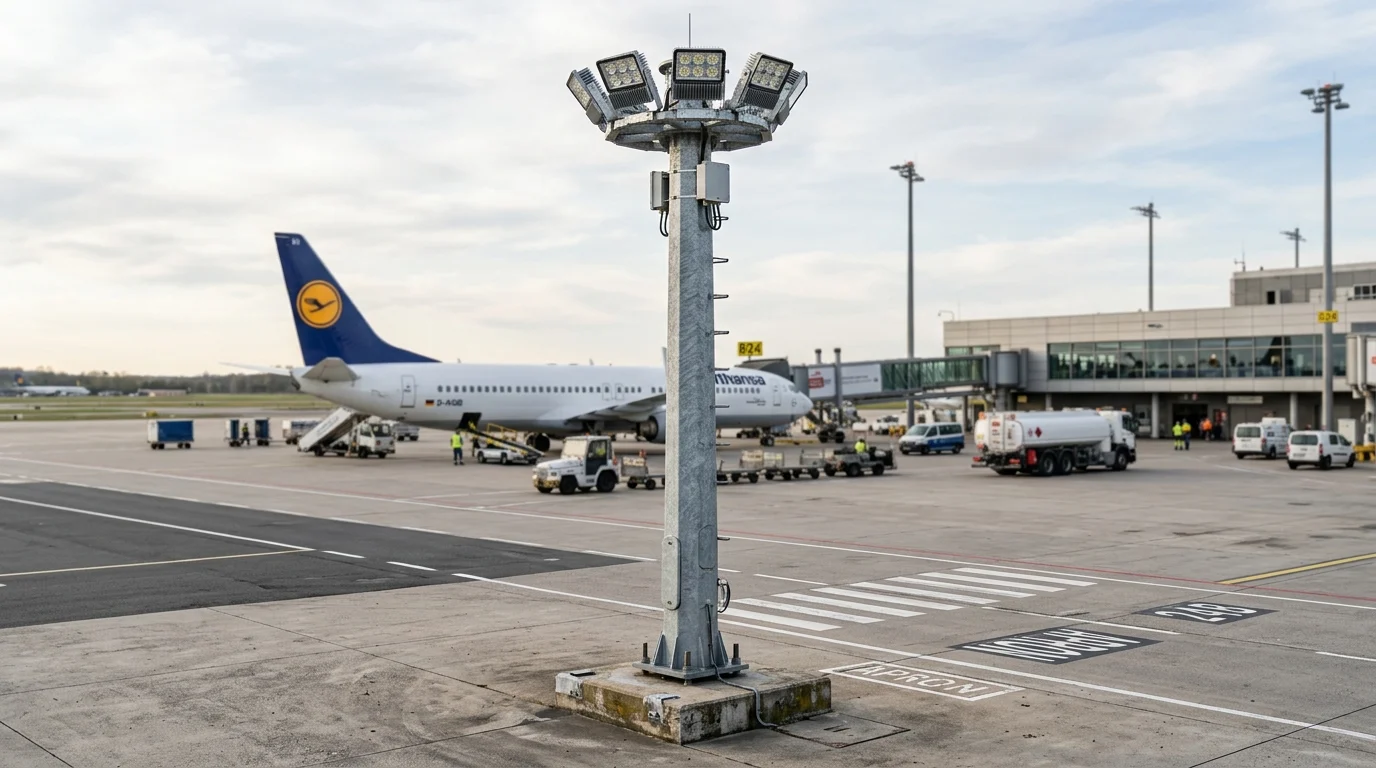
The specification of aviation infrastructure demands strict adherence to structural, photometric, and electromagnetic standards. Among these critical assets, the airport apron lighting pole serves a dual function: securely elevating high-output luminaires while existing harmoniously within a highly sensitive radio frequency (RF) environment. Material selection for these structures is frequently reduced to structural load and corrosion resistance, yet the electromagnetic compatibility (EMC) implications are equally paramount.
Modern high-output LED drivers utilize rapid switching frequencies that inherently generate electromagnetic noise, making the shielding properties of the pole shaft a critical line of defense. Selecting the correct metallurgical composition prevents the infrastructure from becoming a source of electromagnetic interference (EMI), which can degrade critical ground-to-air communication and surface movement radar systems.
Airport Apron Lighting Pole Definition
An airport apron lighting pole is a specialized high-mast structure, typically ranging from 15 to 30 meters in height, engineered to illuminate aircraft parking, loading, and refueling zones. These poles must comply with rigorous international standards, including ICAO Annex 14 and FAA Advisory Circular 150/5360-13, which dictate strict obstacle clearance and operational guidelines.
Beyond physical dimensions, these structures house complex electrical conduits, integrating power distribution for LED arrays alongside control data lines for automated dimming systems. The structural envelope must protect these internal components while withstanding extreme environmental stressors, including jet blast velocities and high-frequency vibration profiles inherent to the heavy-duty apron environment.
EMI, Grounding, and Operational Considerations
The apron operates within a dense RF spectrum, surrounded by VHF communications, transponders, and surface movement guidance and control systems (SMGCS). Poorly specified lighting poles can act as unintended antennas, radiating electrical noise generated by LED drivers, or function as passive reflectors that create multipath interference for ground radar.
Aluminum mitigates these risks through its exceptional electrical properties. Standard structural alloys, such as 6061-T6, possess an electrical conductivity of approximately 3.5 × 10^7 S/m (Siemens per meter). This high conductivity facilitates rapid fault current dissipation and creates a highly efficient continuous path to ground. Consequently, an aluminum pole effectively shields internal cable emissions while minimizing external surface charge accumulation, drastically reducing the overall EMI footprint of the lighting installation.
Aluminum vs Other Airport Apron Lighting Pole Materials
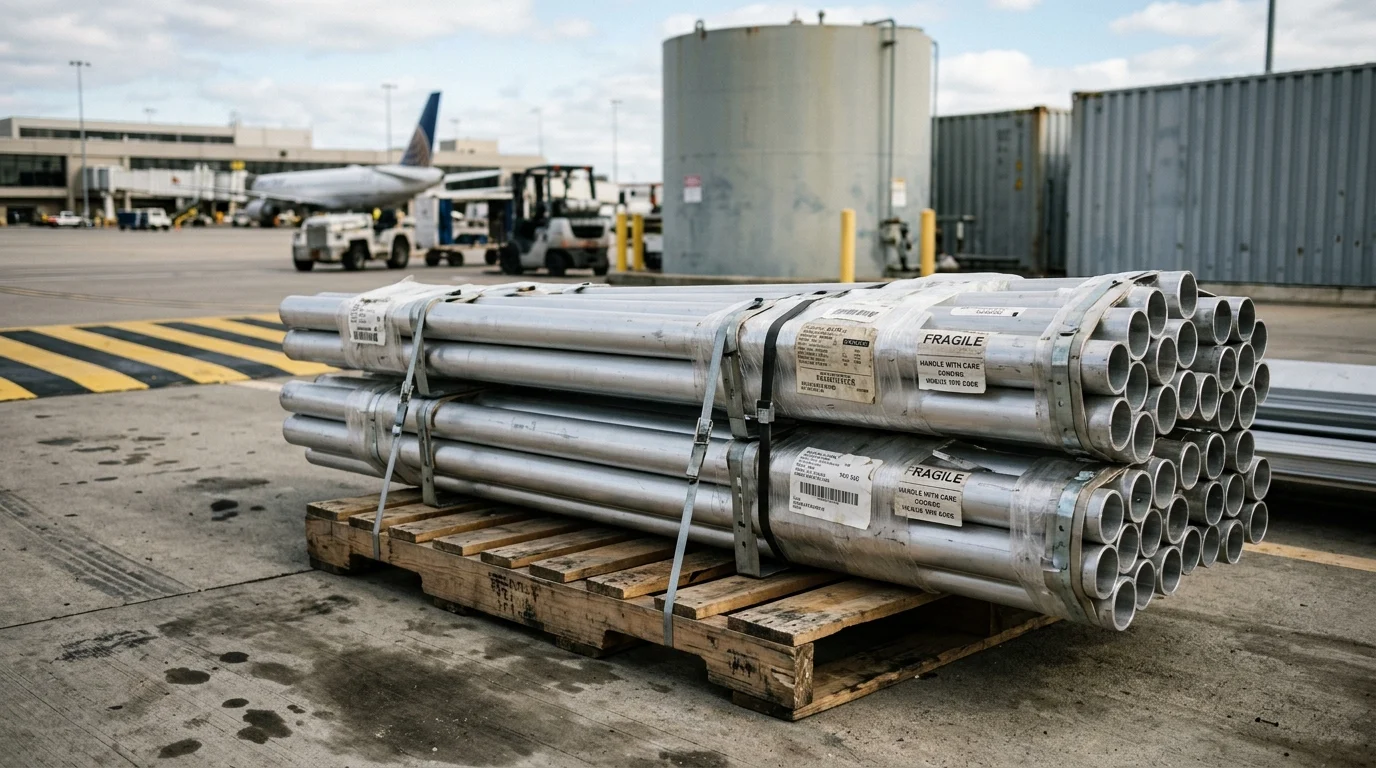
Evaluating an airport apron lighting pole requires comparing aluminum against traditional alternatives like galvanized steel and modern composites such as fiberglass. While steel has historically dominated heavy infrastructure due to its raw tensile strength, and fiberglass offers extreme chemical resistance, the stringent EMC requirements of modern aviation facilities heavily skew the engineering calculus toward aluminum.
Key Comparison Points for EMI Performance
The primary EMI concern in high-mast lighting relates to the shielding effectiveness of the pole’s shaft. Galvanized carbon steel possesses high magnetic permeability but comparatively lower electrical conductivity. This can lead to passive intermodulation (PIM) in dense RF environments and makes steel a highly reflective surface for specific radar bands. Passive intermodulation occurs when multiple RF signals mix within non-linear junctions, such as micro-fractures in galvanized steel coatings, creating ghost signals that can blind air traffic control receivers.
Fiberglass, conversely, is radiotransparent; it offers virtually zero inherent EMI shielding, requiring engineers to specify costly internal copper shielding mesh to isolate power cable noise. Aluminum provides an optimal middle ground. Its non-ferrous nature eliminates magnetic hysteresis losses and PIM generation, while its continuous metallic structure acts as a natural Faraday cage. An extruded aluminum airport apron lighting pole can provide 60 to 80 dB of internal RF attenuation, ensuring that high-frequency noise from luminaire drivers does not escape into the apron’s operational airspace.
Aluminum vs Other Materials Comparison Table
To quantify the operational differences, the following matrix contrasts the three primary materials used in apron lighting infrastructure across critical electrical and lifecycle parameters.
| Material | EMI Shielding Effectiveness | Electrical Conductivity | Weight per 20m Pole | Expected Design Life | Maintenance Requirement |
|---|---|---|---|---|---|
| Extruded Aluminum | High (60-80 dB attenuation) | ~3.5 × 10^7 S/m | ~450 kg | 50+ Years | Minimal (Passive oxide layer) |
| Galvanized Steel | Moderate (Prone to PIM) | ~5.9 × 10^6 S/m | ~1,200 kg | 30-40 Years | High (Periodic coating checks) |
| Fiberglass / Composite | None (Requires mesh insert) | Insulator (0 S/m) | ~350 kg | 25-30 Years | UV degradation monitoring |
This data illustrates that while composites offer weight advantages, aluminum delivers the necessary electromagnetic shielding and conductivity without the massive weight penalty and maintenance overhead associated with carbon steel.
How to Select an Aluminum Airport Apron Lighting Pole
Procuring an aluminum airport apron lighting pole requires precise specification to ensure the structure meets both the aerodynamic demands of the airfield and the strict electrical safety codes. Project stakeholders must transition from generic high-mast specifications to aviation-specific criteria, ensuring the chosen manufacturer understands the nuances of airport EMC and structural dynamics.
Specification and Procurement Steps
The specification process begins by calculating the required Effective Projected Area (EPA) capacity. A standard apron pole must typically support a luminaire ring with an EPA of 2.5 to 4.0 square meters while enduring base wind speeds of 140 mph (225 km/h), inclusive of a standard 1.14 gust factor. Engineers must explicitly mandate marine-grade or structural aluminum alloys, such as 6063-T6 or 6061-T6, to guarantee the yield strength necessary for these loads. Furthermore, if the pole is located near specific taxiway boundaries, it must meet strict frangibility requirements, ensuring the base shears predictably upon impact.
From an electrical standpoint, procurement documents must specify factory-welded grounding lugs at the base and the luminaire mounting bracket. Establishing a low-impedance grounding network is non-negotiable; specifications should demand a total pole-to-ground resistance of less than 5 ohms to ensure lightning strikes and EMI transients are safely shunted to the earth without arcing across sensitive internal components.
Decision Criteria for Project Stakeholders
Decision-makers must evaluate the Total Cost of Ownership (TCO) rather than isolated
Key Takeaways
- The most important conclusions and rationale for Airport Apron Lighting Pole
- Specs, compliance, and risk checks worth validating before you commit
- Practical next steps and caveats readers can apply immediately
Frequently Asked Questions
Why is aluminum preferred for airport apron lighting poles in EMI-sensitive areas?
Aluminum combines high conductivity with non-ferrous behavior, helping shield LED driver noise and reduce passive intermodulation near radar and VHF systems.
How does an aluminum airport apron lighting pole help with grounding?
Its conductive shaft provides a continuous path to ground, improving fault current dissipation and lowering surface charge buildup when properly bonded.
Does aluminum shield internal cables and drivers effectively?
Yes. A continuous aluminum pole body can act like a Faraday cage, typically helping contain emissions from power and control wiring inside the shaft.
How does aluminum compare with steel or fiberglass for apron EMI control?
Aluminum generally offers better overall EMI performance than fiberglass and avoids the PIM risks linked to galvanized steel in dense RF environments.
Can Morelux customize aluminum apron lighting poles for airport projects?
Yes. Morelux supports custom pole specifications with technical drawings, engineer input, and fast quotations for infrastructure and airport lighting projects.