Introduction
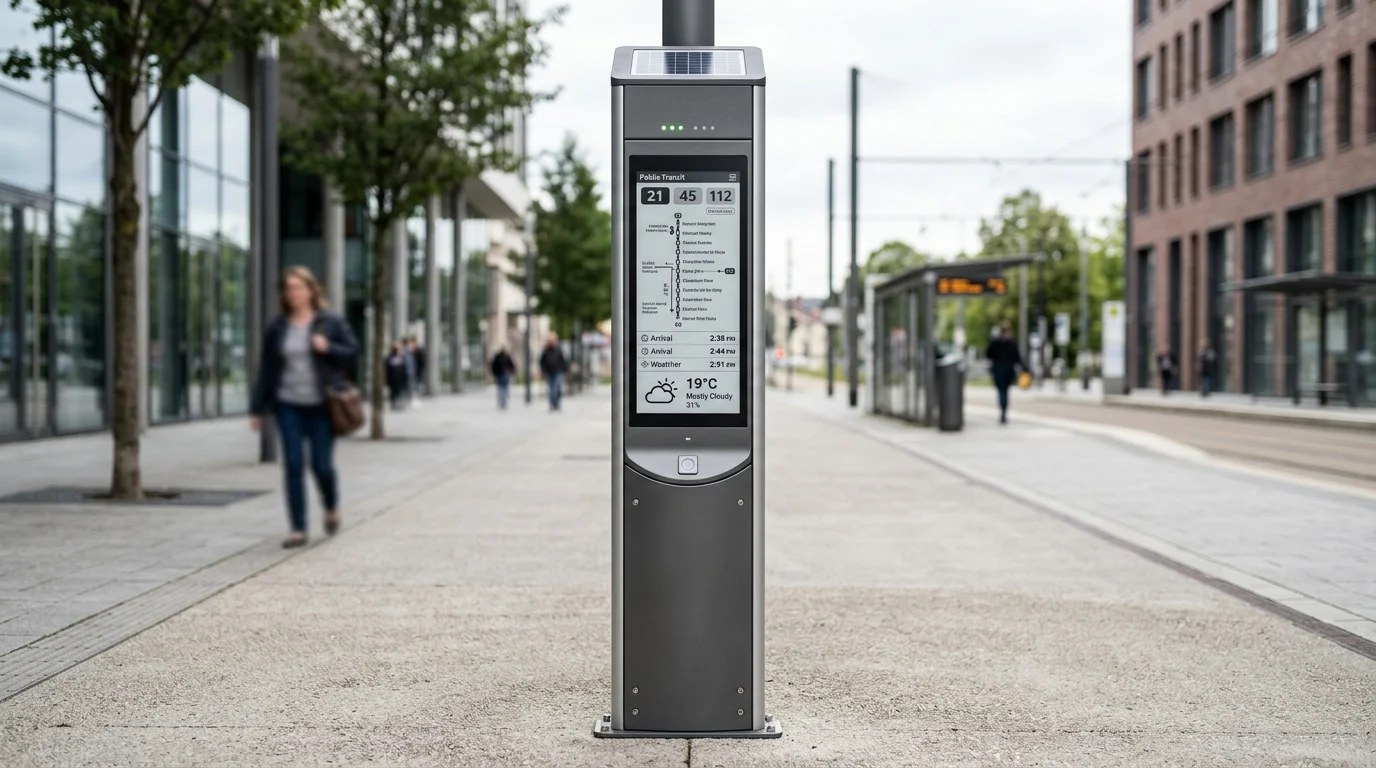
Cities are under pressure to expand digital public information without adding heavy energy loads, costly trenching, or complex maintenance. An e-ink display smart pole addresses that gap by combining always-readable outdoor signage with extremely low power demand, making solar and off-grid deployments far more practical. This article explains why the technology is gaining traction in urban terminals, how its bistable display model changes operating costs, and where it delivers the most value for municipalities, transit systems, and utility operators. From power consumption to deployment flexibility, the sections that follow show what makes e-ink poles a credible alternative to conventional LCD and LED smart infrastructure.
Why E-ink Display Smart Poles Are Emerging
The integration of electrophoretic display technology into urban infrastructure represents a paradigm shift in how municipalities deploy smart city terminals. Historically, digital signage on smart poles relied on high-brightness LCD or LED panels, which demand continuous power loads often exceeding 200 to 350 watts to remain visible in direct sunlight. This heavy power requirement necessitates complex, expensive trenching (which typically costs $100 to $300 per linear foot) to connect the poles to the municipal electrical grid, severely limiting deployment flexibility and inflating capital expenditure.
An E-ink display smart pole fundamentally alters this equation. Operating on a bistable technology matrix, these displays consume zero power to hold a static image, drawing energy only during content updates (typically between 0.5W and 2W depending on the panel size). This ultra-low-power characteristic enables completely off-grid, solar-powered urban terminals that can operate reliably even in areas with limited electrical infrastructure. As urban planners prioritize sustainability and energy efficiency, the E-ink smart pole has emerged as a critical component for disseminating public information without compounding a municipality’s carbon footprint.
Who benefits most from E-ink display smart poles
Transit authorities and municipal utility operators are the primary beneficiaries of this technological transition. For transit agencies, the ability to deploy real-time passenger information (RTPI) at remote bus stops without investing $5,000 to $15,000 per location in civil works for grid connection is transformative. For typical pilot phases of 50 to 100 units, these agencies can rapidly scale their digital infrastructure while adhering to strict capital expenditure limits, reaching suburban or rural transit nodes that were previously deemed too expensive to digitize.
Similarly, utility operators benefit from the reduced load on the electrical grid. By deploying low-power terminals, utilities avoid the localized grid strain associated with thousands of high-brightness screens operating simultaneously. Furthermore, telecommunications companies utilizing smart poles for 5G small cell deployment find that pairing their equipment with E-ink displays reserves the vast majority of the pole’s power capacity (often capped at 500W to 1kW total) for active network transmission rather than secondary public signage.
Which urban use cases offer the strongest business case
The strongest business cases for E-ink smart poles cluster around applications requiring high visibility in direct sunlight but relatively infrequent content updates. Wayfinding totems in municipal parks, smart parking meters, and curbside management zones are prime examples. In these scenarios, the displayed information typically updates every few minutes or hours, which perfectly aligns with the refresh capabilities of electrophoretic technology while maximizing energy savings.
Emergency broadcast systems also present a highly compelling use case. Because E-ink displays can be efficiently paired with high-capacity lithium iron phosphate (LiFePO₄) batteries and modest solar panels, they remain fully operational during widespread grid outages. A smart pole equipped with a 40Ah battery and a 31.2-inch E-ink screen updating every 15 minutes can maintain critical emergency messaging for up to 14 days without a grid connection or any solar yield, providing an indispensable communication channel during natural disasters or power infrastructure failures.
Technical Specifications That Matter Most
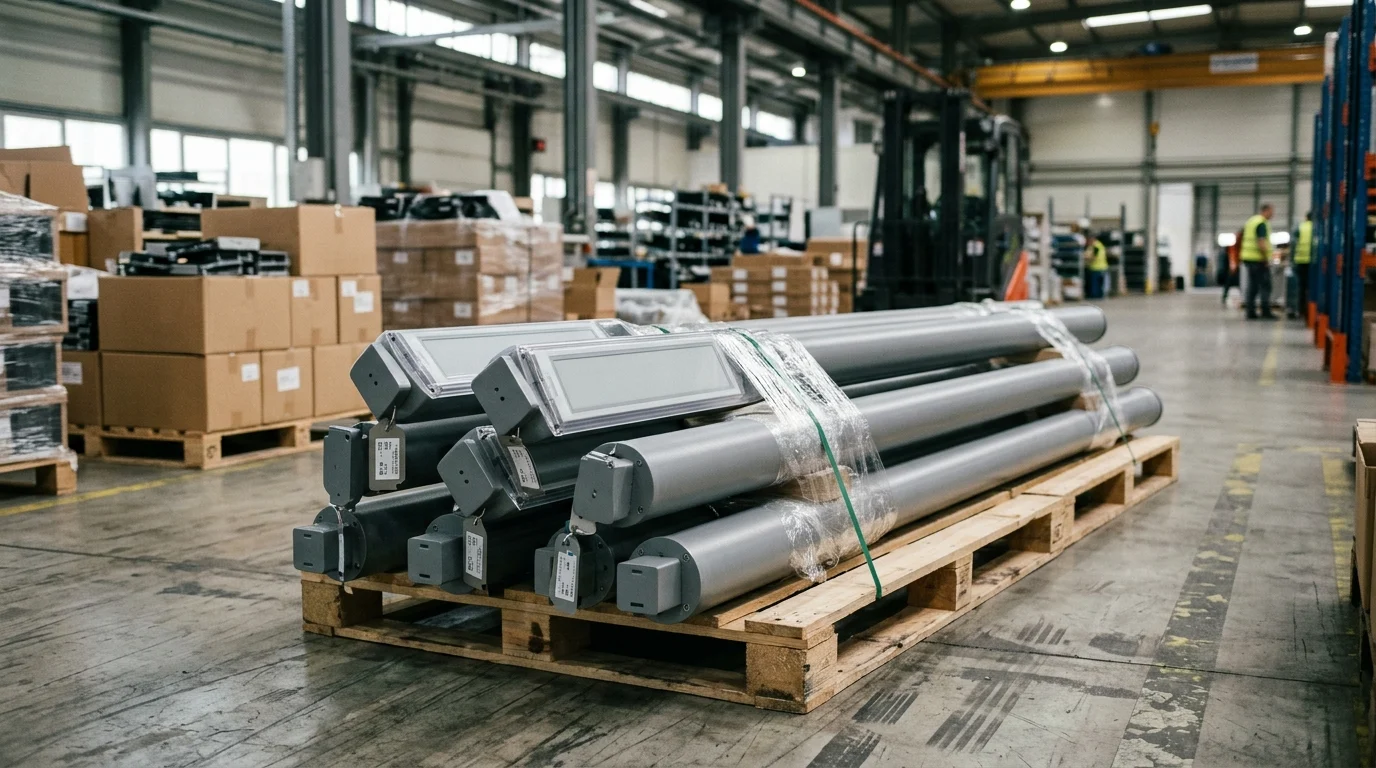
Transitioning a smart pole project from a conceptual pilot to a mass deployment requires rigorous analysis of the underlying hardware specifications. Unlike traditional emissive displays, E-ink relies on ambient light reflection, meaning the criteria for evaluating performance, durability, and visual clarity differ significantly from standard digital signage metrics.
How to evaluate readability and refresh performance
Evaluating readability in E-ink displays requires analyzing contrast ratios and ambient light reflection rather than nit brightness. A high-quality monochrome E-ink module typically delivers a contrast ratio of 15:1 or higher and pixel densities ranging from 115 to 150 PPI, providing a paper-like reading experience with a viewing angle approaching 180 degrees. For full-color applications, Advanced Color ePaper (ACeP) modules utilize a four-pigment system to achieve wide color gamuts, though they often exhibit slightly lower contrast ratios (typically 10:1 to 12:1) than their monochrome counterparts.
Refresh performance is a critical constraint that system architects must evaluate. While an LCD refreshes at 60Hz (16.6 milliseconds per frame), a full-screen update on a large-format (e.g., 42-inch) E-ink panel may take anywhere from 1.5 to 3 seconds for monochrome, and up to 15 seconds for ACeP color displays. Buyers must ensure the display controller supports partial refresh technology, which can update specific localized zones of the screen in under 300 milliseconds, minimizing flashing and improving the user experience for real-time data feeds like countdown timers.
Which hardware integration choices affect durability
Because smart poles operate in unforgiving urban environments, the hardware integration choices directly dictate the asset’s lifespan. Optical bonding is a mandatory requirement; by injecting a specialized resin between the E-ink film and the protective cover glass, manufacturers eliminate the air gap. This prevents condensation build-up in high-humidity environments and reduces internal reflections, improving sunlight readability by up to 15% and extending the module’s operational lifespan to a typical 50,000 to 70,000 hours.
Furthermore, ultraviolet (UV) protection is critical to prevent the degradation of the electrophoretic microcapsules. Integrators must specify a UV-cut filter applied to the front glass that blocks at least 99% of UV radiation. To withstand vandalism and environmental hazards, the enclosure should carry an IP65 or IP67 ingress protection rating against dust and water, alongside an IK08 or IK09 impact resistance rating, ensuring the internal E-ink matrix survives blunt force impacts (up to 10 joules) common in pedestrian zones.
What key specifications buyers should compare
When drafting procurement requirements, buyers must normalize specifications across different vendors to ensure apples-to-apples comparisons. Key metrics include the thermal operating envelope, power draw during image retention, and the mean time between failures (MTBF). Advanced E-ink modules feature integrated front-light guides (FLG) for nighttime visibility, which must be evaluated for uniform light distribution and power efficiency.
| Specification Metric | E-ink Smart Pole Display | High-Brightness LCD Smart Pole |
|---|---|---|
| Power Consumption (Idle) | 0W – 0.5W | 150W – 300W |
| Power Consumption (Update) | 2W – 5W (for 1-3 seconds) | Continuous High Draw |
| Operating Temperature Range | -20°C to +65°C | 0°C to +50°C (Requires active HVAC) |
| Sunlight Readability | Reflective (Improves with light) | Emissive (Requires 2,500+ nits) |
| Nighttime Visibility | Requires Front-Light Guide (FLG) | Native Backlight |
| Mean Time Between Failures (MTBF) | ~70,000 hours | ~50,000 hours |
Compliance, Cost, and Supply Chain Considerations
Managing the procurement and lifecycle of urban IoT infrastructure involves navigating strict regulatory frameworks, volatile global supply chains, and complex financial modeling. A successful E-ink display smart pole deployment must balance the higher initial component costs with long-term operational savings.
Which compliance and environmental standards apply
Deployments must adhere strictly to a matrix of regional and international compliance standards. From an environmental standpoint, RoHS (Restriction of Hazardous Substances) and WEEE (Waste Electrical and Electronic Equipment) directives mandate the safe disposal and material composition of the display modules and internal batteries. Because these poles often integrate wireless telematics (LTE-M, NB-IoT, or LoRaWAN), the internal communication modules must pass FCC (e.g., Part 15 in the US) or CE (in Europe) radio frequency certifications to ensure they do not interfere with existing municipal spectrums.
Accessibility standards also dictate physical deployment characteristics. Under the Americans with Disabilities Act (ADA) or equivalent global accessibility frameworks, interactive or highly detailed information panels must be installed at specific heights—typically with the centerline of the display positioned between 48 and 60 inches from the ground. Furthermore, the high-contrast nature of E-ink inherently aids compliance with visual accessibility guidelines, provided the content management system utilizes adequately sized, sans-serif typography (typically 5/8-inch minimum character height for standing viewers).
How total cost of ownership affects project viability
The total cost of ownership (TCO) for E-ink smart poles is heavily front-loaded. Large-format E-ink panels (such as 31.2-inch or 42-inch modules) typically cost 30% to 50% more at the point of purchase than industrial-grade LCD equivalents. However, project viability is proven over a 5-to-7-year operational horizon. Because E-ink requires no trenching for grid connections, initial installation costs drop dramatically—often saving up to $10,000 per pole in civil engineering and permitting fees.
| Cost Category (Per Pole) | E-ink Smart Pole (Off-Grid) | LCD Smart Pole (Grid-Tied) |
|---|---|---|
| Hardware Cost (Initial) | $2,500 – $4,500 | $1,500 – $3,000 |
| Civil Works / Trenching | $0 | $5,000 – $10,000+ |
| Annual Energy Cost | $0 | $150 – $250 |
| Annual Maintenance Labor | $100 – $150 | $300 – $500 |
Operationally, the financial divergence is even more pronounced. A traditional LCD pole may consume $150 to $250 annually in electricity per unit, whereas an off-grid E-ink pole incurs zero municipal electricity costs. Additionally, the lack of moving parts—such as the cooling fans or active HVAC systems required to keep outdoor LCDs from overheating—reduces routine maintenance visits by an estimated 60%, drastically lowering the labor costs associated with fleet management.
How supply chain risks influence procurement
Procurement teams must account for unique supply chain bottlenecks inherent to electrophoretic technology. Unlike LCD or LED panels, which are commoditized and manufactured by dozens of global tier-one suppliers, the core electrophoretic film is predominantly supplied by a single entity (E Ink Corporation). This single-source dependency can lead to supply constraints during high global demand cycles.
Consequently, lead times for custom-sized or large-format E-ink modules can easily extend from a standard 8 weeks to 20 or 24 weeks. Buyers must mitigate these risks by engaging in long-term forecasting, negotiating multi-year supply agreements, and standardizing their designs around widely available panel sizes (e.g., 13.3-inch, 31.2-inch) rather than demanding bespoke aspect ratios that require custom film cutting, which often requires Minimum Order Quantities (MOQs) exceeding 500 units and carries typical manufacturing yield rates of 95% to 98%.
Deployment, Integration, and Operations Planning
The physical deployment and ongoing operational management of an E-ink smart pole network require meticulous site engineering and robust software integration. Because these terminals are often placed in remote or highly trafficked pedestrian zones, minimizing on-site maintenance through intelligent design and remote telematics is essential.
What deployment steps reduce site and power risks
Reducing site risks begins with comprehensive solar and shading surveys. For off-grid installations, engineers must calculate the optimal tilt and orientation of the integrated photovoltaic panels to ensure a positive energy balance year-round. A typical configuration utilizing a 50W vertically integrated solar cylinder paired with a 50Ah LiFePO4 battery requires at least 3 hours of direct sunlight daily to maintain a 100% state of charge, assuming the E-ink display updates every 5 minutes. Engineers must also account for temperature derating, as battery capacity can drop by 20% to 30% at 0°C.
Power risks are further mitigated by utilizing advanced Maximum Power Point Tracking (MPPT) charge controllers, which can improve energy harvesting efficiency by 15% to 30% over standard PWM controllers. These controllers optimize the energy harvested from the solar panels, even in partial shade conditions common in urban canyons. To prevent deep discharge events during prolonged overcast winter weeks, the pole’s edge-computing module must be programmed to automatically throttle the display refresh rate (e.g., shifting from 1-minute updates to 15-minute updates) when the battery voltage drops below a critical 20% threshold.
How to manage content workflows and remote monitoring
Content management for E-ink displays differs fundamentally from traditional digital signage. Because the displays rely on low-bandwidth cellular networks (NB-IoT or LTE-M) to conserve power, content workflows must be heavily optimized. Instead of streaming large video files or high-resolution images, the Content Management System (CMS) should transmit lightweight JSON payloads (often under 50KB) via MQTT protocols. The pole’s local controller then renders these data payloads into text and graphics locally before pushing the update to the screen.
Remote monitoring via a centralized dashboard is critical for maintaining a target 99.
Key Takeaways
- The most important conclusions and rationale for E-ink Display Smart Pole
- Specs, compliance, and risk checks worth validating before you commit
- Practical next steps and caveats readers can apply immediately
Frequently Asked Questions
Why choose an E-ink display smart pole over LCD or LED for city projects?
E-ink uses power mainly during screen updates, making solar or off-grid deployment practical. It reduces trenching, lowers operating cost, and stays readable in direct sunlight.
Which projects are best suited to E-ink-display smart poles?
Bus stops, park wayfinding, parking zones, campus signage, and emergency message points are strong fits because content changes periodically rather than every second.
Can Morelux customize E-ink smart poles for municipal or infrastructure tenders?
Yes. Morelux supports custom pole dimensions, materials, finishes, mounting layouts, and technical drawings to match project specifications and local standards.
What specifications matter most when sourcing an E-ink smart pole?
Focus on display size, contrast, refresh interval, battery capacity, solar panel sizing, pole material, IP rating, wind resistance, and integration space for communication equipment.
How fast can Morelux provide a quote and engineering support for smart pole projects?
Morelux typically offers fast 24-hour quotations and engineer support, helping project buyers review drawings, customization options, and manufacturing feasibility early.