Introduction
Autonomous driving depends on more than cameras and processors inside the vehicle; it also requires roadside infrastructure that can sense, compute, and communicate in real time. This article examines the V2X communication pole as a core node in that system, explaining how it supports roadside units, edge computing, and sensor integration for low-latency vehicle-to-everything services. You will gain a practical view of its technical role, deployment considerations, and why it matters for safety-critical functions such as intersection awareness, collision prevention, and higher-level automated driving. From there, the discussion moves into the network, hardware, and regulatory factors shaping adoption.
Why V2X Communication Poles Matter
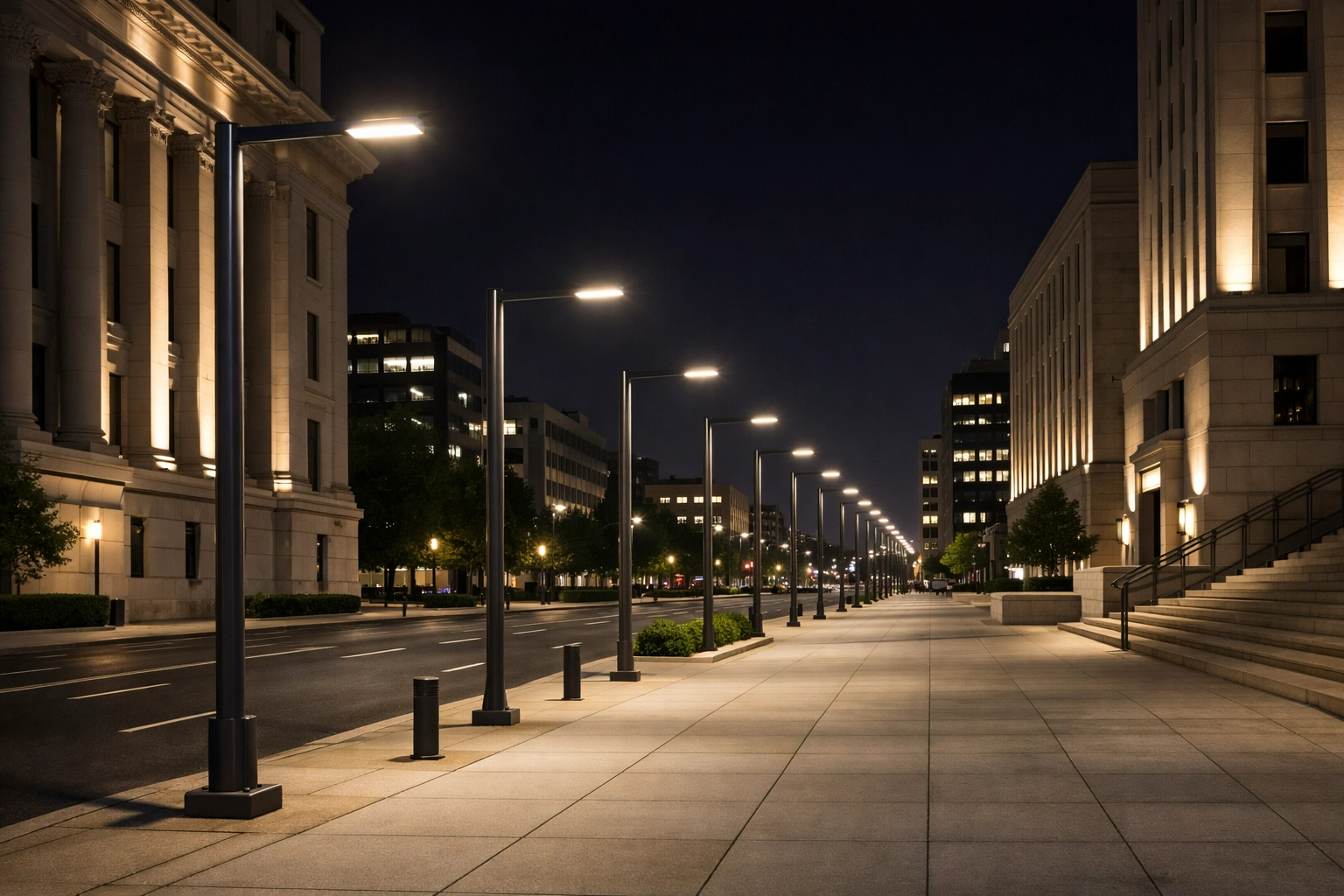
V2X (Vehicle-to-Everything) communication poles serve as the critical physical infrastructure enabling cooperative intelligent transport systems (C-ITS). As the automotive industry transitions toward higher levels of autonomous driving, vehicles can no longer rely solely on onboard sensors. Instead, they require an uninterrupted stream of low-latency, high-reliability data from the surrounding environment, facilitated by strategically placed roadside infrastructure.
Roadside intelligence and network roles
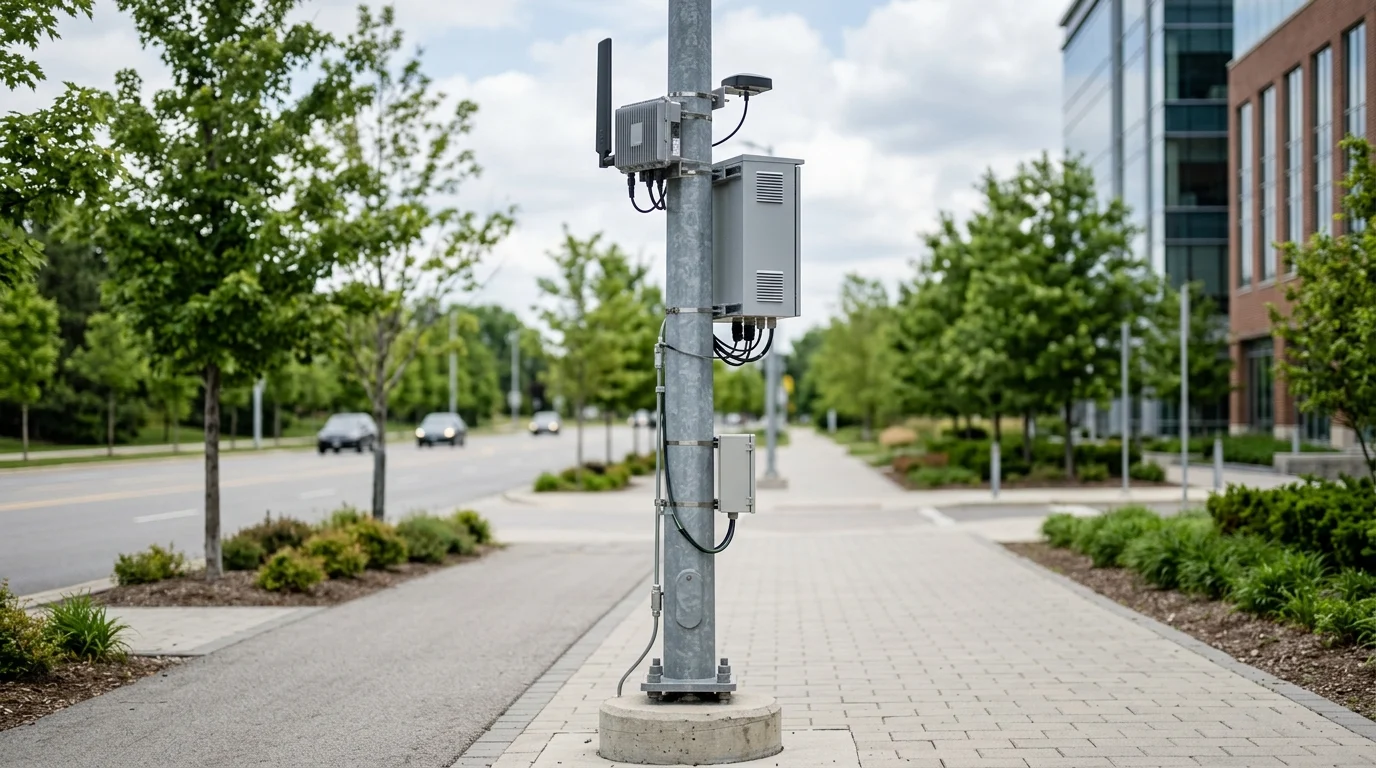
These specialized structures host Roadside Units (RSUs), edge computing nodes, and the dense sensor arrays—including LiDAR, radar, and high-definition cameras—required to process localized traffic data. To support Level 4 and Level 5 autonomous driving, the network architecture must guarantee ultra-reliable low-latency communication (URLLC). In practice, this requires end-to-end network latency to remain strictly below 10 milliseconds for safety-critical applications like intersection collision avoidance and vulnerable road user (VRU) detection. The pole acts as the aggregation point where raw sensor telemetry is processed at the edge, rather than being transmitted to a distant cloud server.
Market and regulatory drivers
Regulatory shifts and spectrum allocations are aggressively accelerating the deployment of this infrastructure. For instance, the US Federal Communications Commission (FCC) reallocation of the 5.850–5.925 GHz spectrum specifically prioritizes Cellular-V2X (C-V2X) technology over legacy protocols. Global market forecasts anticipate V2X infrastructure investments will exceed $2.5 billion by 2028. This capital influx is driven largely by municipal Vision Zero mandates and the statistical necessity of reducing intersection collision rates by up to 40% through enhanced infrastructure-to-vehicle (I2V) communication.
Technical Requirements for V2X Communication Poles

Engineering a V2X communication pole extends far beyond traditional street lighting or cellular macro-cell design. These structures must operate as highly resilient, self-contained data centers exposed to severe environmental stressors.
Core performance specifications
Core performance dictates that poles support high-bandwidth backhaul and continuous, clean power delivery. A fully equipped V2X node—integrating an RSU, optical sensors, and an edge processing unit—typically requires a stable, continuous power draw between 500W and 1,500W. Furthermore, to handle raw data ingestion from multiple high-definition optical and laser sensors, the pole must interface with a minimum 10 Gbps fiber optic backhaul capacity. This ensures no bottlenecks occur before the data reaches the edge compute module.
Pole height, enclosure, and thermal design
Optimal RSU mounting heights range from 5.5 to 8 meters to maximize line-of-sight (LoS) coverage while minimizing signal attenuation caused by heavy commercial vehicles. Enclosures must also manage the substantial heat loads generated by edge compute modules. Active thermal management or advanced passive heat dissipation is critical to maintain internal operating temperatures within the stringent -40°C to +85°C industrial range.
| Component | Typical Mounting Height | Minimum Enclosure Rating | Operating Temp Range |
|---|---|---|---|
| C-V2X RSU | 5.5m – 8.0m | IP67 | -40°C to +85°C |
| Edge Compute Node | 3.0m – 5.0m | IP65 / NEMA 4X | -20°C to +70°C |
| LiDAR / PTZ Camera | 6.0m – 9.0m | IP67 | -40°C to +65°C |
Structural and environmental durability
Structural integrity is non-negotiable given the precise calibration required for optical and laser sensors. Deflection and sway must be minimized to prevent data degradation. Poles are typically engineered to withstand wind loads exceeding 150 mph (aligning with AASHTO LTS-6 standards) and must incorporate vibration-dampening materials. Excessive micro-movements can severely degrade sensor accuracy, leading to spatial miscalculations and false-positive hazard detections in an autonomous vehicle’s navigation stack.
How to Compare V2X Communication Pole Solutions
Municipalities and private operators face critical architectural decisions when selecting V2X infrastructure, balancing initial capital expenditure against long-term scalability and technological longevity.
Dedicated poles vs shared infrastructure
Utilizing shared infrastructure, such as retrofitting existing LED streetlights with V2X modules, can reduce initial deployment costs by 30% to 40%. However, legacy poles often lack the structural rigidity required for heavy sensor payloads or the internal conduit space necessary for fiber optics and upgraded power lines. Purpose-built dedicated poles offer modularity, superior structural stability, and dedicated power grids, albeit at a higher initial unit cost and with more complex permitting requirements.
Standards, interoperability, and cybersecurity
Interoperability depends on strict adherence to global standards. Solutions must support the IEEE 1609.x family of standards for wireless access in vehicular environments (WAVE) or equivalent 3GPP standards for cellular V2X. Furthermore, robust cybersecurity requires seamless integration with a security credential management system (SCMS). A compliant edge node must be capable of validating up to 2,000 security certificates per second to prevent malicious data injection, spoofing, or denial-of-service attacks against the local traffic grid.
DSRC, C-V2X, 5G, and fiber connectivity
The connectivity backhaul and radio protocols dictate the pole’s operational lifespan and specific use cases. While DSRC (Dedicated Short-Range Communications) was the early frontrunner, the industry has aggressively pivoted toward C-V2X and 5G NR (New Radio) for enhanced range, throughput, and integration with broader smart city networks.
| Protocol | Frequency Band | Typical Range (LoS) | Latency | Primary Use Case |
|---|---|---|---|---|
| DSRC (802.11p) | 5.9 GHz | Up to 300m | 2–5 ms | Legacy V2V/V2I safety messaging |
| C-V2X (LTE-V2X) | 5.9 GHz | Up to 1000m | <10 ms | Advanced V2I, non-line-of-sight hazard warnings |
| 5G NR V2X | Variable (Sub-6, mmWave) | Up to 500m (Sub-6) | <5 ms | Raw sensor sharing, automated driving |
Sourcing and Deployment Best Practices
Transitioning from localized pilot programs to large-scale commercial V2X networks requires rigorous procurement strategies and risk-mitigated deployment workflows to control costs and ensure network reliability.
Supplier qualification and procurement criteria
Supplier qualification must extend beyond basic hardware provisioning to include software lifecycle management and hardware modularity. Procurement criteria should strictly mandate ISO 9001 and ISO/IEC 27001 certifications to ensure manufacturing quality and data security. Given global supply chain constraints regarding specialized silicon and structural steel, buyers must account for standard lead times ranging from 12 to 16 weeks for complex, multi-tenant V2X poles. Furthermore, municipalities should negotiate minimum order quantities (MOQs) that align with phased rollout schedules to avoid warehousing costs.
Installation and deployment risk reduction
Installation risks are heavily concentrated in civil engineering and utility coordination. Right-of-way (RoW) acquisition and trenching for power and fiber can account for over 60% of the total deployment timeline. To mitigate these risks, operators should utilize subsurface utility engineering (SUE) during the site survey phase. Specifying poles with pre-cast foundation compatibility or breakaway bases compliant with NCHRP Report 350 can drastically reduce both installation time and liability in the event of vehicular collisions.
Building a Strong V2X Investment Case
Securing capital for comprehensive V2X pole networks demands a robust financial model that quantifies direct operational efficiencies, new revenue streams, and broader socio-economic safety benefits.
Decision criteria for performance and interoperability
The investment case hinges on translating technical performance into measurable utility. Interoperable systems that support multi-modal traffic data can yield substantial ROI through optimized traffic signal timing and dynamic routing. Empirical data from early smart city corridors demonstrates that high-density V2X deployment can achieve a 15% to 20% reduction in intersection congestion and a corresponding decrease in localized carbon emissions. Decision criteria must therefore weigh the upfront cost of 5G and C-V2X upgradability against the projected long-term economic value of these traffic optimizations and the reduction in collision-related municipal liabilities.
Stakeholder planning for municipalities and operators
Successful financing models increasingly rely on public-private partnerships (PPPs) involving municipal departments of transportation, telecommunications carriers, and autonomous fleet operators. Planners must structure agreements that allow municipalities to retain ownership of the physical asset while leasing edge compute capacity or millimeter-wave (mmWave) mounting real estate to private telcos. This multi-tenant revenue model effectively offsets the initial $15,000 to $30,000 capital expenditure required per fully equipped smart pole, ensuring long-term financial sustainability and continuous maintenance for the network.
Key Takeaways
- The most important conclusions and rationale for V2X Communication Pole
- Specs, compliance, and risk checks worth validating before you commit
- Practical next steps and caveats readers can apply immediately
Frequently Asked Questions
What height is typically recommended for a V2X communication pole?
For most roadside units, 5.5 to 8 meters is the practical range to maintain line-of-sight and reduce blockage from large vehicles.
What power and backhaul capacity should a V2X pole support?
A fully equipped node usually needs about 500W to 1,500W continuous power and at least 10 Gbps fiber backhaul for sensor and edge data.
Why choose a dedicated V2X pole instead of retrofitting an existing streetlight?
Dedicated poles offer better rigidity, internal space for fiber and power, and easier sensor integration, which is critical for autonomous driving accuracy.
What environmental protection is needed for V2X pole equipment?
Use enclosures rated at least IP65 to IP67, with thermal control to keep electronics operating within industrial temperature limits in outdoor conditions.
Can Morelux provide customized V2X communication poles for infrastructure projects?
Yes. Morelux supports custom steel or aluminum pole solutions with technical drawings, engineer support, and fast quotes for project buyers and sourcing teams.