Introduction
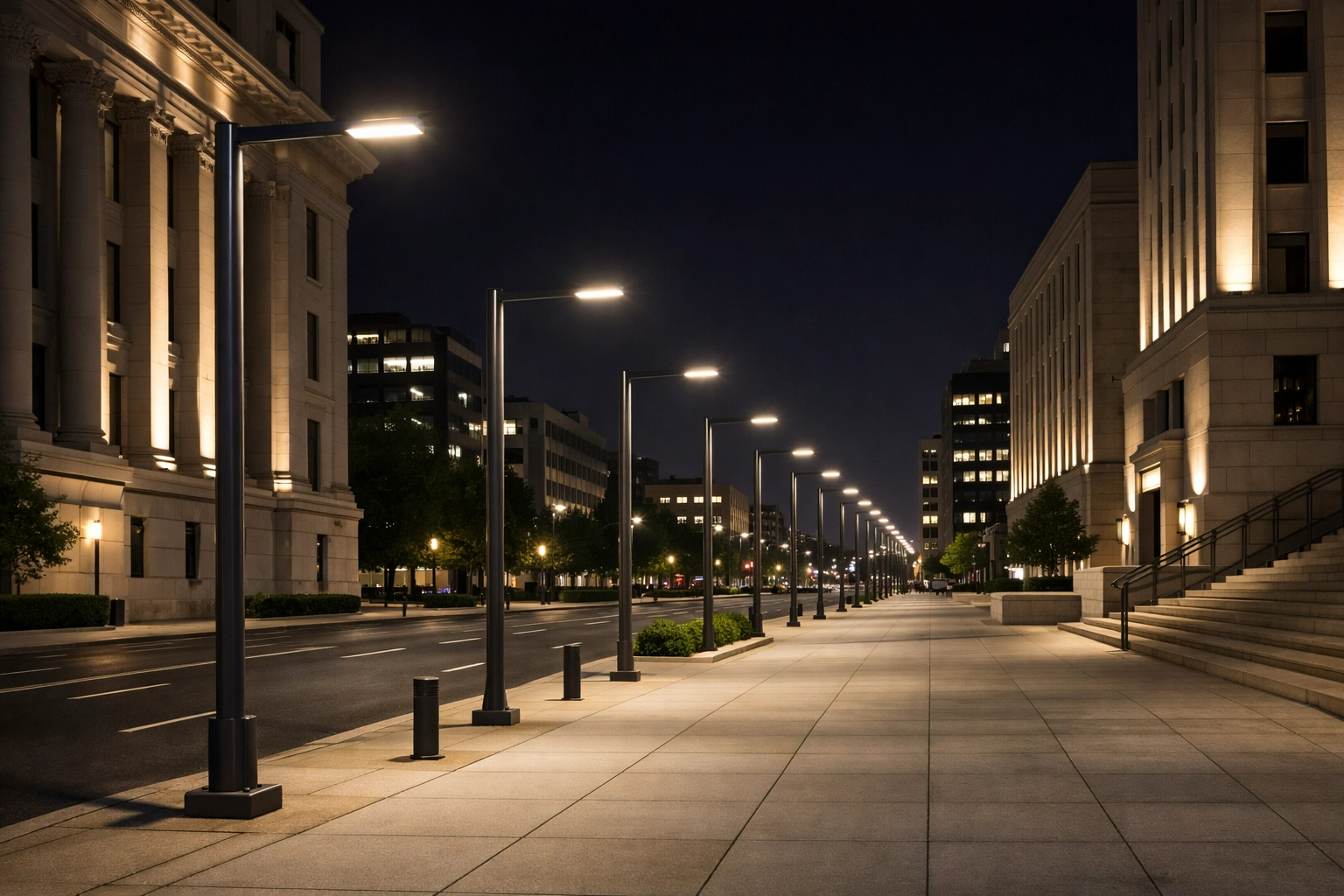
As public spaces grow busier and more dynamic, fixed infrastructure is starting to play a larger role in real-time safety and operations. A computer vision smart pole combines cameras, edge processing, and connectivity to measure crowd density, track movement patterns, and detect emerging risks directly where they occur. This article explains why that matters for crowd counting, how these systems support faster decisions in cities, venues, and transit hubs, and what practical benefits they offer for congestion control, incident prevention, and more informed management of high-traffic environments.
Why Computer Vision Smart Poles Matter for Crowd Counting
Urban infrastructure is undergoing a fundamental transformation from passive structural support to active, data-gathering networks. Computer vision smart poles represent the convergence of municipal lighting, telecommunications, and edge-based artificial intelligence, providing localized surveillance and spatial analytics. In environments where pedestrian traffic is dense and unpredictable, relying solely on historical data or manual observation is insufficient for modern safety standards.
Crowd dynamics can shift rapidly, and localized crowd densities exceeding 4 to 5 persons per square meter pose critical safety hazards, including crowd crush or stampede risks. By integrating computer vision directly into municipal or facility infrastructure, operators gain real-time visibility into pedestrian flow, enabling proactive interventions before congestion reaches critical failure points.
Key use cases in cities, venues, and transport hubs
The deployment of intelligent infrastructure is highly adaptable across various high-density sectors. In smart cities, these poles monitor public squares, pedestrian crossings, and outdoor event spaces, providing urban planners with utilization metrics that inform traffic light sequencing and emergency response routing.
In large-scale venues such as stadiums and convention centers, operators utilize computer vision to manage ingress and egress. For example, clearing a 50,000-capacity stadium requires precise monitoring of exit bottlenecks to dynamically redirect crowds via digital signage. Transport hubs, including international airports and central train stations, rely on smart poles to monitor platform congestion, queue lengths at ticketing zones, and unauthorized access to restricted areas, ensuring traveler safety without impeding flow.
Operational pressures driving edge-based analytics
The shift toward computer vision smart poles is largely driven by the operational limitations of traditional centralized surveillance. Continuous transmission of high-definition video to cloud servers requires substantial bandwidth, often exceeding 15 to 25 Mbps per camera stream. In a network of hundreds of cameras, this creates severe network strain and high cellular data costs.
Edge-based analytics resolve this bottleneck by processing video feeds locally on the pole. Instead of transmitting heavy 4K video streams, the onboard AI extracts metadata—such as bounding boxes, coordinate trajectories, and aggregate counts—which reduces the required transmission payload to mere kilobytes per second. This decentralized architecture also significantly lowers latency, allowing automated safety alerts to trigger in under 500 milliseconds when a crowd density threshold is breached.
What Defines a Computer Vision Smart Pole

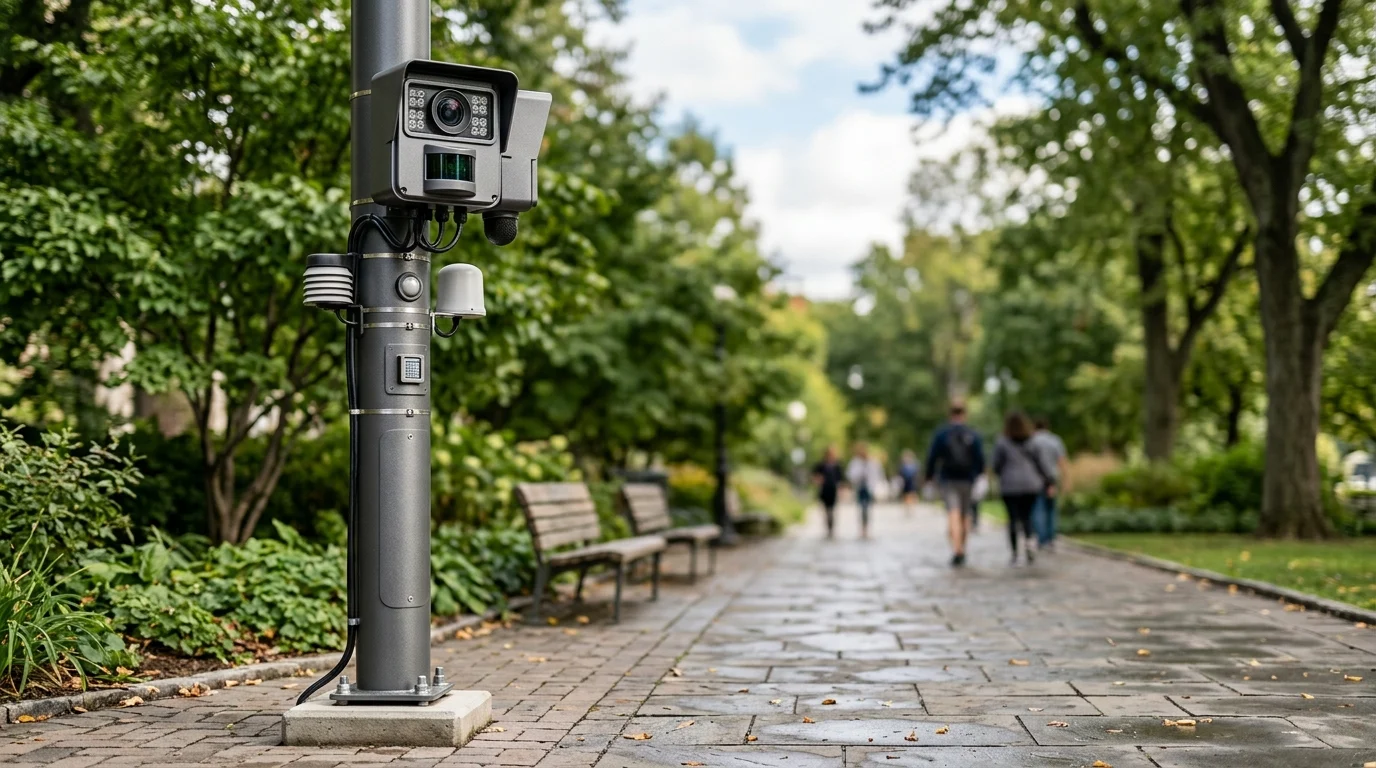
A computer vision smart pole is a modular, integrated system rather than a simple camera mounted on a standard light post. It combines advanced optics, localized computing power, environmental sensors, and robust connectivity to function as an autonomous data node within a broader Internet of Things (IoT) ecosystem.
Core hardware, software, and connectivity components
The architecture of a smart pole relies on industrial-grade hardware designed to withstand extreme environmental conditions while maintaining high computational output. At the core is the edge AI accelerator, typically a neural processing unit (NPU) capable of executing complex machine learning models with minimal power consumption.
| Component Category | Typical Specification Range | Primary Function |
|---|---|---|
| Edge AI Processor | 15 to 40 TOPS (Tera Operations Per Second) | Executes neural networks for object detection locally |
| Optical Sensors | 4MP to 8MP resolution, 0.001 Lux sensitivity | Captures high-fidelity, low-light video for analysis |
| Connectivity Backhaul | 5G, Wi-Fi 6, or Gigabit Fiber | Transmits metadata, alerts, and system diagnostics |
| Power Infrastructure | 110/220V AC, PoE++ (Type 4, up to 90W) | Powers integrated peripherals and emergency backups |
Software components include a hardened Linux-based operating system, containerized analytics applications (often deployed via Docker), and secure OTA (over-the-air) update mechanisms. Connectivity is usually redundant, utilizing fiber optics for primary data transfer and 5G cellular networks as a failover to ensure uninterrupted operation during physical network outages.
Main analytics functions for crowd monitoring
The primary value of these smart poles lies in their specialized analytics capabilities. Bi-directional line crossing is the foundational metric, accurately counting individuals entering and exiting a predefined virtual perimeter. Advanced systems achieve accuracy rates exceeding 95% even in complex, overlapping crowd scenarios.
Beyond simple counting, the analytics engines perform dwell time analysis to measure how long individuals remain in a specific zone, which is critical for identifying loitering or unattended baggage. Trajectory tracking maps the directional flow of crowds, generating heatmaps that highlight primary pedestrian arteries and dead zones. Additionally, macro-density estimation algorithms evaluate the overall saturation of an area, triggering automated alerts when the ratio of people to available square footage crosses a predefined safety threshold.
How smart poles compare with CCTV and standalone sensors
Traditional Closed-Circuit Television (CCTV) relies on human operators to identify risks, an approach that suffers from fatigue and inherent scalability limits. While standard CCTV provides forensic evidence post-incident, smart poles provide preventative intelligence through automated metadata generation.
Compared to standalone sensors like LiDAR or infrared (IR) counters, computer vision smart poles offer richer contextual data. LiDAR is highly accurate for spatial mapping and operates effectively in total darkness, but hardware costs can be 3 to 5 times higher than optical sensors, and it lacks the ability to classify complex visual attributes. Infrared beam counters are inexpensive but fail entirely in dense crowds due to occlusion. Smart poles strike an optimal balance, providing high accuracy, rich visual context for anomaly classification, and scalable edge processing.
How to Evaluate Specifications, Privacy, and Cost
Procuring and scaling a network of smart poles requires a rigorous evaluation of technical capabilities, regulatory compliance, and long-term financial viability. Decision-makers must balance the need for high-fidelity analytics against budget constraints and stringent data protection laws.
Technical specs that affect counting accuracy
Counting accuracy is inextricably linked to the pole’s optical and computational specifications. A minimum resolution of 4 megapixels (1440p) is generally required to maintain sufficient pixel density for identifying individuals at distances up to 30 meters. Frame rate also dictates performance; a minimum of 30 frames per second (fps) is necessary to prevent motion blur and ensure accurate tracking of fast-moving crowds.
Low-light performance is equally critical for 24/7 safety monitoring. Sensors with Wide Dynamic Range (WDR) ratings of 120 dB or higher, coupled with large aperture lenses (e.g., f/1.4), ensure that shadows and harsh glare do not degrade the AI’s detection confidence. Finally, the Field of View (FOV) must be matched to the specific environment—panoramic multi-sensor arrays offering 180-degree or 360-degree coverage are ideal for open squares, while narrow, motorized varifocal lenses are better suited for monitoring distant choke points.
Privacy, cybersecurity, and compliance requirements
Deploying optical sensors in public spaces triggers significant privacy concerns and regulatory obligations under frameworks like the GDPR in Europe or the CCPA in California. Compliant smart pole deployments utilize edge computing to perform on-device anonymization.
In a privacy-first architecture, video frames are analyzed in volatile memory and immediately discarded. Only structured metadata—such as coordinate numbers and timestamps—is transmitted to the central database. Systems must be configured to disable facial recognition or biometric logging by default. Furthermore, cybersecurity hardening is mandatory; this includes end-to-end encryption (TLS 1.3) for data in transit, AES-256 encryption for data at rest, and certificate-based mutual authentication to prevent rogue devices from accessing the municipal network.
Total cost of ownership and deployment economics
Evaluating the Total Cost of Ownership (TCO) requires looking beyond the initial hardware purchase. Deployments involve significant capital expenditures (CapEx) for physical infrastructure alongside recurring operational expenditures (OpEx) for software licensing and maintenance.
| Cost Category | Estimated Range (USD per pole) | Description |
|---|---|---|
| Hardware (CapEx) | $3,500 – $8,500 | Pole structure, multi-sensor camera, edge node, environmental sensors |
| Installation (CapEx) | $1,200 – $3,000 | Trenching, electrical wiring, physical mounting, and initial calibration |
| Software & Cloud (OpEx) | $25 – $75 / month | Analytics licensing, cloud dashboard access, API utilization |
| Maintenance (OpEx) | $200 – $450 / year | Routine lens cleaning, structural inspections, and OTA firmware updates |
While the initial CapEx is substantial, organizations often achieve a positive Return on Investment (ROI) within 24 to 36 months through the reduction of manual security patrols, optimized energy usage (if integrated with smart lighting), and the mitigation of liability costs associated with crowd-related incidents.
How to Implement Smart Poles with Lower Risk
A successful smart pole rollout relies on meticulous planning, field testing, and seamless integration into existing security ecosystems. Poor physical placement or isolated data silos can render even the most advanced AI hardware ineffective.
Site assessment, pilot testing, and calibration steps
Implementation begins with a comprehensive site assessment to determine optimal pole placement. Mounting height is a critical variable; cameras positioned between 4 and 6 meters above ground level generally provide the optimal top-down angle for crowd counting, minimizing the occlusion that occurs when taller individuals block the camera’s view of people behind them.
Before a full-scale rollout, organizations should conduct a 30- to 60-day pilot test in a representative high-traffic zone. During this phase, environmental variables such as seasonal foliage, dynamic lighting, and adverse weather conditions are evaluated. Engineers calibrate the AI models by comparing the edge analytics output against manual baseline counts to fine-tune the confidence thresholds and bounding box parameters.
System integration and operational workflows
Smart pole data must be actionable, which requires deep integration with an organization’s existing Video Management System (VMS) or Physical Security Information Management (PSIM) platform. Modern smart poles facilitate this through RESTful APIs and lightweight messaging protocols like MQTT.
Operational workflows must be defined to determine how the data is utilized. For example, if a smart pole detects a crowd density of 3 persons per square meter at a transit platform, the system should automatically trigger an API call that alerts the control room, dispatches nearby security personnel, and updates digital signage to redirect incoming passengers. Establishing these automated logic gates ensures that the intelligence gathered by the pole translates into immediate physical safety measures.
KPIs for safety, accuracy, and performance
To ensure the system delivers on its safety and operational promises, administrators must track specific key performance indicators (KPIs). For counting accuracy, the standard metric is the Mean Absolute Percentage Error (MAPE). A properly calibrated smart pole should maintain a MAPE of less than 5% under standard conditions and less than 10% during peak congestion.
System reliability is measured through uptime and alert latency. Mission-critical deployments should target a 99.9% uptime SLA, monitored via automated heartbeat signals sent from the edge node to the central server. Alert latency—the time elapsed between a physical event occurring and the notification appearing on the operator’s dashboard—must remain under 2 seconds to allow for effective emergency intervention.
How to Choose the Right Smart Pole Solution
The market for computer vision smart poles is fragmented, encompassing traditional telecommunications providers, specialized AI startups, and legacy surveillance manufacturers. Selecting the appropriate solution requires looking past marketing claims to evaluate the underlying ecosystem maturity, hardware flexibility, and long-term support structures.
Vendor comparison criteria and selection process
When comparing vendors, organizations must prioritize interoperability and open architecture. Proprietary, closed-loop systems risk vendor lock-in, making it difficult to upgrade AI models or integrate third-party sensors in the future. Evaluators should demand access to the vendor’s Software Development Kit (SDK) and verify compatibility with open standards such as ONVIF Profile M, which standardizes the communication of metadata and analytics events.
Supply chain security is another critical selection criterion. For municipal and government deployments, compliance with the National Defense Authorization Act (NDAA) in the United States, or equivalent regional cybersecurity mandates, is often mandatory. Buyers must audit the vendor’s component sourcing to ensure the edge processors and optical sensors do not originate from restricted manufacturers, thereby mitigating the risk of embedded hardware vulnerabilities.
When premium deployments are justified
While standard smart poles are sufficient for general urban monitoring, premium deployments are required for high-risk, mission-critical environments such as international borders, major political centers, and tier-one transit hubs. These scenarios justify a higher CapEx to ensure absolute resilience.
Premium solutions include specialized hardware such as dual-lens thermal and optical
Key Takeaways
- The most important conclusions and rationale for Computer Vision Smart Pole
- Specs, compliance, and risk checks worth validating before you commit
- Practical next steps and caveats readers can apply immediately
Frequently Asked Questions
What is a computer vision smart pole used for?
It combines cameras, edge AI, and connectivity to count people, detect congestion, and trigger fast safety alerts in cities, venues, and transport hubs.
Why use edge analytics on a smart pole instead of cloud-only video processing?
Edge processing analyzes video locally, cuts bandwidth sharply, lowers latency, and sends lightweight metadata instead of continuous HD streams.
Can Morelux customize computer vision smart poles for infrastructure projects?
Yes. Morelux supports custom steel or aluminum smart poles with engineering help, technical drawings, and manufacturing tailored to project requirements.
Which projects benefit most from crowd-counting smart poles?
They are well suited for public squares, stadiums, schools, airports, stations, government sites, and commercial areas with heavy pedestrian flow.
How can buyers get a quote for a smart pole project from Morelux?
Send your pole specs, loading needs, mounting details, and project quantity. Morelux provides fast quotes, technical support, and drawing assistance for sourcing teams.