Introduction
Disasters expose the limits of centralized power, communications, and surveillance systems just when cities need them most. Smart light poles address that gap by turning ordinary street infrastructure into distributed emergency nodes that can support alerts, connectivity, monitoring, and public assistance during outages and fast-moving crises. This article explains why they function as a practical lifeline in emergency management, what capabilities make them valuable across different disaster scenarios, and how they strengthen situational awareness and response continuity. From real-time communication to resilient local services, the discussion below shows how these poles can help communities stay informed, connected, and safer when conventional systems fail.
Why Are Smart Light Poles in Emergency Management a Lifeline
We no longer view light poles as mere illumination assets; rather, they serve as critical, decentralized nodes for emergency management. When a catastrophic event compromises centralized power and communication grids, smart light poles act as a true lifeline. By distributing essential services across a city’s footprint, we guarantee continuous situational awareness and public communication. Municipalities integrating these systems typically target 99.99% uptime for their emergency networks, a metric achievable only through decentralized, hardened infrastructure that operates independently of the main grid.
How do smart light poles support emergency response and public safety
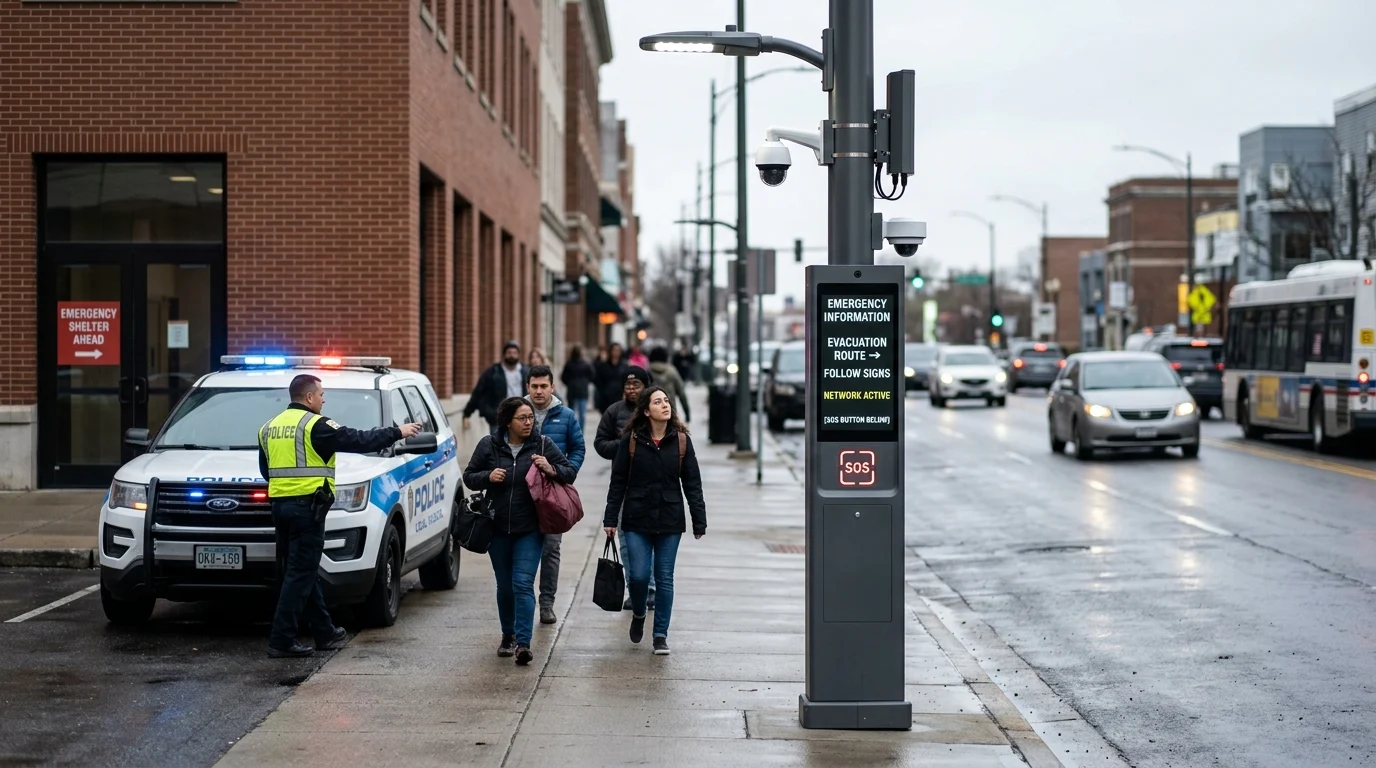
When analyzing disaster response mechanics, the immediate availability of localized data is paramount. I prioritize equipping smart light poles with integrated public address systems broadcasting at 110 decibels, ensuring automated voice warnings cut through heavy environmental noise. High-definition pan-tilt-zoom (PTZ) cameras coupled with edge AI allow command centers to monitor evacuation routes and analyze crowd density in real time. Emergency call buttons embedded at the base provide citizens with a direct, sub-500-millisecond latency connection to dispatchers, bypassing congested commercial cellular networks.
Which disaster scenarios justify investing in smart light poles
Because every municipality faces a unique threat matrix, I tailor investment justifications to specific regional vulnerabilities. In coastal regions prone to hurricanes, the capital investment is validated by localized wind-speed monitoring and flood sensors that trigger automatic evacuation alerts when water levels exceed a 10-centimeter threshold. For earthquake zones, poles equipped with MEMS accelerometers detect seismic P-waves, instantly shutting down connected municipal gas lines and broadcasting drop-and-cover warnings seconds before S-waves arrive. During wide-area grid blackouts, the off-grid capabilities of these poles ensure critical intersections remain safely lit and communication relays stay active.
What Technical Capabilities Should I Compare in Smart Light Poles

Evaluating smart light poles requires a rigorous approach to technical specifications. I advise procurement teams to look past marketing terminology and focus on the hardware’s capacity to withstand extreme operational stress. The goal is to build an interconnected ecosystem that remains fully functional when traditional infrastructure fails.
Which power, communications, sensing, and environmental features matter most
The core of a resilient smart pole lies in its power and communication redundancies. I specify lithium iron phosphate (LiFePO₄) battery banks with a minimum capacity of 200 Ah, paired with vertical solar wraps to guarantee 48 to 72 hours of autonomous operation during total grid failures. For communications, reliance on a single carrier is a single point of failure; therefore, our poles utilize dual-SIM 5G/LTE routers with automatic failover to mesh Wi-Fi and LoRaWAN networks. Environmental resilience is non-negotiable. I require an ingress protection rating of at least IP67 for sensor housings and an IK10 impact resistance rating to withstand flying debris. The sensor payload must include industrial-grade particulate matter (PM2.5) detectors and VOC sensors, providing life-saving data for routing responders around toxic plumes.
How should I compare smart light poles against traditional infrastructure
To justify the capital expenditure to stakeholders, I frequently use a direct technical comparison between smart poles and legacy infrastructure. The differences in capabilities are stark when viewed through the lens of disaster resilience.
| Feature | Traditional Light Pole | Smart Emergency Light Pole |
|---|---|---|
| Power Autonomy | 0 hours (Grid dependent) | 48–72 hours (Integrated Solar/Battery) |
| Comms Network | None | 5G, LTE, Mesh Wi-Fi, LoRaWAN |
| Sensing Payload | Photocell (Dusk-to-Dawn) | Seismic, Flood, Air Quality, PTZ Video |
| Impact & Wind Rating | Standard 90 mph wind load | Ruggedized for 150+ mph winds and IK10 impact |
| Public Interaction | None | SOS panic buttons, 110dB PA speakers |
This side-by-side comparison highlights exactly why I treat traditional poles as a liability during a crisis, whereas smart poles function as an active mitigating asset.
How Do I Plan, Procure, and Deploy Smart Light Poles

Transitioning from technical evaluation to field deployment is where many smart city initiatives falter. In my practice, successful execution hinges on methodical site selection, stringent compliance verification, and a clear understanding of total lifecycle costs. A phased deployment approach mitigates risk and ensures the new infrastructure integrates seamlessly with existing emergency operations centers.
What practical steps should I follow for site selection and rollout
I initiate the rollout process with a comprehensive GIS mapping exercise to identify high-risk zones, such as known floodplains, seismic fault lines, and primary evacuation corridors. We typically launch a pilot phase consisting of 50 to 100 units in these critical areas before committing to a city-wide expansion. Structural integrity assessments of existing concrete foundations are mandatory, as the added weight and wind-sail area of smart payloads often require extensive retrofitting. Procurement teams must also account for extended supply chain realities; depending on the complexity of the integrated sensor payload, manufacturing and delivery typically require a 12- to 16-week lead time.
How do compliance, cost drivers, regional risk profiles, and maintenance affect deployment
Navigating the regulatory landscape is essential for a smooth rollout. I ensure all deployments strictly comply with ANSI C136 standards for roadway lighting and FCC regulations for wireless transmission. Cost drivers are highly variable; while a base smart pole might cost $3,500, a fully equipped emergency management node can easily exceed $8,500 per unit. These capital costs are heavily influenced by the regional risk profile—a pole deployed in a hurricane zone requires heavier-gauge steel and specialized marine-grade anti-corrosion coatings compared to one deployed inland. Finally, I implement predictive maintenance protocols leveraging the poles’ own telemetric data. By monitoring battery health cycles remotely, we routinely reduce ongoing maintenance OPEX by up to 30%, ensuring the network remains at peak operational readiness.
Key Takeaways
- The most important conclusions and rationale for smart light poles in emergency management: a “lifeline” during disasters.
- Specs, compliance, and risk checks worth validating before you commit
- Practical next steps and caveats readers can apply immediately
Frequently Asked Questions
What makes a smart light pole useful during a disaster?
It keeps working off-grid and can provide lighting, alerts, cameras, sensors, and SOS access when central systems fail.
Which emergency features should a city prioritize in smart light poles?
Prioritize backup power, dual-network communications, PA speakers, PTZ cameras, emergency call buttons, and environmental sensors.
How long can a disaster-ready smart light pole stay operational without grid power?
A well-designed unit can run 48–72 hours using solar plus battery storage, depending on load and site conditions.
How do smart light poles improve public warning and evacuation?
They broadcast automated voice alerts, monitor crowd movement, and help command centers guide evacuation routes in real time.
What should procurement teams request from a smart pole manufacturer?
Ask for custom drawings, engineering support, fast quotes, tested wind and impact ratings, and a clear lead-time plan.