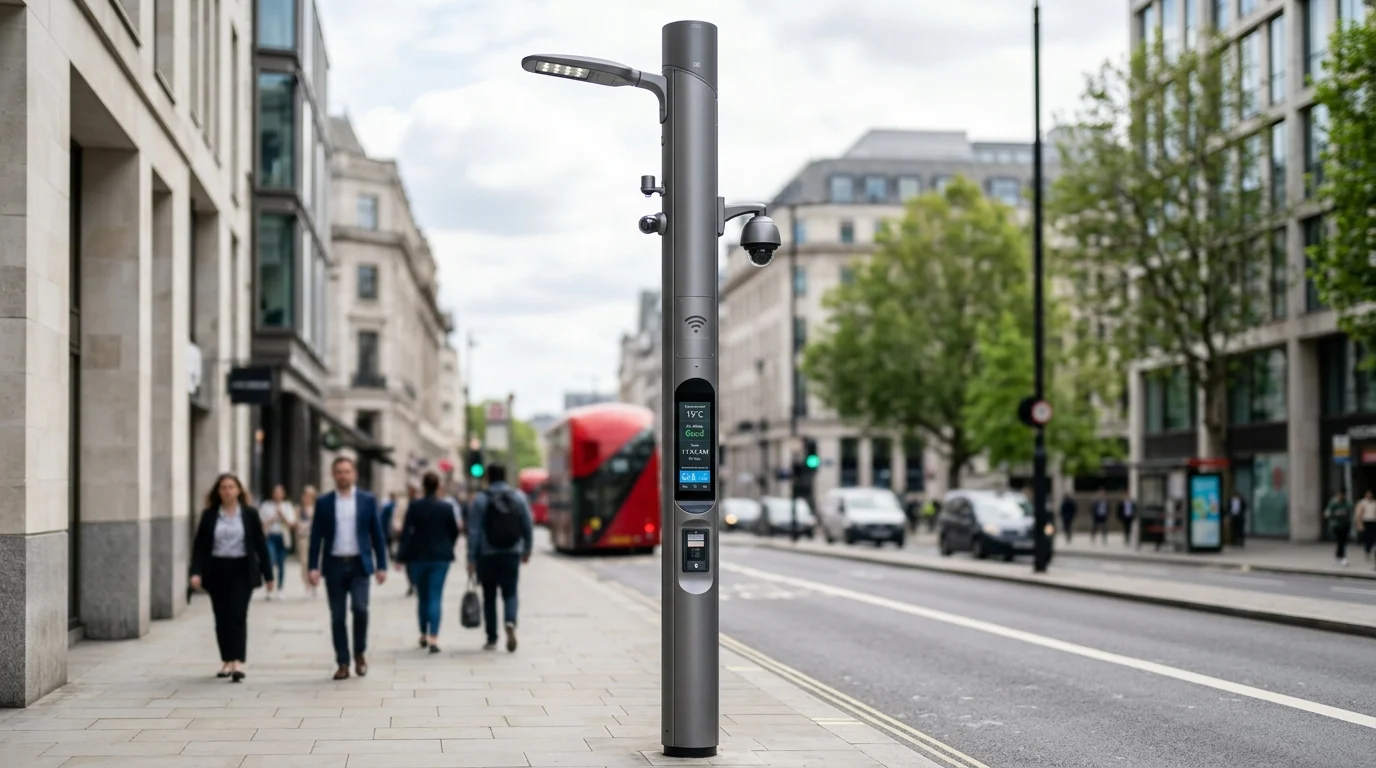
By 2026, cities will face two overlapping infrastructure pressures: denser 5G coverage and wider access to curbside EV charging. Smart pole integration addresses both by combining small cells, power distribution, lighting, sensors, and charging hardware into a single streetside asset. This approach reduces visual clutter, limits repeated excavation, and makes better use of constrained public right-of-way. For municipalities, utilities, and network operators, the value is not just technical consolidation but faster deployment, lower lifecycle costs, and more coordinated urban planning. The discussion ahead explains why this model is gaining urgency, where it delivers the strongest returns, and which design and operational factors determine whether integrated poles succeed at street level.
Why Smart Pole Integration for 5G and EV Charging Matters
As urban infrastructure evolves toward the 2026 horizon, smart pole integration represents a critical convergence of telecommunications and e-mobility. Historically, municipal streetscapes have been fragmented, populated by single-use utility poles, isolated cellular towers, and standalone electric vehicle (EV) charging stations. This siloed approach generates unsustainable spatial clutter and redundant civil engineering costs.
The transition to multi-tenant digital infrastructure consolidates these discrete functions into a unified vertical asset. By embedding high-bandwidth connectivity and power distribution into a single footprint, stakeholders can accelerate deployment timelines while optimizing the use of scarce public right-of-way (ROW) real estate. This paradigm shift is no longer merely a conceptual smart city initiative; it is an economic and operational necessity driven by concurrent surges in data consumption and EV adoption.
Urban Demand for Connectivity and Curbside Charging
The proliferation of 5G millimeter-wave (mmWave) and C-band networks demands unprecedented densification. Because high-frequency signals suffer from rapid attenuation and poor penetration, mobile network operators (MNOs) must deploy small cell nodes every 100 to 200 meters in dense urban corridors. Simultaneously, the accelerated adoption of electric vehicles has exposed a severe deficit in curbside charging infrastructure for residents lacking off-street parking.
Smart pole integration directly addresses these overlapping spatial demands. An integrated pole can house ultra-compact 5G radios while delivering 11kW to 22kW Level 2 AC charging, or even 50kW DC fast charging, at the base. By co-locating these services, municipalities satisfy the broadband demands of commercial districts while closing the charging gap for urban EV owners, maximizing the utility of every square meter of sidewalk.
Business Models for Integrated Smart Poles
The traditional capital expenditure (CapEx) model for street infrastructure is being rewritten by smart pole integration. Historically, a telecommunications provider bore the full cost of site acquisition, power drops, and installation for a small cell. By integrating EV charging and municipal IoT services (such as smart lighting or environmental sensors), capital costs can be distributed across a consortium of MNOs, Charge Point Operators (CPOs), and local governments.
This shared-infrastructure model significantly improves project economics. Data from early commercial deployments indicates that co-trenching and shared grid interconnections can reduce combined CapEx by 30% to 40% compared to building separate telecom and EVSE sites. Furthermore, dual revenue streams—monetizing both gigabyte data traffic and kilowatt-hour energy dispensing—compress the traditional infrastructure return on investment (ROI) timeline from an 8-to-12-year horizon down to a highly competitive 5-to-7-year period.
Core Components of Effective Smart Pole Integration
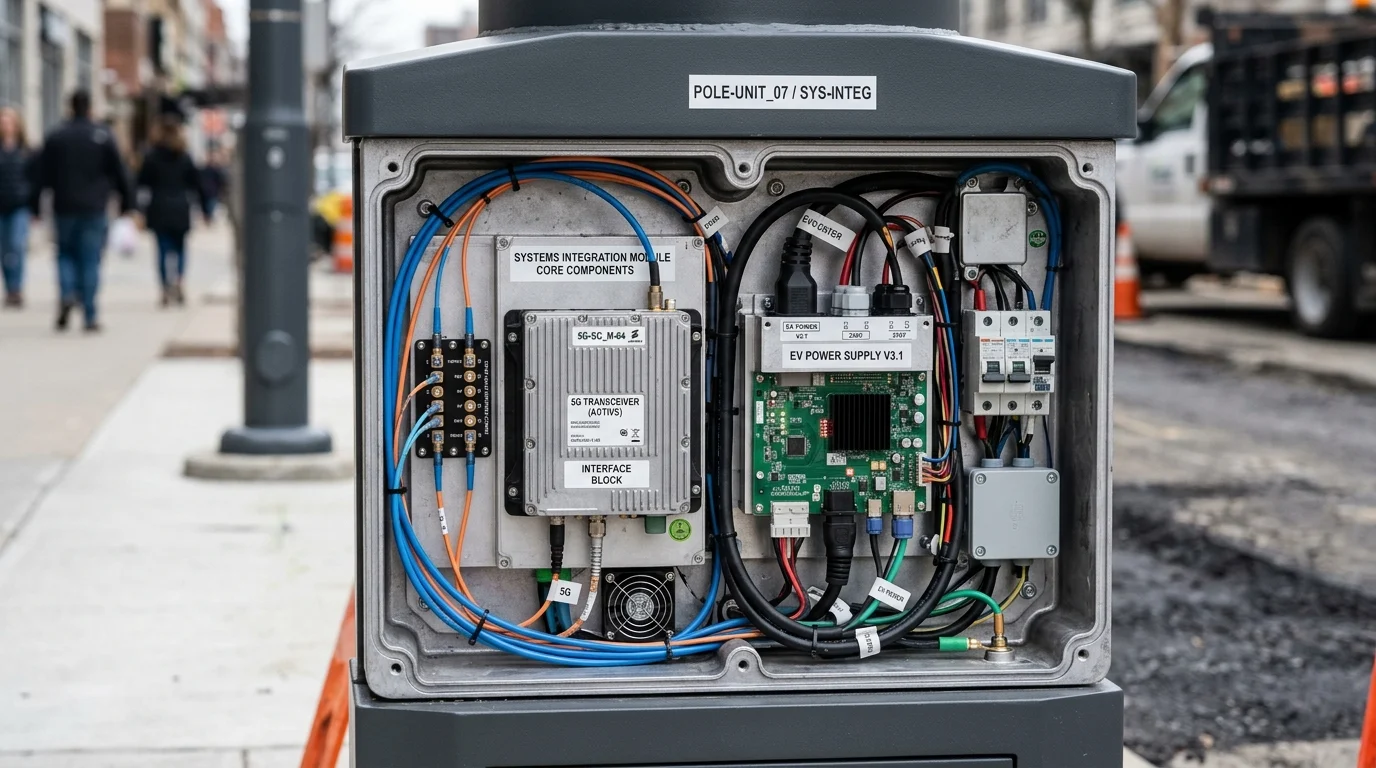
Architecting a functional smart pole requires moving beyond simple physical co-location to achieve deep subsystem integration. The underlying engineering must balance the volumetric constraints of a street pole with the rigorous operational demands of high-voltage power electronics and sensitive radio frequency (RF) equipment.
Essential Subsystems and Coordination Needs
An integrated smart pole comprises several distinct yet interdependent subsystems: the structural chassis, power distribution unit (PDU), baseband processing, active antenna units, EV supply equipment (EVSE), and edge computing nodes. Effective integration requires a modular architecture where components can be serviced or upgraded independently, preventing a failure in the charging module from taking down the cellular node.
Coordination among these subsystems is governed by a unified IoT gateway and an intelligent energy management system (EMS). The EMS is particularly critical, as it must dynamically allocate power between the EV charger and the telecom payload. For example, if a 5G small cell requires a peak draw of 800W during high-traffic periods, the EMS adjusts the EVSE output to ensure the pole’s total consumption remains within the strict limits of its dedicated utility drop, typically capped at 100A or 200A.
Integrated Poles vs Standalone 5G and EV Infrastructure
The operational superiority of smart pole integration becomes evident when benchmarked against legacy standalone infrastructure. Standalone deployments require separate concrete pads, independent utility meters, and redundant trenching for power and fiber backhaul. This fragmented approach not only inflates capital costs but also exacerbates visual pollution and pedestrian bottlenecks.
| Metric | Standalone Infrastructure (Combined Sites) | Integrated Smart Pole |
|---|---|---|
| Average Footprint per Node | 3.5 to 5.0 sq meters | 0.8 to 1.2 sq meters |
| Trenching & Grid Connection Cost | $18,000 – $28,000 | $9,000 – $14,000 |
| Typical Deployment Timeline | 6 – 9 months | 3 – 5 months |
| Visual Clutter / Street Impact | High (multiple cabinets/bollards) | Low (concealed base/flush mount) |
By consolidating hardware, integrated poles reduce the physical footprint by up to 75%. Furthermore, utilizing a single trench for both a 100Gbps fiber backhaul and a high-capacity electrical feed drastically minimizes street disruption, accelerating municipal approval processes and reducing civic pushback.
Technical and Compliance Requirements
Deploying integrated infrastructure introduces a complex matrix of engineering tolerances and regulatory hurdles. Combining high-power electrical dispensation with mission-critical telecommunications within a confined cylindrical enclosure requires rigorous attention to thermal dynamics, power quality, and structural integrity.
Power, Load Management, Thermal Design, and Cybersecurity
Thermal management is the most acute engineering challenge in smart pole integration. A 50kW DC fast charging module generates significant waste heat, which naturally rises within the pole structure. If unmitigated, this heat can degrade the performance and lifespan of the 5G baseband units mounted above, which typically require operating temperatures to remain below 55°C. Advanced integration employs compartmentalized active cooling, phase-change materials, and strict physical segregation of high-voltage and RF zones.
Cybersecurity is equally critical in a multi-tenant environment. The pole’s network architecture must enforce Zero Trust principles, ensuring strict logical separation between the CPO’s payment processing data, the MNO’s cellular payload, and the municipality’s IoT sensor traffic. Vulnerabilities in an EV charging API cannot be allowed to provide a lateral attack vector into the municipal grid or the 5G core network.
Permitting, Right of Way, Grid Interconnection, and Safety Rules
Regulatory compliance dictates the physical and geographical feasibility of smart pole networks. Structurally, integrated poles must adhere to stringent standards, such as AASHTO guidelines in North America, which often mandate wind load ratings of 120 mph to 150 mph. The added weight and sail area of 5G radomes and external EV cables necessitate robust foundation engineering, frequently requiring deeper micro-pile foundations than standard streetlights.
Navigating the permitting landscape requires compliance with both telecom and electrical codes. RF emissions must remain strictly within FCC or ICNIRP public exposure limits, factoring in the proximity of pedestrians utilizing the EV charger at the pole’s base. Simultaneously, the electrical installation must comply with regional standards like NEC Article 625 for EV charging systems, ensuring proper grounding, ground-fault protection, and safe grid interconnection protocols.
Deployment, Sourcing, and Total Cost Evaluation
The transition from pilot programs to city-wide rollouts necessitates a rigorous approach to procurement and lifecycle cost analysis. Because smart pole integration crosses traditional industry boundaries, sourcing strategies must evaluate consortiums of vendors rather than single-domain manufacturers.
Vendor Evaluation Criteria
Evaluating a smart pole vendor requires assessing their capability across structural engineering, telecommunications, and e-mobility. Key criteria include the modularity of the design—specifically the ability to swap EVSE components or upgrade from 5G to future 6G antennas without replacing the entire pole chassis. Open-architecture compliance is non-negotiable; charging modules must support OCPP 2.0.1 (Open Charge Point Protocol) to ensure interoperability with any major charging network.
| Cost Component | Typical Capital Expenditure (CapEx) | Annual Operating Expenditure (OpEx) |
|---|---|---|
| Pole Hardware & Structural Enclosure | $8,000 – $15,000 | $200 – $400 (Physical Maintenance) |
| 5G Small Cell & Antenna Payload | $5,000 – $12,000 | $1,200 – $2,400 (Fiber Backhaul) |
| EVSE Module (Level 2 to DCFC) | $2,500 – $18,000 | $500 – $1,500 (Software & Connectivity) |
| Site Prep, Trenching & Permitting | $10,000 – $22,000 | $0 (Amortized CapEx) |
Furthermore, vendor Service Level Agreements (SLAs) must account for the dual-criticality of the asset. MNOs typically demand 99.99% uptime for cellular nodes, while EV chargers require high reliability to maintain consumer trust. Vendors must provide unified remote diagnostic platforms capable of isolating faults to specific subsystems before dispatching maintenance crews.
Implementation Steps to Reduce Deployment Risk
To mitigate deployment risks, network planners must execute a phased implementation strategy. The critical path begins with a granular grid capacity audit. Identifying specific street segments where the local distribution network can support an additional 20kW to 50kW per pole without requiring expensive substation upgrades is essential for maintaining project viability.
Subsequent steps involve securing blanket ROW agreements with municipal authorities to avoid site-by-site permitting delays. Establishing a standardized “pole catalog” pre-approved by city planners for specific zoning districts accelerates approval timelines. Finally, deploying a small-scale pilot of 10 to 20 poles allows operators to validate thermal models, test dynamic load balancing algorithms, and refine the revenue-sharing software before committing to a multi-million-dollar, city-wide buildout.
Decision Framework for Smart Pole Investment

Capital allocation for smart pole integration requires a strategic framework that evaluates localized demand, existing infrastructure lifecycle, and multi-party commercial viability. Not every urban street requires an integrated solution, making site selection the primary driver of portfolio profitability.
When Integration Delivers Better Returns
Smart pole integration delivers the highest returns in dense urban cores where real estate constraints are severe. In metropolitan zones where land values exceed $1,000 per square foot, securing dedicated parcels for standalone EV charging plazas is economically unfeasible. Here, monetizing the vertical ROW through integrated poles yields superior capital efficiency.
Integration is also highly advantageous when synchronized with existing municipal upgrade cycles. If a city is already scheduled to replace aging utility poles or transition a district to LED smart lighting, the marginal cost of upgrading to a fully integrated 5G/EV pole is drastically lower than initiating a greenfield deployment. In these scenarios, the shared civil works costs generate immediate ROI improvements for all participating stakeholders.
Readiness Signals by Location and Ownership Model
Identifying the right deployment environment relies on specific readiness signals. Grid capacity maps are the foremost indicator; target zones should feature substations and local distribution feeders with greater than 20% capacity headroom. Areas requiring immediate transformer upgrades to support EV charging will severely delay project timelines and erode profit margins.
Equally important is the maturity of the local regulatory framework. Jurisdictions offering structured Public-Private Partnership (PPP) models with long-term, 10-to-15-year concession agreements provide the stability necessary to amortize the upfront CapEx. As the market approaches 2026, the success of smart pole integration will be defined by entities that successfully navigate these cross-sector partnerships, transforming static streetscapes into dynamic, revenue-generating digital assets.
Key Takeaways
- The most important conclusions and rationale for smart pole integration
- Specs, compliance, and risk checks worth validating before you commit
- Practical next steps and caveats readers can apply immediately
Frequently Asked Questions
What is the main benefit of integrating 5G and EV charging into one smart pole?
It reduces street clutter, shares trenching and power infrastructure, and improves ROI by combining telecom and charging revenue in one asset.
Can Morelux customize smart poles for different 5G and EV charging project needs?
Yes. Morelux supports customized steel and aluminum smart poles with technical drawings, engineer input, and manufacturing matched to project requirements.
What power levels are common in integrated smart poles?
Typical setups include 11kW to 22kW AC charging, while some projects use 50kW DC charging depending on grid capacity and site goals.
How does a smart pole manage both telecom equipment and EV charging safely?
A modular design and energy management system help separate subsystems and balance power so charging does not disrupt 5G operation.
How quickly can Morelux provide pricing and technical support for smart pole projects?
Morelux emphasizes fast B2B response, including 24-hour quotes, technical drawings, and engineer support for infrastructure buyers and sourcing teams.