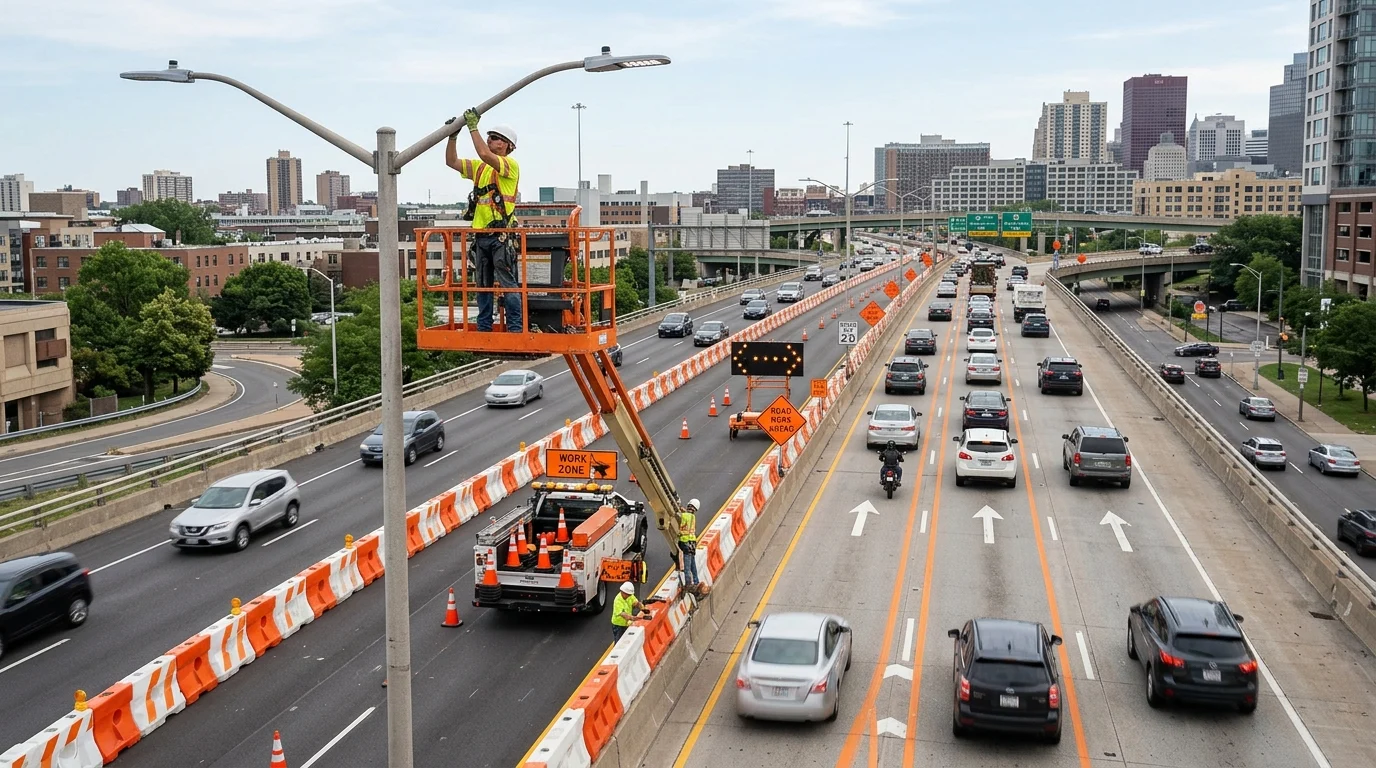
Retrofitting expressway lighting is rarely a simple fixture replacement. On corridors carrying more than 100,000 vehicles per day, every lane closure affects safety, travel time, emergency access, and contractor productivity. A successful plan must balance precise work-zone geometry, nighttime operating windows, ramp continuity, utility protection, and stakeholder coordination. This article outlines how engineers can design practical traffic diversion strategies for LED and smart lighting upgrades, from defining closure limits and buffer space to comparing lane closures, full directional detours, and rolling roadblocks. For cities and infrastructure buyers, the goal is clear: deliver safer, more efficient lighting systems without allowing construction to overwhelm the network.
Project Scope and Constraints
Urban expressway lighting retrofits, particularly transitions to high-efficiency LED luminaires and smart control systems, present significant logistical challenges. Executing these upgrades on high-volume corridors—often characterized by Average Daily Traffic (ADT) exceeding 100,000 vehicles—requires meticulous traffic diversion planning. A poorly designed diversion plan not only jeopardizes worker safety but also induces severe network-wide congestion. The foundation of a successful diversion strategy lies in rigorously defining the project scope and understanding the operational constraints unique to controlled-access highways.
Define work zones and lane closures
Establishing accurate work zone perimeters is the critical first step. Lighting retrofits typically require the deployment of heavy machinery, including articulating boom lifts, crane trucks, and material transport vehicles. To accommodate this equipment safely, engineers must allocate a minimum 3.5-meter lateral clearance for the active work area, supplemented by a longitudinal buffer space calculated based on approach speeds. Depending on whether the light poles are located in the median or along the shoulder, this necessitates either inner or outer lane closures, directly reducing the directional capacity of the expressway.
Identify stakeholders and affected assets
Expressway infrastructure intersects with numerous jurisdictional and utility boundaries. Stakeholder identification extends beyond the primary transportation department to include municipal transit authorities, emergency medical services, and telecommunications providers who may have fiber optic lines collocated with lighting conduits. Asset protection protocols must be established to ensure that temporary barrier installations and heavy vehicle outriggers do not damage existing Intelligent Transportation Systems (ITS), underground drainage structures, or bridge expansion joints during the retrofit process.
Set safety, schedule, and access constraints
Operational constraints dictate the feasible temporal windows for construction. Due to high daytime traffic volumes, lighting retrofits are predominantly restricted to nighttime operations, typically bounded between 22:00 and 05:00. Environmental constraints, such as municipal noise ordinances capping construction noise at 75 dB at the nearest residential property line, further restrict the types of equipment utilized during these hours. Additionally, the diversion plan must guarantee that access to critical on-ramps and off-ramps is either maintained or that viable, clearly marked detours are provided for local traffic.
Traffic Diversion Design Criteria

With constraints established, engineers must evaluate traffic diversion design criteria to select the most efficient routing methodology. The objective is to balance contractor productivity with the preservation of acceptable traffic flow. Design criteria rely heavily on empirical traffic data and established highway capacity analytical frameworks to project the operational impacts of various closure scenarios.
Compare closure and diversion options
Evaluating closure methodologies requires comparing the operational throughput of partial lane closures against full directional closures with off-network detours.
| Closure Type | Typical Capacity Impact | Contractor Productivity | Risk Profile |
|---|---|---|---|
| Single-Lane Closure | 30-40% reduction per lane | Moderate (restricted access) | High (adjacent live traffic) |
| Full Directional Closure | 100% reduction (diverted) | High (unrestricted access) | Low (isolated work zone) |
| Rolling Roadblock | Temporary 100% reduction | Low (short intervention windows) | Moderate (speed differentials) |
Selecting the appropriate option depends on the duration of the specific retrofit task, such as luminaire head replacement versus full pole structural replacement.
Assess capacity, queues, and crash risk
Quantitative assessment of network capacity is mandatory to prevent catastrophic queue spillback. Using Highway Capacity Manual (HCM) methodologies, engineers calculate the reduced capacity of the bottleneck. For urban expressways, maintaining a flow rate of at least 1,200 passenger cars per hour per lane (pcphpl) during partial closures is generally required to keep Level of Service (LOS) from degrading to a failing grade. If queuing analysis indicates that vehicle queues will exceed a threshold of 2.5 kilometers, the diversion plan must be revised to include broader upstream network detours or adjusted work hours to mitigate crash risks associated with sudden stops.
Account for lighting retrofit requirements
A unique criterion for lighting retrofits is the management of illumination levels during the construction phase. Because existing luminaires are systematically decommissioned or removed, the work zone and the adjacent live traffic lanes can suffer from severe visibility deficits. The diversion plan must incorporate temporary lighting towers or mobile illumination systems. Specifications typically require temporary lighting to deliver a minimum average illuminance of 20 lux with a uniformity ratio (U0) of 0.4. This ensures that drivers navigating narrowed lanes or shifted alignments can do so safely, offsetting the loss of permanent expressway lighting.
Buildable Diversion Plan
Translating theoretical design criteria into a buildable diversion plan requires precise field data, advanced modeling, and strict adherence to traffic control device standards. The buildable plan serves as the primary blueprint for the contractor, detailing the spatial and temporal deployment of all temporary traffic management infrastructure.
Conduct traffic surveys and simulations
Accurate modeling relies on high-fidelity empirical data. Traffic engineers must conduct continuous 72-hour volume, speed, and classification counts using radar or inductive loop detectors. This data feeds into microsimulation software, allowing designers to replicate complex merging behaviors and route choice diversions dynamically. Simulations test the resilience of the proposed diversion against peak shoulder periods and validate whether the off-network arterial streets possess the residual capacity to absorb the diverted expressway volume without suffering gridlock.
Plan temporary signs, barriers, and markings
The deployment of temporary signs, concrete barriers, and pavement markings must comply strictly with national or regional manuals on uniform traffic control devices. Taper lengths for lane drops are critical safety parameters, typically calculated using the formula L = WS (where W is the width of the offset and S is the design speed). For an expressway with an 80 km/h temporary design speed and a 3.6-meter lane width, the merging taper must be a minimum of 288 meters. Furthermore, high-visibility temporary markings and glare screens on temporary concrete barriers are mandated to delineate the shifted alignment clearly under nighttime conditions.
Coordinate contractor and emergency access
A buildable plan must explicitly detail the ingress and egress logistics for the construction fleet. Articulating boom lifts and flatbed trucks carrying heavy light poles require significant turning radii and acceleration lengths to merge back into live traffic safely. The plan must designate specific construction access points, protected by crash attenuators. Simultaneously, the design must guarantee uninterrupted access for emergency responders. This typically involves maintaining a dedicated emergency access corridor with a minimum width of 3.0 meters within or adjacent to the work zone, ensuring fire and medical services can bypass project-related congestion.
Implementation and Operations
The transition from planning to execution introduces the volatile variables of live traffic operations. Implementing the traffic diversion plan requires active management, real-time monitoring, and rapid response mechanisms to maintain network stability and protect both the workforce and the traveling public during the lighting retrofit.
Maintain network reliability during works
Maintaining network reliability necessitates dynamic traffic routing and active demand management. Expressway operators utilize Variable Message Signs (VMS) and integrate with third-party navigation applications to distribute advance warnings. Best practices dictate that VMS updates reflecting real-time travel times and detour instructions must be displayed at least 3 to 5 kilometers upstream of the primary diversion point. This proactive communication allows drivers to make informed route choices long before encountering the physical work zone, thereby reducing the pressure on the immediate diversion bottleneck.
Manage incidents and public communication
Even with robust planning, incidents within the narrowed work zone or along the diversion routes are inevitable. The implementation phase must include a comprehensive incident management protocol.
| Performance Metric | Operational Threshold | Required Action |
|---|---|---|
| Incident Response Time | < 10 minutes | Dispatch dedicated work-zone patrol |
| Incident Clearance Time | < 15 minutes | Deploy heavy-duty tow trucks to clear secondary crashes |
| Arterial Detour Delay | > 20 minutes above baseline | Adjust arterial traffic signal timing plans |
Public communication channels, including local radio broadcasts and dedicated project websites, must be synchronized with these protocols to alert the public of unexpected delays or extended closure windows.
Monitor safety and traffic performance
Continuous monitoring of traffic performance and safety indicators ensures the diversion plan functions as intended. Mobile radar units and CCTV trailers are deployed to track speed variance and queue propagation. If monitoring reveals that the 85th percentile speeds within the work zone exceed the posted temporary speed limit by more than 15 km/h, immediate corrective actions are triggered. These may include the deployment of additional traffic calming measures, such as transverse rumble strips or increased automated speed enforcement, to ensure compliance and protect the personnel executing the luminaire installations.
Selection and Validation
Before any traffic control devices are deployed on the expressway, the proposed diversion plan must undergo a rigorous selection and validation process. This final phase ensures that the chosen strategy represents the optimal balance of competing project constraints and has been legally and operationally vetted.
Use a safety, cost, and schedule matrix
Engineers employ a Multi-Criteria Decision Analysis (MCDA) matrix to evaluate competing diversion alternatives objectively. This matrix applies weighted scoring to various factors, typically assigning 40% weight to safety metrics (e.g., predicted crash modification factors), 35% to mobility impacts (e.g., total network delay in vehicle-hours), and 25% to contractor schedule and cost efficiencies. By quantifying these variables, project managers can definitively justify the selection of a specific diversion strategy—such as a series of nightly partial closures versus a single weekend full closure—based on empirical data rather than subjective preference.
Secure approvals and permits
The selected plan must navigate a complex regulatory environment to secure necessary approvals and permits. This involves submitting detailed temporary traffic control (TTC) plans to the Department of Transportation, local municipal councils, and law enforcement agencies. Because urban expressway diversions heavily impact local arterial roads, jurisdictions typically require a minimum 30-day lead time for right-of-way occupancy permits. This window allows local traffic engineers to reprogram arterial signal timings to accommodate the anticipated surge in diverted traffic.
Run trials and refine the final plan
The final validation step involves running field trials, often referred to as soft launches. A typical trial involves a 2-hour dry run during the lowest volume off-peak periods (for example, Sunday morning between 02:00 and 04:00). During this trial, the traffic control contractor deploys the advance warning signs and initial tapers without initiating the actual construction work. Engineers drive the diversion route to evaluate the visibility of retroreflective signage, the clarity of temporary pavement markings, and the physical feasibility of the lane shifts. Any identified deficiencies are refined and corrected before the diversion plan is officially authorized for the duration of the lighting retrofit project.
Key Takeaways
- Define work zone boundaries early and reserve at least 3.5 meters of lateral clearance for construction equipment operating near live expressway traffic.
- Use nighttime work windows, commonly 22:00 to 05:00, to reduce disruption on urban corridors with Average Daily Traffic above 100,000 vehicles.
- Compare single-lane closures, full directional closures, and rolling roadblocks against traffic capacity, contractor productivity, and worker exposure before selecting a diversion method.
- Coordinate with transit agencies, emergency services, utility owners, and telecom providers to protect ITS assets, fiber lines, drainage structures, and bridge components.
- Maintain ramp access where possible, and provide clear, viable detours whenever on-ramps or off-ramps must be temporarily restricted.
- Account for local noise limits, such as 75 dB at nearby residential property lines, when selecting nighttime construction equipment and methods.
Frequently Asked Questions
Why are lighting retrofits on urban expressways usually scheduled at night?
Night work, often between 22:00 and 05:00, reduces disruption on corridors with very high daytime traffic volumes and gives crews safer access for pole, luminaire, and control system upgrades.
How much work zone clearance is needed for expressway lighting construction?
A minimum lateral clearance of about 3.5 meters is typically required for boom lifts, crane trucks, and material vehicles, plus a speed-based longitudinal buffer for approaching traffic.
What is the main risk of a poorly planned traffic diversion?
It can endanger workers, reduce expressway capacity, create network-wide congestion, block ramp access, and increase conflicts between live traffic and construction equipment.
Should agencies choose single-lane closure or full directional closure?
It depends on traffic volume, detour capacity, work duration, and safety needs. Single-lane closures preserve some flow but expose crews to live traffic, while full closures improve productivity and isolation but require robust detours.
Which stakeholders should be involved before construction begins?
Transportation agencies, municipal transit operators, emergency services, utility owners, telecom providers, local authorities, and contractors should be coordinated early to protect assets and maintain critical access.