
Introduction
Choosing an aluminum alloy for a lighting pole is less about picking a familiar grade and more about matching material behavior to structural, manufacturing, and finish requirements. The differences between 6063, 6061, and 6005 affect wind-load capacity, extrusion complexity, corrosion resistance, surface quality, and overall cost. This comparison explains where each alloy performs best, where compromises appear, and how project conditions such as pole height, wall thickness, finish expectations, and exposure environment should guide the decision. By the end, you will have a practical basis for selecting the most suitable alloy rather than relying on generic assumptions about aluminum.
Why alloy choice matters for lighting poles
When a lighting pole fails, it is rarely a simple design error—it usually comes down to incorrect material specification. While it is easy to assume that “aluminum is aluminum” when reviewing a CAD drawing, choosing between the 6063, 6061, and 6005 alloys is a critical decision for any outdoor lighting project.
Selecting the right alloy impacts everything from the pole’s ability to withstand 150 mph hurricane-force winds to how well it holds an anodized finish over a 30-year lifespan. Getting it wrong can lead to catastrophic structural failures, aesthetic nightmares, or massively inflated project costs.
How to compare 6063, 6061, and 6005
Lighting poles almost exclusively utilize the 6xxx series of aluminum alloys. Alloyed primarily with magnesium and silicon, these metals are heat-treatable, highly corrosion-resistant, and ideal for the extrusion process used to manufacture seamless pole shafts.
To compare them effectively, view them on a spectrum. On one end is 6063, the undisputed king of architectural finishes and complex shapes. On the other end is 6061, the heavy-duty structural workhorse. Sitting right in the middle—often overlooked but highly effective—is 6005, which bridges the gap between extrudability and structural muscle.
Which project conditions drive selection
The environment typically dictates the alloy long before the budget does. It is essential to evaluate the specific wind zones of the installation site. A standard pedestrian plaza might only need to account for 90 mph wind gusts, making a standard architectural alloy perfectly viable. However, installing 40-foot high-mast poles along a coastal highway in Florida means AASHTO specifications will demand resistance to 150+ mph winds.
Beyond wind, consider the dead load and EPA (Effective Projected Area) of the luminaires. Heavy, multi-fixture LED arrays mounted on long bracket arms create significant bending moments at the pole’s base. Finally, coastal environments introduce brutal salt-spray conditions, meaning the alloy’s inherent corrosion resistance and its ability to hold a protective coating become structural necessities rather than cosmetic preferences.
6063 vs 6061 vs 6005: key properties
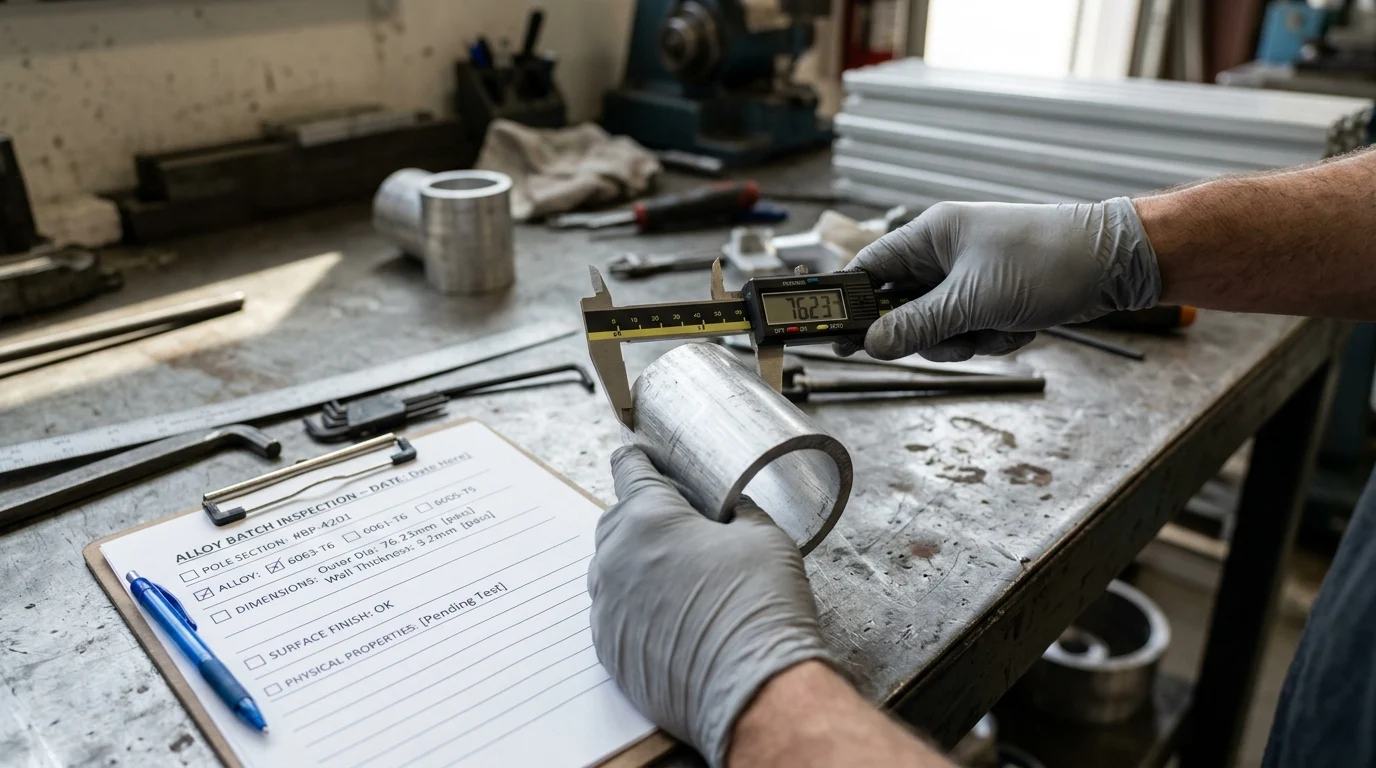
To understand why these alloys behave differently in the field, it is helpful to examine their chemistry and mechanical properties. Slight variations in magnesium, silicon, and trace elements like copper or chromium completely change how the metal reacts under stress.
How chemistry, temper, strength, and corrosion differ
The most critical metrics are yield strength and ultimate tensile strength. Yield strength indicates how much stress the pole can take before it permanently bends, while tensile strength is the breaking point. The 6061-T6 alloy includes copper and chromium, pushing its yield strength to a robust 40 ksi (kilopounds per square inch). Lacking those heavier elements, 6063-T6 tops out around 31 ksi. Meanwhile, 6005-T5 sits comfortably in the middle at roughly 35 ksi.
Here is a quick breakdown of how they stack up mechanically:
| Alloy & Temper | Yield Strength (ksi) | Ultimate Tensile Strength (ksi) | Extrudability Rating |
|---|---|---|---|
| 6063-T6 | ~31 | ~35 | Excellent (100%) |
| 6005-T5 | ~35 | ~38 | Good (75%) |
| 6061-T6 | ~40 | ~45 | Fair (60%) |
Notice that while 6061 wins on raw strength, it takes a significant hit in extrudability. Additionally, because 6061 contains copper, its baseline corrosion resistance is slightly lower than the highly pure 6063, making surface treatments much more critical.
Which mechanical properties and extrudability matter most
Extrudability is a major factor for lighting poles. Manufacturers push heated aluminum billets through steel dies to create long, seamless tubes. The 6063 alloy is incredibly forgiving; it flows smoothly through complex dies at speeds up to 100 meters per minute. This allows manufacturers to easily create intricate fluted designs or poles with internal structural ribs.
Because 6061 is physically harder, it drags on the extrusion dies. It cannot be extruded nearly as fast, and forcing it into highly complex, thin-walled shapes often results in tearing or surface defects. If a design requires sharp corners or intricate internal channels for wiring, 6061 will present manufacturing challenges.
Why wall thickness, profile design, and heat treatment affect performance
Alloy strength is inextricably linked to wall thickness and heat treatment. A common engineering workaround is specifying a thicker wall in a 6063 pole (e.g., 0.188 inches) to match the bending strength of a thinner 6061 pole (0.125 inches). While this works structurally, it increases the total weight of the aluminum, driving up material and shipping costs.
Heat treatment (the “T” designation) is equally vital. Extruding the pole is only half the process; quenching and artificially aging the metal locks in its strength. A T6 temper means the pole was solution heat-treated and artificially aged to achieve maximum structural integrity. Accepting a T4 or T5 temper when the specification calls for T6 sacrifices up to 30% of the pole’s potential yield strength.
Manufacturing and finishing considerations
A lighting pole is not just a structural support; it is a highly visible architectural element. How the metal behaves during the manufacturing process directly dictates the final product’s appearance on a street corner.
Which alloy is best for extrusion, straightness, and machining
When specifying decorative, fluted, or multi-track poles, 6063 is the undisputed champion. Its high extrudability ensures the structural integrity of thin fins or decorative grooves remains intact. It also emerges from the die incredibly straight, requiring less post-extrusion stretching to correct bowing.
Machining these poles—drilling handholes, cutting luminaire tenons, or tapping for base covers—also varies by alloy. The 6061 alloy machines beautifully, producing small, easily cleared chips. While 6063 is slightly “gummier” during machining, modern CNC routers handle it without issue. However, if a pole requires heavy welding at the base plate, 6061 retains less of its strength in the heat-affected zone compared to 6005, a factor structural engineers must account for.
How anodizing, powder coating, and surface appearance compare
If a project demands a clear anodized finish, 6063 is the necessary specification. Because of its pure chemistry, 6063 takes anodizing perfectly, resulting in a smooth, uniform, mirror-like architectural finish. Attempting to clear-anodize 6061 causes the trace copper and chromium to create a grainy, dull, or streaky surface—often described as a “galvanized” look.
For powder coating, the underlying appearance matters less, but surface adhesion is key. Whether using 6063 or 6061, poles destined for coastal environments should feature a coating that meets AAMA 2604 or 2605 standards. These standards require the finish to survive a rigorous 3,000-to-4,000-hour salt spray test without blistering, leveling the playing field regarding the base metal’s cosmetic limitations.
What standards, testing, and certification to review
It is crucial to ensure manufacturers adhere to strict industry standards. Extruded aluminum shafts should meet ASTM B221 specifications, which govern the chemical composition and mechanical properties of the raw material. Furthermore, the final pole assembly should be designed and tested according to AASHTO LTS-6 (Structural Supports for Highway Signs, Luminaires, and Traffic Signals). A visually appealing 6063 pole is inadequate if it has not been mathematically certified to handle local fatigue and wind load standards.
Cost, sourcing, and specification trade-offs
Even when the optimal alloy is clear on paper, reality often intervenes through budget constraints, supply chain bottlenecks, and minimum order quantities. Understanding the commercial side of these metals is just as important as knowing their yield strengths.
How availability, MOQ, and lead time vary
Availability is rarely an issue for 6063; it is the most common extrusion alloy globally. Because extruders run it constantly, buyers can often secure very low Minimum Order Quantities (MOQs)—sometimes as low as 1,000 to 2,000 lbs for custom profiles. Lead times are generally short because the billets are consistently in stock.
The 6061 and 6005 alloys present a different scenario. If a custom shape is needed in 6061, the extruder might demand an MOQ of 5,000 lbs or more to justify scheduling a dedicated run and swapping out standard billet inventory. While 6005 is an excellent structural alternative, it is considered a niche alloy in some regions, potentially leading to extended lead times while suppliers source the raw material.
Where total cost and failure risk diverge
When calculating total cost, look beyond the spot price of aluminum. Raw 6061 is only marginally more expensive per pound than 6063, but hidden costs lie in the tooling. Because 6061 is harder, it causes 15% to 20% more wear and tear on extrusion dies. Extruders bake this die replacement cost—and the slower production speeds—into the final price.
However, this must be weighed against failure risk. Saving money by using a thin-walled 6063 pole in a high-wind area can backfire; the cost of a single pole failing, damaging property, or injuring a pedestrian will instantly wipe out initial purchase savings. Over-engineering with 6061 in high-risk zones acts as a necessary insurance policy.
What specification steps help align alloy choice
A common mistake is writing a purchase order for “Aluminum Lighting Poles” without specifying the grade. Specification documents must be ironclad. They need to call out the exact alloy (e.g., 6063), the temper (e.g., T6), and the minimum wall thickness.
It is also highly recommended to specify the maximum allowable EPA (Effective Projected Area) for the chosen alloy. If the specification is loose, a manufacturer might substitute a 6063 pole where a 6061 was intended, purely because it is cheaper to extrude. Tight specifications protect both the project timeline and overall liability.
How to choose the right alloy
Ultimately, making the final call between 6063, 6061, and 6005 comes down to prioritizing a project’s unique demands. There is no single “best” metal, only the right metal for a specific application.
When 6063 is the best fit
The 6063 alloy is generally the best recommendation for standard commercial lighting, pedestrian walkways, and residential streetscapes. If poles are under 30 feet tall, carrying standard LED fixtures, and located in normal wind zones (under 100 mph), 6063 is the ideal choice. It provides the best aesthetic finish, the lowest tooling costs for custom shapes, and easily meets the structural requirements for everyday applications.
When 6061 or 6005 makes more sense
Stepping up to 6061 is necessary when structural survival overrides aesthetics. For designing 40-to-50-foot high-mast highway lighting, installing heavy traffic signal arms, or building in a 150 mph hurricane zone like Miami or Houston, 6061-T6 is the gold standard. While it sacrifices a bit of surface finish quality, it provides the peace of mind that comes with a 40 ksi yield strength.
If a project falls between the two—needing more strength than 6063 but better extrudability and finish than 6061—6005 is the answer. It is an incredible middle-ground alloy for heavy-duty architectural poles, provided there is adequate lead time to source it.
How to build a final decision matrix
To simplify the selection process, use a decision matrix when evaluating options with project stakeholders. It forces a clear assessment of what is most valuable for the installation.
| Project Priority | Top Recommendation | Trade-off to Consider |
|---|---|---|
| Complex fluted design & aesthetics | 6063 | Lower maximum wind load capacity |
| High-mast / Hurricane wind zones | 6061 | Harder to extrude, duller surface finish |
| Balanced structural & visual needs | 6005 | Less common availability, higher MOQ |
Key Takeaways
- The most important conclusions and rationale for Top 3 Aluminum Alloys for Lighting Poles: 6063 vs. 6061 vs. 6005
- Specs, compliance, and risk checks worth validating before you commit
- Practical next steps and caveats readers can apply immediately
Frequently Asked Questions
Which aluminum alloy is best for decorative lighting poles?
6063 is usually best for decorative poles. It extrudes complex shapes easily, delivers the cleanest anodized finish, and offers good corrosion resistance for plazas, parks, and streetscapes.
When should a project use 6061 for lighting poles?
Choose 6061 when maximum structural strength is the priority, such as taller poles, heavier luminaires, or higher wind loads. Confirm design, wall thickness, and finish requirements with your pole supplier.
Is 6005 a good middle-ground alloy for outdoor lighting poles?
Yes. 6005 balances better strength than 6063 with easier extrusion than 6061, making it a practical option for many standard roadway and area-lighting poles.
How does coastal exposure affect alloy selection for lighting poles?
Coastal sites need strong corrosion performance and reliable coatings. 6063 generally has the best baseline corrosion resistance, while 6061 may need more careful finishing and maintenance near salt spray.
Can Morelux help match pole alloy to wind and fixture loads?
Yes. For projects on Moreluxlamp.com, share pole height, bracket arm, fixture EPA, and site wind speed. That information helps identify whether 6063, 6005, or 6061 fits the application.