Introduction
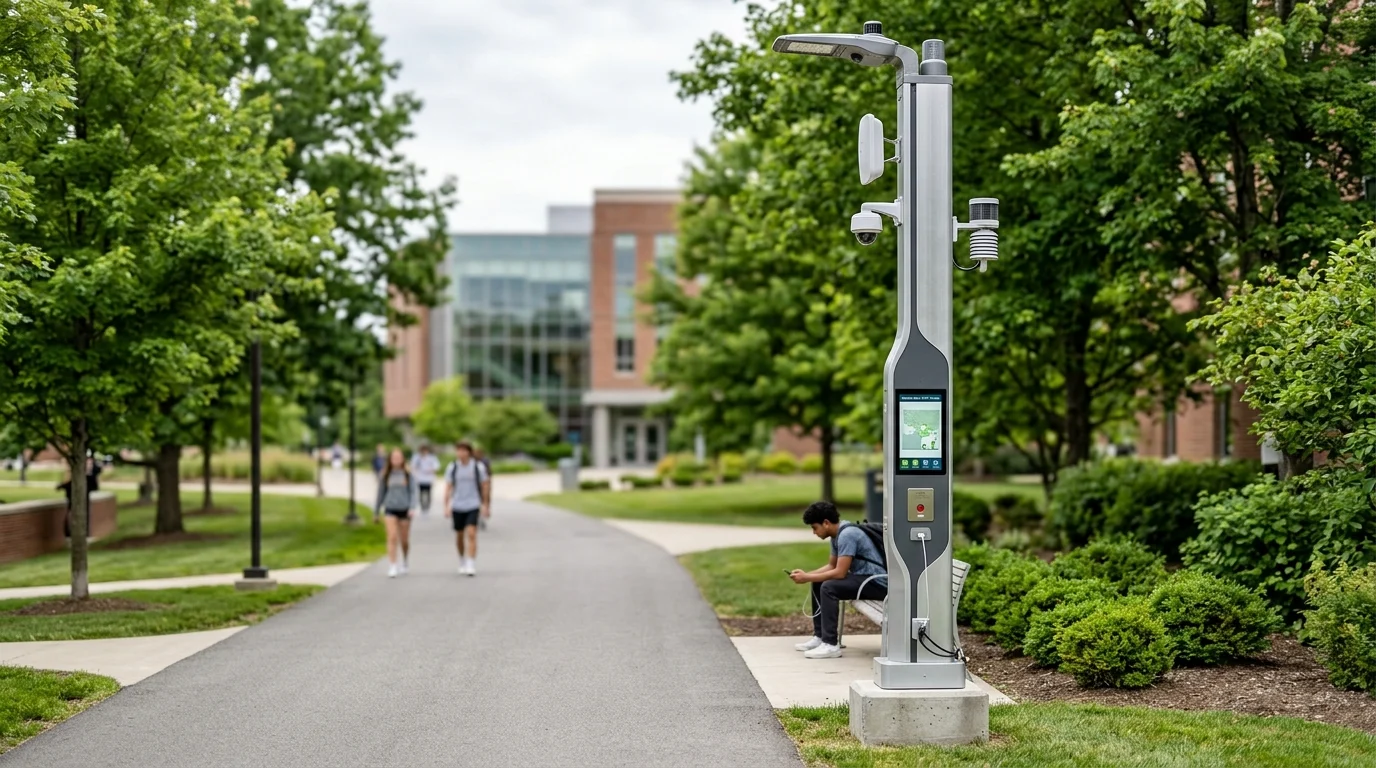
Across campuses, lighting infrastructure is becoming a practical platform for safety, communication, and connectivity. A smart campus light pole does more than illuminate walkways: it can combine emergency help access, public address functions, cameras, Wi-Fi, and sensors in one managed asset. This article explains why that consolidation matters, how it supports faster incident response and clearer campus-wide communication, and where it can reduce installation complexity, clutter, and operating costs. It also sets up the technical and planning considerations behind deploying poles that serve both everyday operations and critical moments.
Why Smart Campus Light Poles Are Strategic Infrastructure
Modern educational and corporate campuses are rapidly transitioning away from single-function infrastructure. The smart campus light pole has emerged as a cornerstone of this transformation, consolidating disparate systems into a unified, vertical asset. By integrating emergency help points, public address capabilities, and environmental sensors, these structures eliminate redundant cabling and civil works.
Facility managers and urban planners increasingly view these poles as the physical backbone for campus Internet of Things (IoT) deployments. Consolidating four distinct physical assets—lighting, security cameras, Wi-Fi access points, and emergency call boxes—into a single smart pole can reduce infrastructure footprint and visual clutter by up to 75 percent, while centralizing power and network distribution.
How smart campus light poles combine lighting and connectivity
The fundamental advantage of a smart campus light pole lies in its ability to simultaneously provide high-efficiency illumination and high-bandwidth connectivity. Traditional high-pressure sodium or early-generation LED fixtures are replaced with network-controlled luminaires that adjust brightness based on ambient light sensors or pedestrian movement, yielding significant energy savings.
Beyond illumination, the pole serves as a dense connectivity hub. By housing 5G small cells, Wi-Fi 6 access points, and LoRaWAN gateways, the pole establishes a ubiquitous wireless canopy across the campus. Fiber optic backhaul routed through the pole’s foundation ensures low-latency data transmission, while Power over Ethernet (PoE) switches securely enclosed within the pole’s base distribute both power and data to top-mounted peripherals.
Which campus use cases justify investment
Investment in smart poles is primarily driven by rigorous safety and communication mandates. The integration of emergency help points—often featuring prominent blue light indicators and single-button SIP intercoms—provides students and staff with immediate access to security personnel. Historical campus data indicates that widely distributed, highly visible emergency points can reduce incident response times from an average of four minutes to under 90 seconds.
Public address (PA) systems integrated into the poles further justify the capital expenditure by enabling zoned or campus-wide emergency broadcasting. During critical events, synchronized strobe lights, directional audio alerts, and high-definition pan-tilt-zoom (PTZ) cameras function cohesively to manage crowd movement and provide situational awareness to first responders. Furthermore, environmental sensors monitoring air quality and noise levels offer actionable data for campus sustainability initiatives.
What Technical Specifications and Design Choices Matter Most
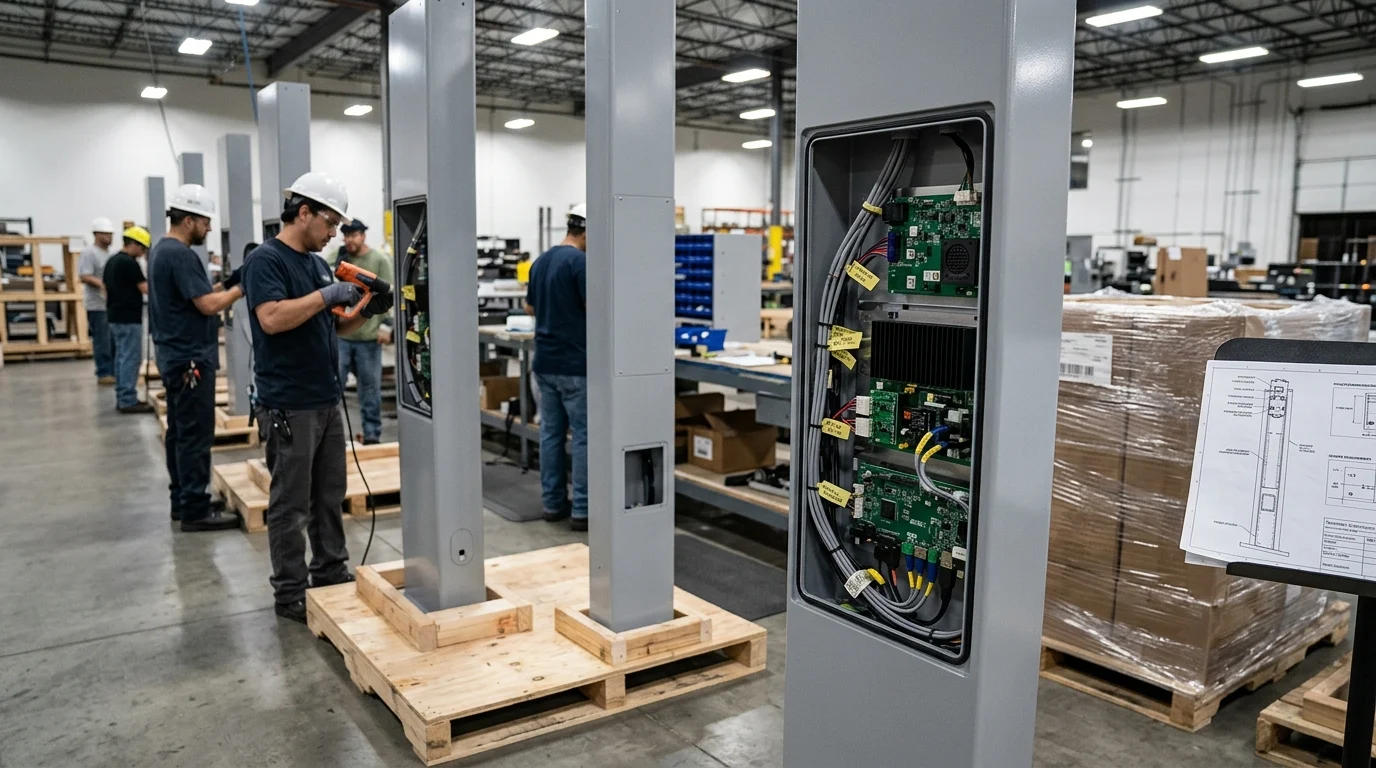
Procuring smart campus light poles requires stringent evaluation of physical resilience, thermal management, and electrical architecture. Because these poles house sensitive telecommunications and security equipment alongside high-output LEDs, the engineering specifications must far exceed those of traditional lighting infrastructure.
Which hardware, software, and integration requirements matter
The physical enclosure of a smart pole must withstand severe environmental stressors while maintaining aesthetic integration with the campus environment. Extruded aluminum alloy is the industry standard, providing high tensile strength and superior heat dissipation for internal active electronics. Enclosures housing delicate networking gear must meet a minimum IP66 rating for dust and water ingress protection, alongside an IK10 rating to resist vandalism and blunt force impacts.
Software integration is equally critical. A proprietary, siloed management platform severely limits the utility of a smart pole. Specifications must mandate open APIs and support for standard protocols like MQTT or ONVIF, allowing the pole’s integrated systems to interface seamlessly with the campus’s existing Central Management System (CMS) or Video Management System (VMS).
| Feature | Standard Light Pole | Smart Campus Light Pole |
|---|---|---|
| Material | Spun Concrete / Steel | Extruded Aluminum Alloy |
| Ingress/Impact | IP65 / IK08 | IP66 / IK10 (Equipment nodes) |
| Power Capacity | 50W – 100W (Lighting only) | 300W – 600W+ (Lighting + IoT) |
| Data Backhaul | None | Fiber Optic / Gigabit Ethernet |
| Wind Load Rating | 90 mph | 120 – 150 mph (EPA adjusted) |
How to compare power, communications, and control architecture
The electrical architecture of a smart pole must account for diverse voltage requirements. While the primary feed may be standard AC mains (120V/277V), internal power distribution units (PDUs) must reliably step down and convert power to DC for various IoT payloads. Engineers typically specify a power budget that reserves 150W to 300W exclusively for auxiliary devices, ensuring that the addition of a high-draw PTZ camera or 5G radio does not compromise base functionality.
Communications architecture dictates the pole’s reliability during a crisis. A redundant network design is standard practice; primary data routing occurs via hardwired fiber optics, while integrated LTE/5G modems provide failover connectivity. Control architecture should feature edge-computing capabilities, allowing the pole to execute local logic—such as increasing lighting output when the emergency button is pressed—even if the connection to the central server is temporarily severed.
How to Evaluate Compliance, Deployment, and ROI
Transitioning from pilot programs to full-scale deployment requires meticulous planning regarding regulatory compliance, civil engineering logistics, and financial modeling. A successful rollout hinges on selecting vendors capable of meeting strict accessibility codes and navigating complex data privacy landscapes.
Which codes, accessibility, cybersecurity, and privacy rules apply
Physical accessibility and digital security are paramount compliance factors. In the United States, the Americans with Disabilities Act (ADA) mandates that integrated emergency help buttons must be operable with a closed fist and installed at a height between 36 and 48 inches from the finished grade. Visual indicators, such as strobes, must also meet specific candela output and flash rate regulations to accommodate individuals with photosensitive conditions.
On the digital front, the convergence of audio, video, and network access creates a massive attack surface. Cybersecurity specifications must mandate IEEE 802.1X port-based network access control and end-to-end encryption for all IP camera feeds. Furthermore, campuses must establish strict data retention and anonymization policies to comply with privacy frameworks like GDPR or CCPA, particularly concerning the deployment of facial recognition or MAC address tracking via Wi-Fi access points.
What deployment steps, cost drivers, and vendor criteria matter
Deployment involves significant civil works, including trenching for power and fiber, pouring reinforced concrete foundations, and executing
Key Takeaways
- The most important conclusions and rationale for Smart Campus Light Pole
- Specs, compliance, and risk checks worth validating before you commit
- Practical next steps and caveats readers can apply immediately
Frequently Asked Questions
What functions can a smart campus light pole combine?
It can combine LED lighting, emergency help points, public address speakers, cameras, Wi-Fi/5G, and environmental sensors in one pole to reduce footprint and cabling.
Why are emergency help and PA systems important on campus poles?
They improve safety by enabling fast security contact and clear zoned or campus-wide alerts during incidents, helping reduce response time and guide movement.
Which specifications should buyers check first?
Focus on material, IP66 protection, IK10 impact resistance, power capacity, thermal design, wind-load rating, and support for open protocols like MQTT or ONVIF.
Can Morelux customize smart campus light poles for project requirements?
Yes. Morelux supports custom steel or aluminum pole solutions with technical drawings, engineer support, and manufacturing tailored to campus safety and connectivity needs.
How fast can Morelux provide a quote for a smart pole project?
For many project inquiries, Morelux aims to provide a fast quote within 24 hours, helping sourcing teams compare options and move procurement forward quickly.