Introduction
Busy container yards depend on fast, accurate identification of vehicles, chassis, and containers, yet scattered hardware often creates blind spots and maintenance complexity. A port logistics smart pole addresses this by combining RFID yard control with cameras, lighting, edge processing, and wireless backhaul in one coordinated asset. This article explains how that integrated setup improves real-time visibility, supports faster gate and yard decisions, and reduces common bottlenecks such as missed reads, manual checks, and infrastructure sprawl. It also sets up the practical role smart poles play in connecting field-level data to terminal operating systems for more reliable port operations.
Why Port Logistics Smart Poles Matter
Modern maritime terminals require unprecedented visibility to manage high-throughput container yards effectively. Port logistics smart poles have emerged as critical infrastructure, transforming passive lighting structures into active data-collection nodes.
By consolidating multiple sensory and communication modalities into a single vertical asset, terminal operators can achieve real-time yard control without deploying redundant cabling and mounting hardware across sprawling terminal footprints.
How smart poles combine RFID, cameras, lighting, and connectivity
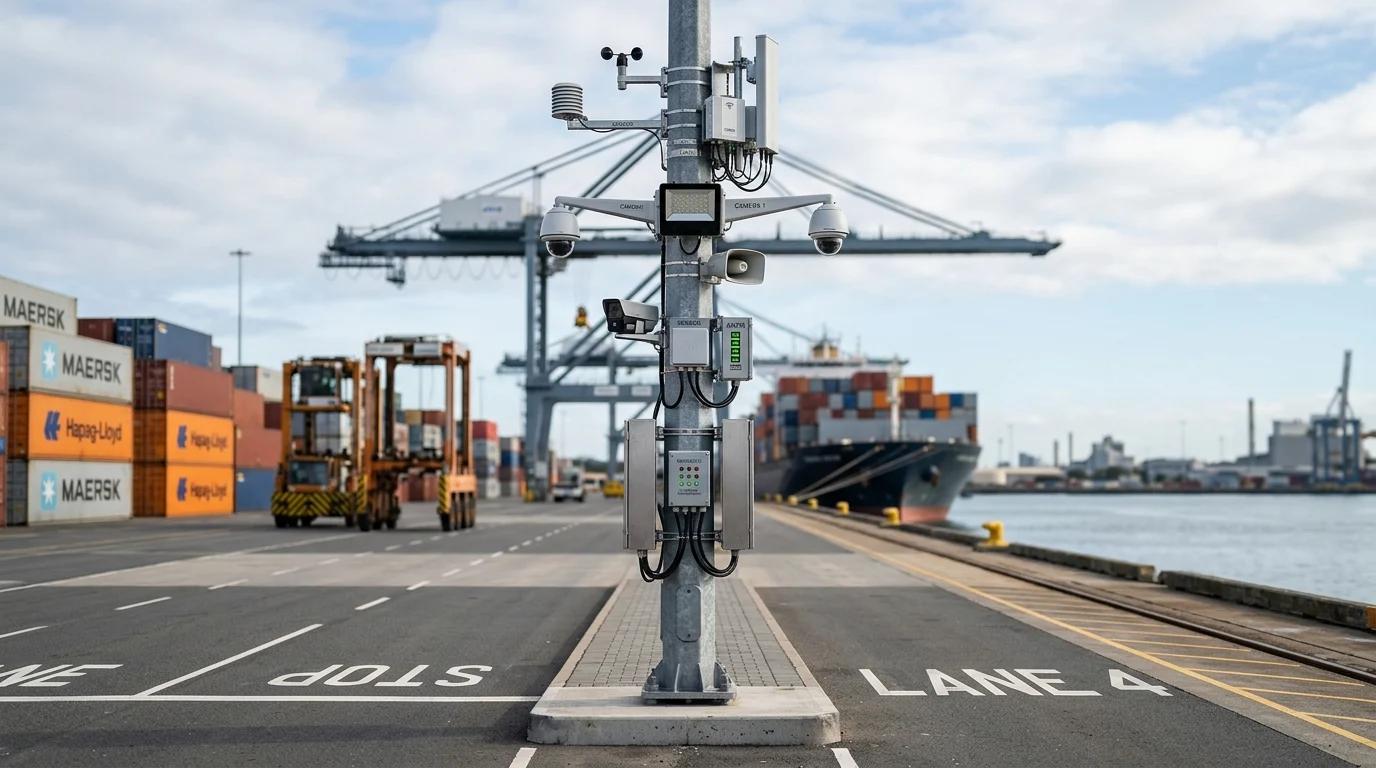
The architecture of a port logistics smart pole integrates several discrete systems into a unified platform. At the core is ultra-high-frequency (UHF) RFID operating within the 860–960 MHz band, capturing tag data from passing utility tractor rigs (UTRs) and chassis.
This technology is paired with high-definition optical character recognition (OCR) cameras and pan-tilt-zoom (PTZ) lenses to verify container numbers visually. To illuminate the operational zone, modular LED arrays delivering upwards of 30,000 lumens are integrated, engineered specifically to reduce glare for crane operators. Finally, edge computing modules and high-bandwidth backhaul—typically utilizing 5G millimeter-wave or Wi-Fi 6—process and transmit this multi-layered data back to the central terminal operating system (TOS) with sub-10-millisecond latency.
Which port bottlenecks they help reduce
Deploying these consolidated nodes directly addresses chronic friction points in terminal operations. Traditional yard management relies on manual spotters or fragmented sensor networks, leading to misplaced chassis and extended dwell times.
Smart poles establish continuous visibility zones, allowing operators to track horizontal transport movements seamlessly. Empirical deployments demonstrate that implementing RFID-enabled smart poles at critical yard intersections can reduce gate-to-yard transit delays by up to 35% and decrease the incidence of lost containers to near zero. By automating asset localization, terminals significantly mitigate the cascading delays that typically plague peak-season port logistics.
Technical Specifications and Integration

Transitioning from standard high-mast lighting to intelligent yard control infrastructure demands rigorous attention to technical specifications. Port environments are uniquely hostile, subjecting equipment to constant vibration, saline exposure, and extreme weather.
Which hardware, environmental, and communication specs matter most
Hardware resilience is the foundational requirement for port logistics smart poles. Structural integrity must account for severe coastal weather, necessitating wind load ratings of at least 240 km/h (150 mph). Enclosures housing sensitive edge computing and RFID modules must achieve IP67 or IP68 ingress protection against heavy seas and dust. Furthermore, the metallic structures require C5-M marine-grade anti-corrosion treatments, typically combining hot-dip galvanization with specialized epoxy coatings.
| Specification Category | Standard Yard Infrastructure | Advanced Smart Pole System |
|---|---|---|
| Wind Load Resistance | 160 km/h | 240+ km/h (Hurricane rated) |
| Corrosion Protection | C3 (Standard Industrial) | C5-M (Marine Grade) |
| Data Backhaul | Hardwired Ethernet only | 5G, Wi-Fi 6, Fiber Optic |
| Ingress Protection | IP65 | IP67 / IP68 |
How to evaluate RFID performance and system integration
Optimizing RFID performance within a heavy-metal environment requires precise antenna configuration. Smart poles utilize high-gain, circularly polarized antennas to mitigate multipath reflections caused by stacked steel shipping containers, achieving reliable read ranges of 15 to 20 meters.
Evaluation of these systems relies on read accuracy rates, which must consistently exceed 99.5% even when UTRs are traveling at speeds up to 40 km/h. System integration extends beyond hardware; the edge processing units must filter raw RFID reads to eliminate ghost tags before passing clean, actionable telemetry via RESTful APIs or MQTT protocols directly into modern TOS platforms.
Compliance, Deployment, and ROI
The transition to smart pole infrastructure represents a significant capital expenditure, requiring meticulous planning regarding regulatory compliance, vendor selection, and economic justification. Strategic deployment ensures that the technological benefits translate directly into measurable operational efficiency.
Which regulatory, cybersecurity, safety, and interoperability requirements apply
Deploying radio-frequency and surveillance equipment in critical infrastructure zones necessitates strict adherence to international standards. RFID modules must comply with ISO/IEC 18000-63 (EPC Class 1 Gen 2) to ensure interoperability with global supply chain tags.
Given the sensitive nature of port data, cybersecurity is paramount; edge computing nodes must align with IEC 62443 standards for industrial control systems, utilizing hardware-based encryption and zero-trust network architectures to prevent unauthorized access. Additionally, electrical and structural designs must satisfy local occupational safety mandates, ensuring that maintenance access points do not expose technicians to high-voltage hazards or structural collapse risks.
How to plan deployment, choose suppliers, and measure ROI
Terminal operators typically approach deployment through phased pilot programs, targeting high-traffic choke points before terminal-wide rollout. When evaluating suppliers, procurement teams should expect minimum order quantities (MOQs) of 10 to 20 units for initial pilots, with manufacturing lead times averaging 8 to 12 weeks for custom marine-grade configurations.
Measuring the return on investment (ROI) involves tracking the reduction in manual yard spotter labor, decreased UTR fuel consumption from optimized routing, and increased overall yard throughput. Terminals executing well-integrated smart pole strategies frequently report a comprehensive ROI payback period of 18 to 24 months, driven by double-digit percentage improvements in chassis utilization and container velocity.
Key Takeaways
- The most important conclusions and rationale for Port Logistics Smart Pole
- Specs, compliance, and risk checks worth validating before you commit
- Practical next steps and caveats readers can apply immediately
Frequently Asked Questions
What functions can a port logistics smart pole combine?
It can integrate UHF RFID, OCR/PTZ cameras, LED lighting, edge computing, and 5G/Wi-Fi backhaul on one pole for real-time yard control.
What pole specifications matter most for port yard environments?
Choose marine-grade poles with 240+ km/h wind resistance, IP67/IP68 enclosures, and C5-M anti-corrosion protection for reliable coastal performance.
How far can RFID smart poles reliably read moving yard assets?
With proper antenna design, read range is typically 15–20 meters, and accuracy should exceed 99.5% for tagged vehicles moving up to 40 km/h.
Can Morelux customize port logistics smart poles for RFID yard projects?
Yes. Morelux supports custom steel or aluminum smart pole designs, technical drawings, engineer support, and fast quotes for infrastructure buyers.
How do smart poles connect with a terminal operating system?
Edge devices filter RFID and camera data, then send clean events to the TOS through RESTful APIs or MQTT over fiber, 5G, or Wi-Fi 6.