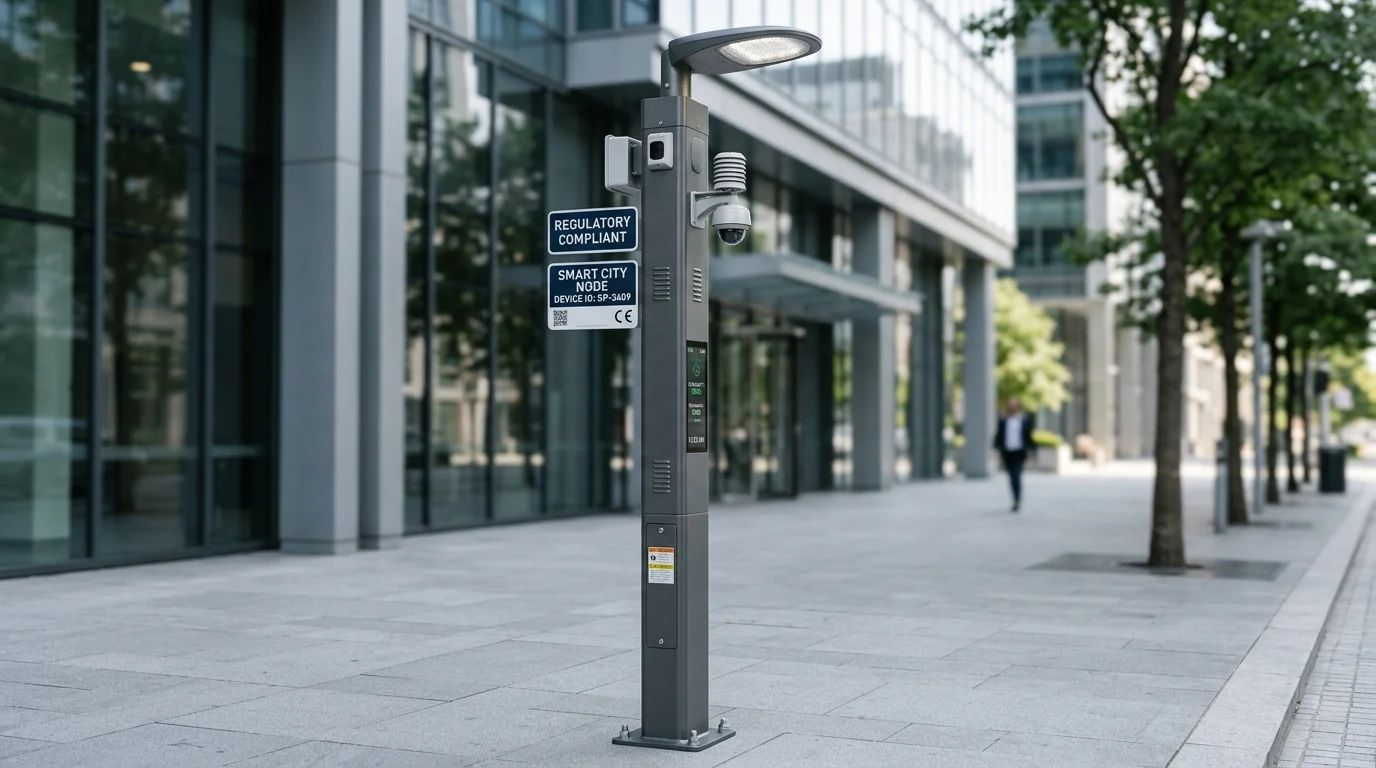
As 5G small cells move onto street-level smart poles, compliance is no longer just a telecom paperwork issue but a core part of safe urban infrastructure deployment. The main challenge is proving that cumulative RF emissions from colocated antennas, Wi-Fi, and IoT equipment remain within EMF exposure limits in spaces used daily by the public. This article explains how smart pole compliance regulation shapes design choices, approval timelines, documentation requirements, and stakeholder coordination across cities, operators, and regulators. It also sets out the practical risks of getting compliance wrong, from delayed permits and redesign costs to legal exposure and weaker public trust, preparing the reader for the regulatory and technical details that follow.
Why Smart Pole Compliance Regulation Is a Strategic Requirement
Integrating high-frequency 5G small cells into municipal street furniture necessitates strict adherence to smart pole compliance regulation. Unlike traditional macro-cell towers isolated from pedestrian traffic, smart poles operate at street level, dramatically altering the spatial relationship between radio frequency (RF) emitting equipment and the public. This proximity elevates electromagnetic field (EMF) safety from a technical afterthought to a foundational strategic requirement governing urban infrastructure deployment. The convergence of telecommunications, municipal lighting, and edge computing within a single physical asset requires a unified approach to regulatory adherence.
Stakeholder demands and approval pressures
Navigating multi-jurisdictional approvals remains a primary bottleneck for telecommunications operators and municipal integrators. Regulatory frameworks dictate stringent timelines for application processing. For example, federal guidelines in various jurisdictions impose strict “shot clocks”—such as 60 days for small cell colocation and 90 days for new smart pole installations. However, these timelines are frequently paused or reset if the applicant fails to provide comprehensive predictive EMF modeling. Stakeholders demand rigorous proof that the cumulative RF exposure from collocated 4G/5G antennas, Wi-Fi access points, and IoT gateways will not exceed localized safety thresholds. When multiple Mobile Network Operators (MNOs) share a single pole, proving that the aggregated emissions remain compliant requires complex, multi-party coordination.
Commercial, legal, and public-acceptance risks
The failure to preemptively address compliance introduces severe commercial and legal vulnerabilities. Public apprehension regarding 5G millimeter-wave (mmWave) exposure frequently leads to community resistance, stalling rollouts and complicating zoning hearings. From a financial perspective, non-compliant installations that necessitate post-deployment physical mitigation—such as altering antenna tilt, reducing transmission power, or applying RF shielding—can incur redesign and retrofitting costs ranging from $15,000 to $25,000 per pole. Furthermore, legal liability escalates if periodic audits reveal that cumulative emissions breach the International Commission on Non-Ionizing Radiation Protection (ICNIRP) baseline public exposure limits, potentially resulting in forced decommissioning of the asset.
Technical and Regulatory Criteria for Smart Pole Compliance
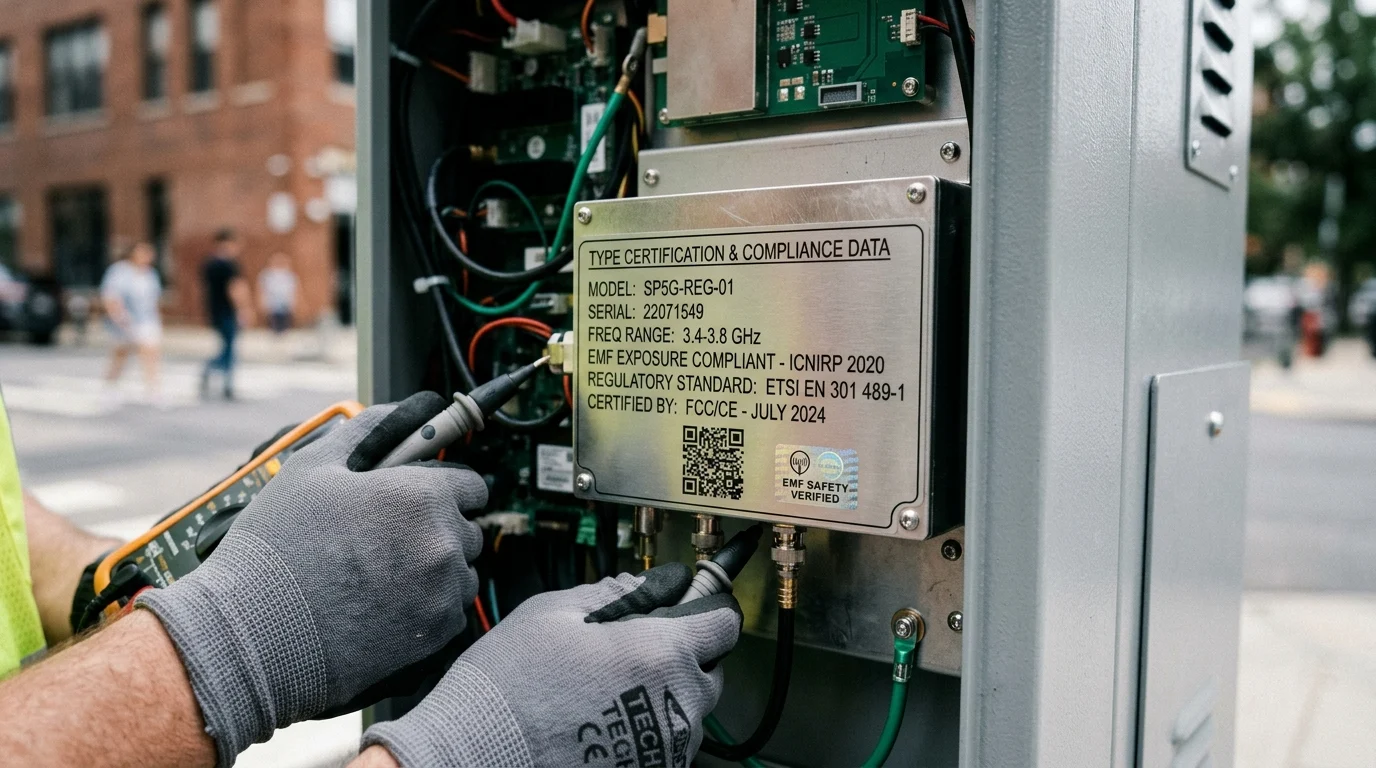
Engineering a legally compliant smart pole requires synthesizing structural, electrical, and telecommunications standards into a unified architectural footprint. The most critical vector of smart pole compliance regulation involves managing the cumulative RF energy emitted by dense, multi-tenant antenna configurations operating within meters of the general public. Accurate quantification of these emissions is essential to satisfy both international guidelines and hyperlocal municipal ordinances.
Comparing EMF, equipment, and permitting requirements
Evaluating compliance necessitates analyzing the interplay between operating frequencies, transmission power, and localized permitting mandates. Modern deployments typically utilize a combination of Sub-6 GHz spectrum for broad coverage and millimeter-wave (mmWave) bands for high-capacity throughput. Regulatory bodies enforce distinct power density limits across these bands.
| Regulatory Body | Frequency Band | General Public Exposure Limit | Occupational Exposure Limit |
|---|---|---|---|
| ICNIRP (2020) | 2 GHz – 6 GHz | 40 W/m² | 200 W/m² |
| ICNIRP (2020) | 24 GHz – 39 GHz (mmWave) | 10 W/m² | 50 W/m² |
| FCC (OET Bulletin 65) | 1.5 GHz – 100 GHz | 1.0 mW/cm² (10 W/m²) | 5.0 mW/cm² (50 W/m²) |
Equipment must be certified to operate within these thresholds dynamically, often requiring hardware power lockouts if multiple carriers collocate on a single structure. Permitting authorities increasingly mandate that site applications include precise spatial mapping of the exclusion zones where these thresholds are mathematically exceeded.
Standards and exposure assessment overview
Exposure assessment methodologies rely on both theoretical modeling during the design phase and empirical validation post-deployment, heavily guided by standards such as IEC 62232. Engineers utilize advanced computational electromagnetics, including finite-element method (FEM) simulations, to calculate spatial power density. For smart poles, the critical assessment boundary is typically the cylindrical volume extending 2 to 4 meters from the radome. If the predictive model indicates that the general public exposure limit extends into pedestrian walkways or adjacent residential windows, the pole design must be structurally or electronically altered. Mitigation strategies include elevating the antenna centerline above 6 meters or implementing software-defined beamforming constraints to nullify emissions directed at sensitive receptors.
Implementing Smart Pole Compliance Across the Project Lifecycle
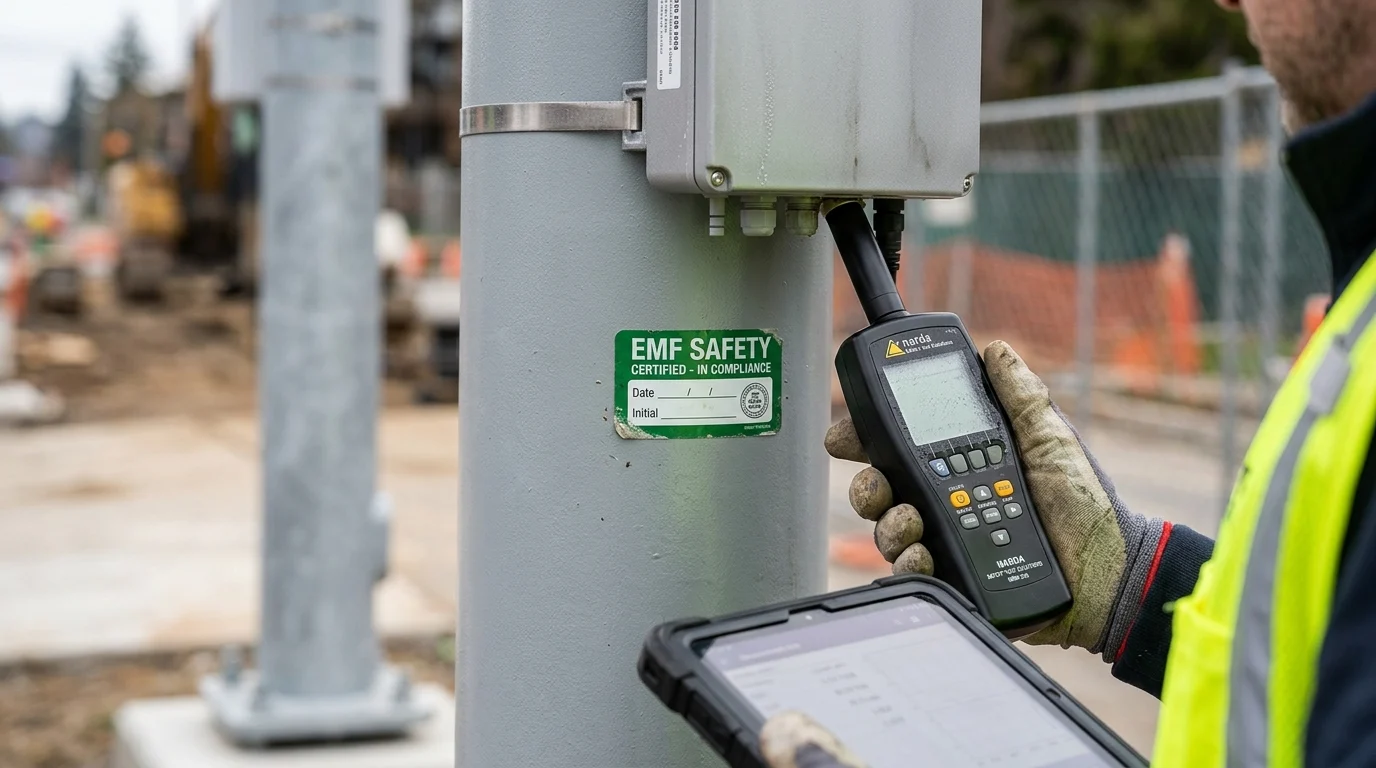
Translating theoretical EMF safety limits into operational reality requires a lifecycle approach to smart pole compliance regulation. Infrastructure providers must embed regulatory checkpoints into every phase, from initial site acquisition and structural engineering to ongoing maintenance and eventual decommissioning. A fragmented approach inevitably leads to operational bottlenecks and costly remediation.
Practical steps for design, permitting, and deployment
The deployment lifecycle begins with a rigorous spatial and RF analysis during the site selection phase. Engineers must establish a baseline of existing ambient RF energy before introducing new 5G small cells to accurately calculate the cumulative effect. During the design phase, integrating concealed antennas within visually unobtrusive radomes must not compromise heat dissipation or alter the calculated EMF propagation patterns. Permitting requires submitting a comprehensive Compliance Assessment Report (CAR). This documentation often mandates a minimum clearance radius—typically requiring antennas to be mounted at least 5.5 to 6 meters above ground level to ensure the occupational and public exclusion zones remain strictly inaccessible. Post-deployment, physical commissioning involves utilizing calibrated broadband field meters to conduct sweep tests, verifying that the actual measured power density aligns with the predictive models submitted during the permitting stage.
Decision criteria for compliance strategies
Selecting the optimal compliance strategy involves evaluating the trade-offs between capital expenditure (CAPEX) and operational expenditure (OPEX), as well as the choice between passive and active mitigation.
Key Takeaways
- The most important conclusions and rationale for smart pole compliance regulation
- Specs, compliance, and risk checks worth validating before you commit
- Practical next steps and caveats readers can apply immediately
Frequently Asked Questions
What documents are usually required for smart pole EMF compliance approval?
Most authorities expect predictive EMF modeling, antenna specifications, power levels, equipment certifications, pole drawings, and exclusion-zone mapping before permit review.
How can a smart pole design reduce 5G EMF compliance risk?
Raise antenna height, control tilt and beamforming, separate public access areas, and verify cumulative emissions from all collocated radios early in design.
Why is cumulative RF analysis important on multi-tenant smart poles?
Because 4G, 5G, Wi-Fi, and IoT radios on one pole can combine exposure levels. Authorities often review total emissions, not each device separately.
Can Morelux support custom smart pole compliance preparation?
Yes. Morelux can provide custom pole drawings, engineering support, and manufacturing coordination to help buyers align pole structure and equipment layout with permit needs.
What happens if a smart pole fails EMF compliance after installation?
You may need antenna retuning, power reduction, shielding, or physical redesign. These fixes can delay activation and add significant retrofit cost per pole.