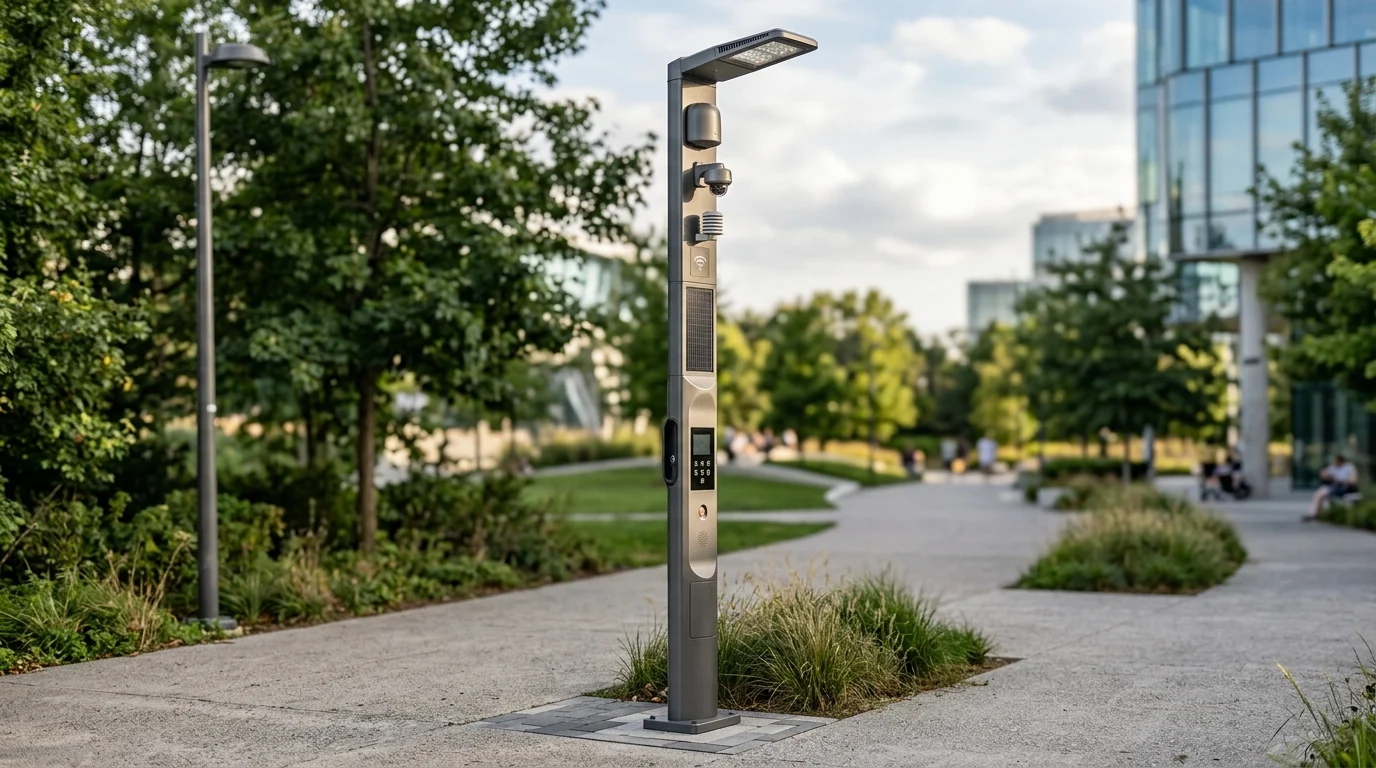
Smart poles can transform ordinary lighting assets into connected platforms for energy management, traffic insight, public safety, and wireless coverage—but only if the pilot is structured with discipline. For cities, utilities, and infrastructure buyers, the early phase is where technical ambition must meet measurable outcomes, controlled budgets, and public trust. A successful deployment starts with a clear operating problem, realistic KPIs, and hardware designed for long-term service rather than short-term experimentation. This guide outlines how to frame, scope, test, and evaluate a smart light pole pilot so decision-makers can move from concept to acceptance with fewer cost overruns, fewer integration surprises, and a stronger path to scalable infrastructure.
Frame the Smart Light Pole Pilot
Initiating a smart light pole pilot project represents a fundamental shift from deploying passive municipal infrastructure to integrating complex, multifaceted IoT ecosystems. For urban planners, utility operators, and systems integrators, these pilot programs serve as the critical proving ground for technologies that will eventually span entire city grids. A poorly structured pilot can lead to feature bloat, budget overruns, and stranded assets, while a rigorously framed project establishes scalable blueprints for smart city architecture.
The primary objective is to transition abstract smart city goals into measurable, localized deployments. This requires stakeholders to align on specific technological interventions, establish baseline metrics, and define the boundaries of the pilot before any hardware is procured or installed. By establishing a constrained, data-driven framework—typically spanning 6 to 12 months with a $50,000 to $250,000 initial hardware and integration budget—municipalities and private operators can mitigate the high capital expenditure (CAPEX) risks associated with unproven multi-tenant infrastructure.
Define the operational problem
Project leaders must isolate a specific, measurable urban challenge rather than deploying technology for its own sake. Operational problems must be quantified. For instance, a municipality might aim to reduce street lighting energy consumption by a targeted 40% to 60% through adaptive dimming, or a telecommunications provider may need to address specific 5G millimeter-wave (mmWave) dead zones in a high-density commercial district.
Other operational problems might include high crime rates necessitating video analytics with sub-20-millisecond processing latency or severe traffic congestion requiring continuous edge-processed intersection monitoring. By clearly defining the operational deficit, project managers can prevent the “Swiss Army knife” syndrome—where a pole is overloaded with disparate, conflicting sensors that degrade overall system reliability. This explicit design constraint against payload creep is vital for maintaining pilot focus.
Set success criteria and risk tolerance
Stakeholders must establish rigid success criteria and define acceptable risk thresholds early in the planning phase. Success criteria should encompass technical performance, financial viability, and operational efficiency. Industry benchmarks typically target technical KPIs such as achieving 99.9% network uptime, ensuring API payload delivery under 50 milliseconds, and maintaining sensor calibration accuracy within a 2% margin of error over a six-month period.
Risk tolerance must also account for public perception, cybersecurity, data privacy, and physical infrastructure resilience. Stakeholder communication and public buy-in are frequent stumbling blocks in smart city projects; a pilot might tolerate a 10% to 15% budget variance during installation due to unforeseen subterranean utility conflicts, but fail entirely if residents perceive the poles as unchecked surveillance tools. Municipalities must address potential data ownership disputes with telecom operators and define parameters for community engagement upfront. Documenting these parameters allows evaluators to objectively grade the pilot’s performance rather than relying on subjective post-deployment impressions.
Define Pilot Scope

Defining the physical and functional scope controls costs, as adding high-draw payloads or complex backhaul requirements exponentially increases the baseline cost per pole. This phase involves selecting the hardware payloads, identifying optimal deployment locations, and determining the structural and electrical requirements necessary to support the chosen technologies.
Select minimum viable functions
Selecting the minimum viable functions (MVF) is essential to manage power and data bandwidth budgets effectively. While modern smart poles can host dozens of modules (often supporting 50 to 150 lbs of total payload capacity), a pilot should restrict its initial payload to core functions that directly address the defined operational problem. Essential modules typically include a smart LED luminaire (managed via a NEMA or Zhaga receptacle), environmental sensors (PM2.5 and NO₂), and a foundational connectivity module (Wi-Fi 6 or a 4G/5G small cell).
Advanced functions, such as Level 2 EV charging (typically drawing 7.2 kW to 22 kW) or high-resolution pan-tilt-zoom (PTZ) cameras with edge-AI processing, should only be included if they are central to the pilot’s success criteria. Restricting non-essential functions simplifies power distribution, manages the thermal load on internal components, and clarifies the data sets required to evaluate the primary use case.
Choose sites, pole types, and power options
Site selection dictates the environmental variables the smart pole will encounter. A pilot should ideally span 5 to 15 locations. This range provides enough statistical variance—capturing different grid conditions, traffic patterns, and environmental stresses—to extrapolate findings for larger deployments without triggering massive capital expenditure. Custom pole extrusions may require a Minimum Order Quantity (MOQ) of 20 to 50 units, making off-the-shelf retrofits preferable for smaller tests. The physical pole type must be selected based on modularity and structural integrity, often utilizing extruded aluminum or galvanized steel with compartmentalized internal channels to separate high-voltage power lines from low-voltage data cables.
Power provisioning is frequently the most limiting factor in scope definition. Traditional streetlights operate on 110V/220V or 277V circuits designed solely for low-draw illumination. If the pilot scope includes telecom small cells or EV charging modules, the site may require retrofitting to support 480V three-phase power. Assessing the existing subterranean grid capacity early prevents costly trenching and utility upgrade delays during installation.
Compare configuration options
Comparing configuration options allows project managers to balance capability against expenditure. The table below outlines standard configuration tiers for smart light pole pilots, illustrating the correlation between payload complexity, power demands, and data backhaul requirements to support decision-making.
| Configuration Tier | Typical Use Case | Primary Payloads | Peak Power Requirement | Est. Data Backhaul Need |
|---|---|---|---|---|
| Basic IoT | Residential streets, parks | LED luminaire, basic weather sensor, photocell | < 150 W | < 10 Mbps (Cellular IoT) |
| Urban Security | High-crime areas, plazas | LED, PTZ Camera, Edge NPU, Public PA system | 300 W – 500 W | 50 – 100 Mbps (Fiber/5G) |
| Telecom Node | Commercial districts | LED, 5G mmWave Small Cell, Wi-Fi AP | 800 W – 1,500 W | 1 – 10 Gbps (Dark Fiber) |
| Transit/EV | Curbside parking, transit hubs | LED, Traffic Radar, Level 2 EV Charger | 7.2 kW – 22 kW | 20 – 50 Mbps (Fiber/5G) |
Selecting the appropriate configuration tier ensures that the foundational infrastructure—specifically the structural foundation, electrical conduit sizing, and data backhaul medium—is appropriately matched to the pilot’s technological ambitions.
Set Technical and Compliance Requirements
Procurement teams should specify rigorous technical and compliance mandates to translate the pilot scope into actionable engineering guidelines. Smart light poles exist at the intersection of municipal infrastructure, telecommunications, and information technology, subjecting them to a complex web of regulatory standards. Failure to adhere to these standards can result in delayed permitting, compromised public safety, or forced removal of non-compliant hardware.
Specify hardware and software interfaces
Teams should standardize hardware and software interfaces to ensure interoperability and prevent vendor lock-in beyond the initial procurement phase. On the hardware side, specifications should mandate modular mounting systems and standardized enclosures rated at IP65 or IP66 for ingress protection against dust and high-pressure water jets. If edge computing is utilized, the specification should dictate the necessary processing power, often requiring a Neural Processing Unit (NPU) capable of at least 5 to 10 Tera Operations Per Second (TOPS) to handle localized video analytics without cloud latency.
Software interfaces require equally strict definition. The central management system (CMS) must ingest data from diverse sensors via standardized API protocols such as RESTful APIs or MQTT. Data payloads should be structured using universal JSON formats. Specifying open architecture and standard protocols ensures that the municipality can swap out defective or obsolete sensor modules in the future without needing to overhaul the entire software backend.
Address electrical, structural, telecommunication, and privacy rules
Compliance spans multiple engineering and legal disciplines across different jurisdictions. Structurally, the pole and its attached payloads must meet regional wind load regulations. Engineers must calculate the Effective Projected Area (EPA) of all attachments to ensure the pole can withstand high-velocity winds, often requiring certification for 120 mph to 150 mph wind zones depending on coastal proximity. Electrically, all components must carry UL, CE, or equivalent regional certifications, and internal wiring must comply with the National Electrical Code (NEC) or local equivalents.
Telecommunications payloads require FCC (US), CE (Europe), or equivalent regional certification to ensure they do not emit harmful RF interference. Furthermore, if the pilot incorporates cameras, audio sensors, or MAC-address tracking for foot-traffic analysis, the deployment must strictly adhere to privacy frameworks such as GDPR (EU), CCPA (California), or APAC equivalents. This typically mandates localized data anonymization—where video frames are processed into metadata at the edge and immediately discarded—ensuring no personally identifiable information (PII) is transmitted or stored.
Compare turnkey vendors and component suppliers
Procuring the infrastructure requires choosing between turnkey vendors and component-level assembly. Turnkey vendors provide a unified, pre-integrated pole with a proprietary CMS. This accelerates deployment timelines and simplifies warranty claims, but vendors may quote premiums of 15% to 35% depending on integration complexity, which can restrict future hardware choices. Conversely, sourcing from multiple component suppliers allows for a highly customized, best-of-breed architecture.
However, the multi-supplier approach shifts the burden of integration and interoperability testing onto the project manager or a contracted systems integrator. For a pilot project, organizations with limited internal IT and engineering resources generally favor turnkey solutions to expedite proof-of-concept, whereas mature municipalities aiming for massive, city-wide scale may prefer a component approach to retain absolute control over the supply chain and long-term lifecycle costs. The table below quantifies the typical trade-offs between these two procurement strategies.
| Sourcing Strategy | Typical Lead Time | Cost Premium | Integration Burden | Est. Early Defect Rate |
|---|---|---|---|---|
| Turnkey Vendor | 12 – 16 weeks | 15% – 35% | Low (Pre-integrated) | < 2% (Factory tested) |
| Component Assembly | 8 – 12 weeks | 0% (Baseline) | High (In-house/SI) | 3% – 5% (Field integrated) |
Install, Test, and Monitor the Pilot
The transition from planning to execution requires synchronized efforts among civil contractors, utility providers, IT network engineers, and municipal inspectors. Installing a smart light pole is significantly more involved than erecting a standard luminaire. Rigorous testing and continuous monitoring during this phase are paramount to validate the pilot’s underlying assumptions.
Manage permitting, installation, and commissioning
Permitting is often the primary bottleneck in the deployment timeline. The duration varies significantly by jurisdiction type, often ranging from 4 to 12 weeks; for instance, historic districts or state DOT-controlled arterials may require extensive reviews, while standard municipal zones might move faster. Project managers should employ parallel-track approval processes to mitigate delays. Once permits are secured, civil works commence. This includes trenching for fiber optics and high-voltage power (averaging $50 to $150 per linear foot), followed by pouring specialized concrete foundations designed to handle the increased moment arm of heavy telecom payloads, which require a curing period of 7 to 14 days.
Commissioning follows the physical erection of the pole. This involves sequential energization, network provisioning, and sensor calibration. Each subsystem must be brought online independently to isolate potential faults. For example, the luminaire controller is configured and tested before the Wi-Fi access point is initialized, ensuring baseline power stability before high-draw network equipment is engaged.
Test lighting quality and connected services
Once commissioned, rigorous functional testing begins. Lighting quality is assessed through photometric testing to ensure compliance with roadway illumination standards (e.g., IES RP-8), verifying that the addition of bulky smart modules has not created dangerous shadow zones or compromised lux uniformity. The adaptive dimming schedules are tested against photocell triggers and centralized CMS commands.
Connected services undergo equally stringent validation. Network throughput and latency are measured during peak load times. A 5G small cell deployment, for instance, must reliably demonstrate throughput and latency that meet standard telecom service level agreements (SLAs), which often target speeds exceeding 500 Mbps and latency under 20 milliseconds. Edge AI cameras are tested for accuracy in object classification, ensuring that vehicle counts or pedestrian tracking metrics align with manual baseline audits (typically targeting >95% accuracy).
Evaluate Readiness for Acceptance
Transitioning from deployment to full-scale implementation requires a rigorous evaluation of the smart light pole pilot. Municipalities and infrastructure stakeholders must measure empirical performance against initial objectives to determine the project’s long-term viability.
Convert pilot results into acceptance criteria
Pilot data provides the foundation for binding Service Level Agreements (SLAs) and procurement standards. As outlined in US Ignite’s Smart Street Light Pilot Project guidelines, cities must systematically assess the utility and upgrade feasibility of the installed infrastructure. When a pilot integrates complex multi-functional payloads—such as EV charging, public Wi-Fi, and security cameras, mirroring the 2019 Budapest smart pole initiative—acceptance criteria must define acceptable system uptime, bandwidth delivery, and thermal management thresholds. Procurement teams must translate these empirical pilot results into strict technical specifications for future vendor contracts.
Assess cost, lifecycle, and ownership models
Scaling a smart light pole network demands a sustainable financial framework. Project managers must evaluate the total cost of ownership (TCO), factoring in hardware longevity, energy savings from LED retrofits, and ongoing maintenance protocols. Structural optimization significantly impacts lifecycle costs; a 2021 performance analysis published by De Gruyter demonstrated that optimized smart light pole designs can reduce structural mass by 14.2% and cut material costs by 14.7%.
Stakeholders must also finalize the operational framework before formal acceptance. Below is a comparison of common ownership models evaluated during pilot phases:
| Ownership Model | Capital Expenditure (CapEx) | Maintenance Responsibility | Revenue Share (Data/Telecom) |
|---|---|---|---|
| Municipally Owned | High | Local Government | 100% Municipality |
| Public-Private Partnership (PPP) | Shared / Moderate | Private Operator | Shared |
| Telecom Leased | Zero (Funded by Operator) | Telecom Operator | Retained by Operator |
Decide whether to scale, revise, or stop
The final evaluation dictates the project’s operational trajectory based on three distinct paths:
- Scale: If the smart light pole meets all acceptance criteria and demonstrates a verifiable return on investment—similar to successful integrations seen in recent Ameresco retrofit pilots—the project graduates to city-wide procurement and deployment.
- Revise: If specific modular components (e.g., environmental sensors or edge computing nodes) underperform or create integration bottlenecks, engineers must alter the hardware specifications, adjust the software architecture, or change vendors before expanding.
- Stop: If the pilot reveals critical structural vulnerabilities, unresolved data privacy compliance issues, or a TCO that drastically exceeds initial projections, halting the initiative is necessary to prevent compounding municipal losses.
Key Takeaways
- Define one measurable operational problem, such as energy reduction, mmWave coverage gaps, traffic monitoring, or public safety, before selecting smart pole hardware.
- Use a constrained 6- to 12-month pilot with a defined budget range of $50,000 to $250,000 to reduce CAPEX risk before citywide rollout.
- Set technical KPIs early, including 99.9% network uptime, API delivery under 50 milliseconds, and sensor accuracy within a 2% margin over six months.
- Limit payload creep by avoiding unnecessary sensors or conflicting technologies that increase power demand, integration complexity, and maintenance risk.
- Address public perception, cybersecurity, privacy, and data ownership before procurement so the pilot can be evaluated objectively after deployment.
Frequently Asked Questions
What is the ideal duration for a smart light pole pilot?
Most pilots should run 6 to 12 months, giving teams enough time to test uptime, sensor accuracy, energy savings, public feedback, and maintenance workflows before scaling to a wider deployment.
How should project teams define success before installation?
Set measurable KPIs upfront, such as 99.9% network uptime, API delivery under 50 milliseconds, 40% to 60% lighting energy reduction, or sensor calibration within a 2% error margin.
Why is scope control important in a smart pole pilot?
Adding too many sensors, radios, or high-draw devices can increase cost, power demand, integration complexity, and failure risk. A focused pilot prevents payload creep and produces clearer results.
What budget range is typical for an initial smart pole pilot?
A constrained pilot often starts with a hardware and integration budget of about $50,000 to $250,000, depending on pole quantity, sensors, connectivity, power requirements, and civil works.
What risks should cities evaluate before launching a pilot?
Key risks include cybersecurity, data privacy, public perception, utility conflicts, weather resilience, data ownership, and long-term maintenance responsibility. These should be documented before procurement.