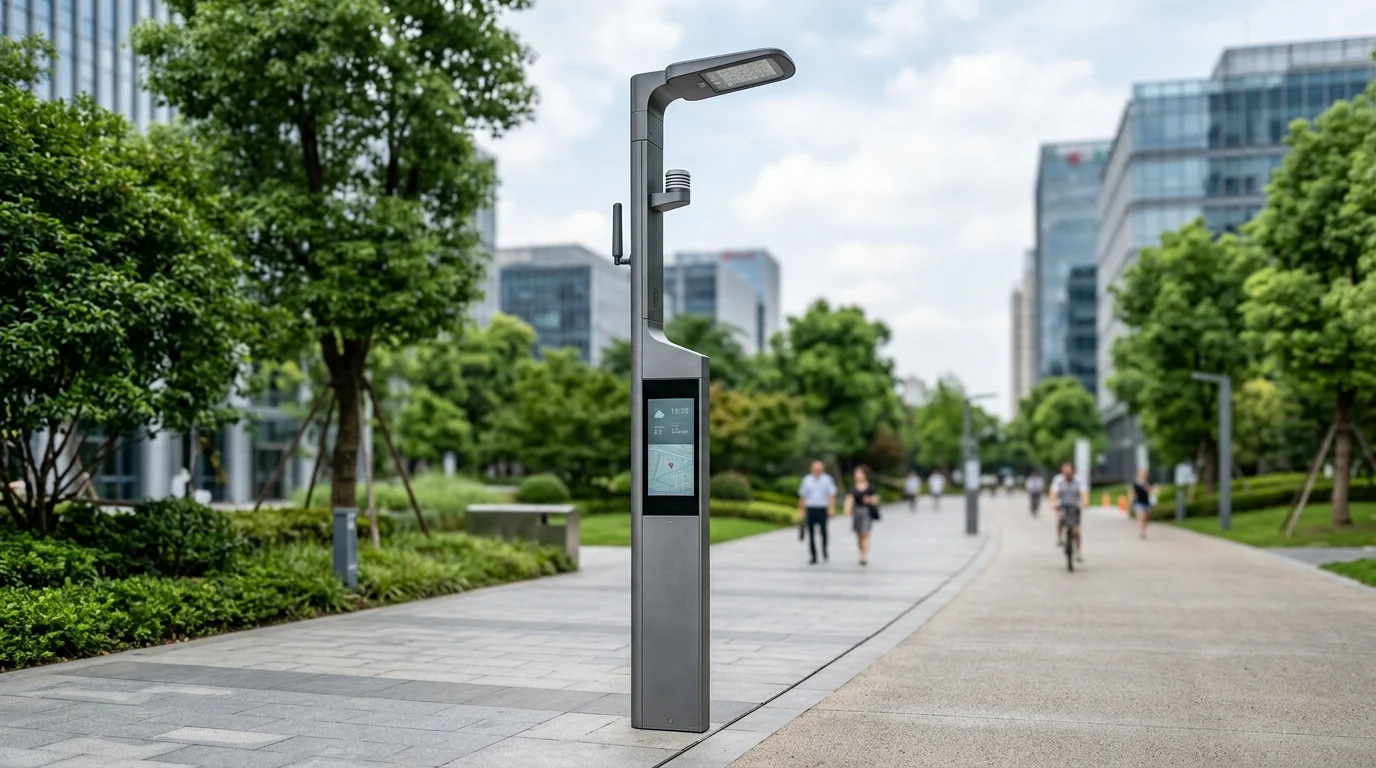
Cities are under pressure to deliver safer streets, cleaner mobility, stronger connectivity, and better public services without filling sidewalks with more hardware. Multi-function lighting infrastructure offers a practical path forward by turning a familiar asset—the street pole—into a shared platform for LEDs, sensors, telecom equipment, cameras, EV charging, and data networks. For municipalities, developers, and infrastructure buyers, the value is not just technical; it is financial and operational. A well-engineered pole can reduce duplicate installations, simplify maintenance, support new revenue models, and improve streetscape design. This article explains the capabilities, use cases, commercial benefits, and planning considerations behind this fast-growing category of urban infrastructure.
Why Smart Light Poles Matter
The transition toward shared urban infrastructure has positioned the traditional streetlight as an underutilized municipal asset. Smart light poles represent a major evolution in urban planning, combining up to 6 to 8 distinct hardware systems into a single, unified structure. By transforming passive illumination structures into active digital nodes, municipalities and private developers can drastically reduce street-level clutter while unlocking new revenue streams and operational efficiencies.
Definition and Core Capabilities
At their core, smart light poles are multi-tenant infrastructure assets—typically ranging from 6 to 12 meters in height—designed to house lighting, telecommunications, and IoT equipment within a cohesive, aesthetic chassis. Unlike legacy poles engineered solely to support a luminaire, these advanced structures feature modular compartments, integrated thermal management, and robust power distribution systems capable of supporting dynamic payloads of 50 to 150 kg.
Core capabilities extend far beyond adaptive LED illumination. Modern smart poles function as edge computing nodes, providing the physical housing and high-speed backhaul required for next-generation urban connectivity. By integrating modular rails and standardized mounting brackets, these poles can achieve an estimated 40% reduction in visual street clutter by eliminating the need for separate telecom masts, traffic camera stanchions, and environmental monitoring stations.
Key Use Cases Across Cities and Utilities
The utility of smart light poles spans multiple municipal and commercial sectors. For city administrators, they serve as the backbone for intelligent transportation systems (ITS), supporting license plate recognition (LPR) cameras and traffic flow sensors that optimize signal timing. In public safety applications, integrated emergency call buttons and public address systems provide on-site crisis management capabilities.
Utilities and energy providers leverage these structures to expand decentralized infrastructure. A prominent use case is the integration of Level 2 electric vehicle (EV) charging stations directly into the pole base. Capable of delivering between 7 kW and 22 kW of power, these integrated chargers utilize existing municipal grid connections to provide curbside charging solutions without requiring additional real estate or extensive trenching. However, municipalities must carefully evaluate site selection, as early deployments have frequently experienced lower-than-projected EV charger utilization rates (often hovering between 5% and 15% in the first two years of operation).
Commercial Problems They Solve
Deploying isolated infrastructure for lighting, telecom, and security creates redundant capital expenditures (CAPEX) and complex maintenance workflows. Smart light poles address these financial hurdles by introducing a shared-infrastructure model that significantly reduces the total cost of ownership (TCO)—often estimated at 15% to 25% over a 10-year horizon—for smart city initiatives.
Furthermore, these poles address the persistent challenge of municipal infrastructure funding through innovative financial mechanisms. By leasing internal compartment space and radome access to telecommunications operators for 5G micro-cell deployments, municipalities can generate recurring revenue. This monetization strategy effectively transforms a historical cost center into a self-sustaining asset. While industry estimates suggest a favorable payback period of 5 to 8 years, independent verification is limited. Real-world deployments often face operational challenges, including difficult negotiations with telecom carriers and instances of failed monetization where projected lease revenues do not materialize.
Technical Architecture for Reliable Deployment

Deploying a network of smart light poles requires a rigorous technical architecture that balances structural physics with advanced digital connectivity. The convergence of high-voltage power distribution, sensitive microelectronics, and continuous environmental exposure demands a highly engineered approach to physical and digital design.
Pole, Foundation, and Power Requirements
The physical foundation and structural integrity of a smart pole dictate its operational viability. Because these poles carry significantly higher wind loads than standard streetlights—often housing bulky telecom antennas and multiple camera arrays—they must be engineered to withstand severe weather events. High-grade aluminum or galvanized steel extrusions are standard. Structural ratings frequently require tolerance for wind speeds up to 150 mph (240 km/h), depending on the regional environmental profile.
Power architecture is equally critical. A standard streetlight requires minimal amperage (typically 0.5 to 1.5 amps), but a fully loaded smart pole demands robust electrical provisioning. The internal power distribution unit (PDU) must seamlessly manage AC mains power for EV charging and luminaires, while providing precise DC conversion for sensitive IoT and telecom payloads (often drawing 30 to 50 amps or more if EV charging is active). Foundations must be engineered not only for structural moment capacity but also to accommodate oversized conduit sweeps for both heavy-gauge power lines and dedicated fiber optic backhaul.
IoT Sensors, Cameras, and Environmental Monitoring
The sensory layer of the pole relies on an edge-based local area network (LAN), typically utilizing Power over Ethernet (PoE) to deliver both data and electricity to peripheral devices. Advanced smart poles support the IEEE 802.3bt standard, delivering up to 90W per port to power pan-tilt-zoom (PTZ) cameras, edge AI processors, and sophisticated environmental sensor arrays.
Environmental monitoring modules integrated into the pole structure track micro-environmental data, including particulate matter (PM2.5 and PM10), nitrogen dioxide (NO2), temperature, and humidity. Because these sensors are highly sensitive to thermal interference, the pole’s architecture must isolate heat-generating components, such as power supplies and 5G radios, from the environmental sampling intakes to ensure data accuracy, requiring recalibration cycles typically every 12 to 18 months.
Interoperability and Cybersecurity Requirements
For a smart pole network to function cohesively, strict adherence to interoperability protocols is mandatory. Hardware components typically utilize standardized interfaces, such as the 7-pin NEMA ANSI C136.41 socket or the newer Zhaga Book 18 specification, ensuring that controllers and sensors from disparate vendors can interface seamlessly with the pole’s central management system.
Cybersecurity forms another critical pillar of the technical architecture. Because smart poles act as networked nodes with direct access to municipal data streams, they represent potential attack vectors. Enterprise-grade deployments require end-to-end encryption, typically utilizing AES-256 standards, secure boot mechanisms for edge computing devices, and compliance with frameworks like the TALQ Consortium standards. Furthermore, edge computing modules must meet strict latency requirements (often <10ms for real-time traffic applications). However, practical implementation remains complex; municipalities must ensure they have the IT capacity for managing encryption keys at scale and mitigating supply chain vulnerabilities.
Beyond technical cybersecurity, data governance and public acceptance present significant hurdles. Deploying surveillance cameras and environmental sensors often raises valid citizen concerns regarding privacy, facial recognition, and data ownership. Municipal decision-makers must establish transparent data policies detailing what information is collected, who controls it, and how long it is retained before finalizing any smart pole deployment.
Smart Light Poles vs Conventional Streetlights
Evaluating smart light poles against conventional streetlights requires a fundamental shift in how urban infrastructure is valued. While conventional lighting serves a single, static purpose, smart poles are dynamic assets that alter the financial and operational calculus of urban planning.
Cost, Performance, and Functionality Comparison
The initial procurement cost of a smart light pole is undeniably higher than that of a conventional streetlight. However, this upfront premium buys exponentially greater functionality and long-term value. Note that precise CAPEX figures are indicative ranges and vary significantly based on geographic region, currency, and specific hardware configurations.
| Metric | Conventional Streetlights | Smart Light Poles |
|---|---|---|
| Initial Unit CAPEX | $500 – $1,500 | $3,000 – $8,000+ |
| Primary Function | Illumination | Illumination, Telecom, IoT, EV Charging |
| Typical Power Draw | 30W – 100W | 100W – 22kW+ (with EV charging) |
| Revenue Generation | None | High (Telecom leasing, EV charging fees) |
| Energy Efficiency | High (if LED) | High (LED + adaptive dimming controls) |
| ROI Timeline | N/A (Sunk Cost) | 5 to 8 Years (Dependent on tenant leases) |
Performance-wise, smart poles leverage adaptive dimming based on pedestrian or vehicular traffic detected by integrated sensors, yielding further energy savings over standard photocell-controlled LED fixtures. The functionality leap transforms a static light source into a multi-purpose utility node. Financial models must also account for ongoing software licensing costs and data backhaul fees, which can erode projected returns if not carefully managed.
Where Modular Poles Outperform Single-Purpose Infrastructure
Modular smart poles significantly outperform single-purpose infrastructure in dense urban environments where spatial efficiency is critical. In a traditional streetscape, a municipality might require a streetlight, a separate mast for a traffic camera, a standalone telecom small cell, and a dedicated EV charging pedestal. Each of these requires its own permitting, trenching, grid connection, and concrete foundation.
By combining these functions, modular poles eliminate redundant site works, saving an estimated 2 to 3 square meters of pedestrian space per consolidated node. The modular design allows specific payloads to be swapped or upgraded without replacing the entire structural asset. For example, as 5G technology evolves into 6G, the telecom payload housed in the pole’s radome can be upgraded independently, maintaining the asset’s relevance and maximizing spatial efficiency on crowded sidewalks.
Lifecycle Cost, Upgrades, and Asset Ownership
Analyzing the lifecycle cost reveals the true commercial advantage of smart infrastructure. A conventional streetlight has an operational lifespan of 15 to 20 years, during which it represents a continuous operational expenditure (OPEX) in the form of energy consumption and maintenance, generating zero direct revenue.
Conversely, while a smart pole incurs higher OPEX due to software licensing, data backhaul, and complex maintenance (complex electronics often exhibit a 2% to 5% annual hardware failure rate), its revenue-generating capabilities fundamentally alter its lifecycle economics. Through telecom co-location leases and EV charging tariffs, a smart pole can offset its initial costs, though actual ROI depends heavily on sustained tenant occupancy. Furthermore, multi-tenant poles create complex liability disputes when components from different vendors damage each other or cause system-wide failures. Asset ownership models are evolving; many municipalities now engage in public-private partnerships (PPPs) where a private entity funds the CAPEX in exchange for long-term concession rights to the pole’s telecom and advertising real estate.
Compliance, Sourcing, and Deployment
Transitioning from pilot projects to city-wide deployments requires careful navigation of regulatory compliance, supply chain logistics, and complex installation workflows. Successful execution depends on aligning engineering specifications with local civil codes.
Standards, Permits, and Structural Certifications
Smart light poles must satisfy a dual regulatory framework: structural engineering codes and electronic compliance standards. Structurally, poles deployed in North America generally must comply with AASHTO LTS-6 (Standard Specifications for Structural Supports for Highway Signs, Luminaires, and Traffic Signals), while European deployments adhere to the EN 40 standard for lighting columns. These certifications guarantee the pole’s deflection limits and fatigue resistance under heavy payloads.
Electronically, the integrated systems must meet stringent safety and electromagnetic compatibility standards, such as CE or UL certifications. Equipment enclosures must typically meet IP65 or IP66 ratings for water and dust ingress, alongside IK08 to IK10 ratings for impact resistance. Furthermore, deploying telecommunications equipment mandates compliance with federal spectrum regulations (e.g., FCC in the United States), requiring precise documentation of radio frequency (RF) emissions and antenna placement heights to secure municipal deployment permits.
Vendor Prequalification and Procurement Steps
Procuring smart poles requires rigorous vendor prequalification, as the market includes both established infrastructure conglomerates and emerging IoT startups. Buyers must evaluate vendors based on their manufacturing capacity, track record of interoperability, and long-term financial stability to ensure ongoing software support. Standard structural warranties span 5 to 10 years, while integrated electronics typically carry only 1- to 3-year guarantees.
Procurement timelines and minimum order quantities (MOQs) are critical planning factors. Custom aluminum extrusions with specific regional modularity often carry MOQs of 50 to 100 units to justify tooling costs. Furthermore, due to the integration of complex electronics and global supply chain dependencies for microprocessors, lead times for fully integrated smart poles typically range from 12 to 16 weeks from purchase order to site delivery.
Installation, Grid Connection, and Maintenance Planning
The installation phase demands coordination across multiple utility domains. Unlike standard lighting replacements, smart pole deployment often requires extensive subsurface work. Civil works and trenching for high-capacity power lines and dark fiber optic backhaul often add $1,000 to $3,000 per pole in deployment costs.
How to Select the Right Smart Light Poles
Decision Matrix for Technical and Commercial Fit
Selecting the optimal smart light poles requires balancing structural engineering constraints with long-term commercial viability. Because these units act as foundational nodes for shared urban infrastructure, procurement teams must evaluate both physical capacity and modularity.
| Evaluation Criteria | Technical Requirement | Commercial Impact |
|---|---|---|
| Structural Load | Must withstand increased wind and weight loads from connected infrastructure (e.g., 5G small cells, EV chargers). | Prevents premature mechanical failure and reduces liability costs. |
| Modularity | Support for standardized, plug-and-play hardware modules. | Lowers future upgrade costs and extends the overall asset lifecycle. |
| Interoperability | Open API architecture and standardized mounting brackets. | Avoids vendor lock-in and enables competitive bidding for future sensor integrations. |
When to Prioritize Lighting, Connectivity, or Sensors
Urban planners must customize smart light poles based on the specific zoning requirements of the deployment area. Attempting to equip every pole with maximum hardware leads to budget overruns and unnecessary energy consumption.
- Connectivity-Driven Deployments: In high-density commercial districts and transit corridors, prioritize telecommunications. For example, the City of Los Angeles Bureau of Street Lighting pilots smart hub poles featuring Wi-Fi, USB ports, and integrated speaker systems to directly enhance public utility.
- Sensor-Heavy Configurations: Industrial zones, coastal areas, and heavy traffic intersections require robust data collection. Focus on environmental sensors capable of air quality monitoring, weather tracking, and flood detection, alongside CCTV for traffic management.
- Lighting-First Models: In residential neighborhoods, the primary focus remains public safety and energy efficiency. Prioritize adaptive LED lighting with motion sensors, keeping secondary features limited to basic environmental monitoring to minimize visual clutter and citizen privacy concerns.
Procurement and Governance Recommendations
Acquiring smart light poles bridges multiple municipal departments—including public works, IT, and transportation—requiring a unified governance framework.
First, mandate pre-certified hardware in the initial tender. Utilizing plug-and-play modules allows municipalities to deploy foundational infrastructure today while retaining the flexibility to add specialized services as future budgets permit.
Second, establish clear data governance policies before deployment. Because these poles capture sensitive telemetry and surveillance data, strict cybersecurity protocols and public transparency guidelines are mandatory for compliance.
Finally, explore public-private partnerships (PPPs) during the procurement phase. Telecommunications operators will frequently subsidize the capital expenditure of smart light poles in exchange for guaranteed mounting rights for 5G small cells, significantly reducing the upfront financial burden on local governments.
Key Takeaways
- Use smart light poles to consolidate 6 to 8 urban hardware systems into one structure and reduce visual street clutter by up to 40%.
- Specify pole height, payload capacity, power distribution, thermal management, and modular mounting requirements before requesting technical drawings.
- Evaluate EV charging demand before deployment, as early curbside charger utilization can remain around 5% to 15% in the first two years.
- Consider telecom leasing for 5G micro-cell space to create recurring revenue and improve the payback case for smart city infrastructure.
- Plan smart pole projects around lifecycle economics, since shared infrastructure can reduce 10-year total cost of ownership by an estimated 15% to 25%.
Frequently Asked Questions
What makes a smart light pole different from a traditional streetlight?
A smart light pole supports more than illumination. It can integrate LED lighting, telecom equipment, cameras, sensors, EV charging, power distribution, and IoT devices in one engineered structure, reducing the need for separate street-level assets.
How tall are typical smart light poles?
Most smart light poles are designed in the 6 to 12 meter range, depending on roadway type, equipment load, wind requirements, lighting performance, and local project standards.
Can smart poles support 5G and IoT equipment?
Yes. Smart poles can be designed with modular compartments, radomes, mounting rails, backhaul pathways, and thermal management to support 5G micro-cells, IoT sensors, cameras, and edge connectivity devices.
Do smart light poles reduce project costs?
They can reduce the total cost of ownership by consolidating lighting, telecom, safety, and monitoring systems into one shared asset. The article notes potential 10-year TCO savings of 15% to 25%, depending on deployment scale and site conditions.
Can EV chargers be integrated into smart light poles?
Yes. Some designs integrate Level 2 EV chargers into the pole base, typically delivering 7 kW to 22 kW. Cities should assess demand carefully because early utilization may be low in some locations.