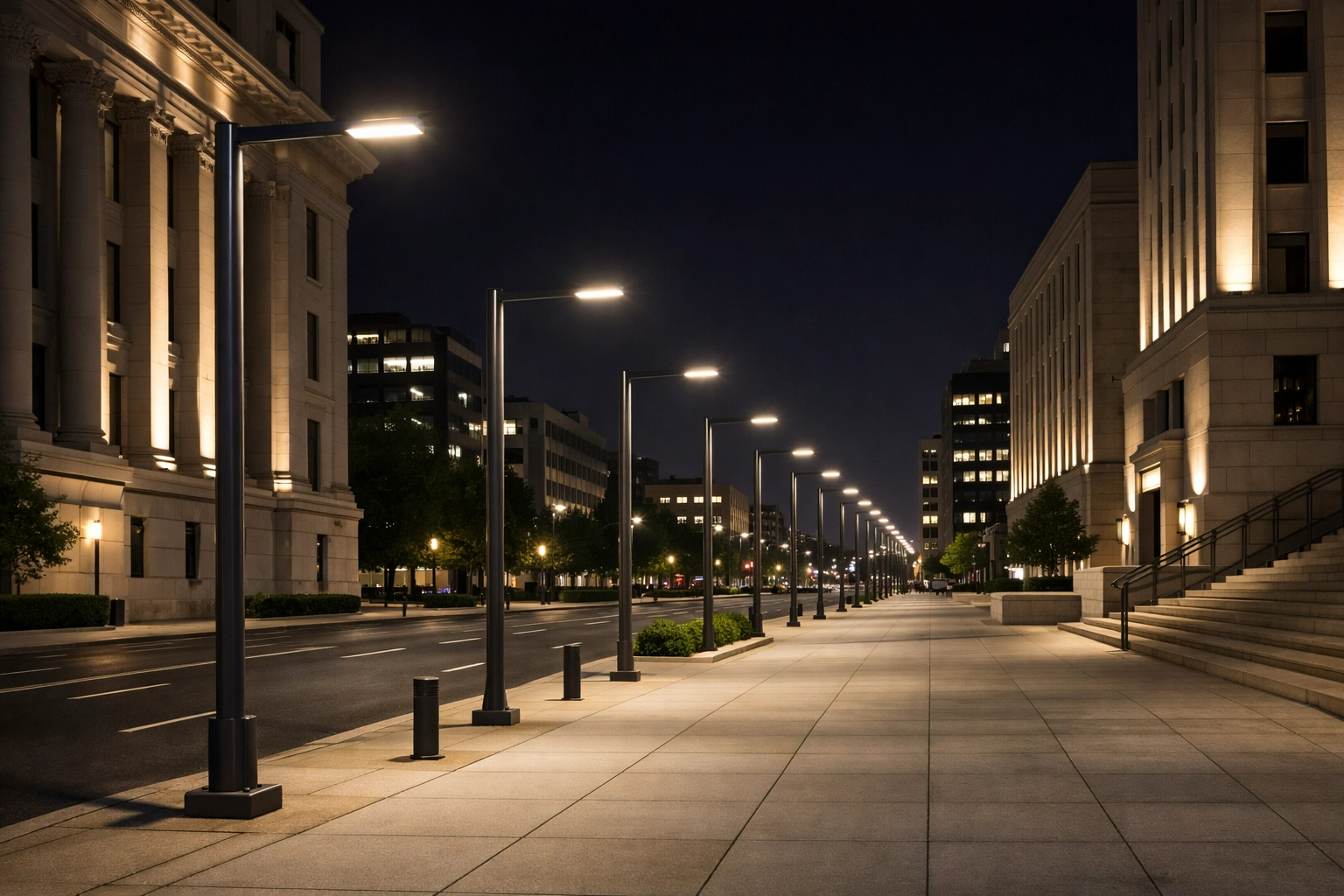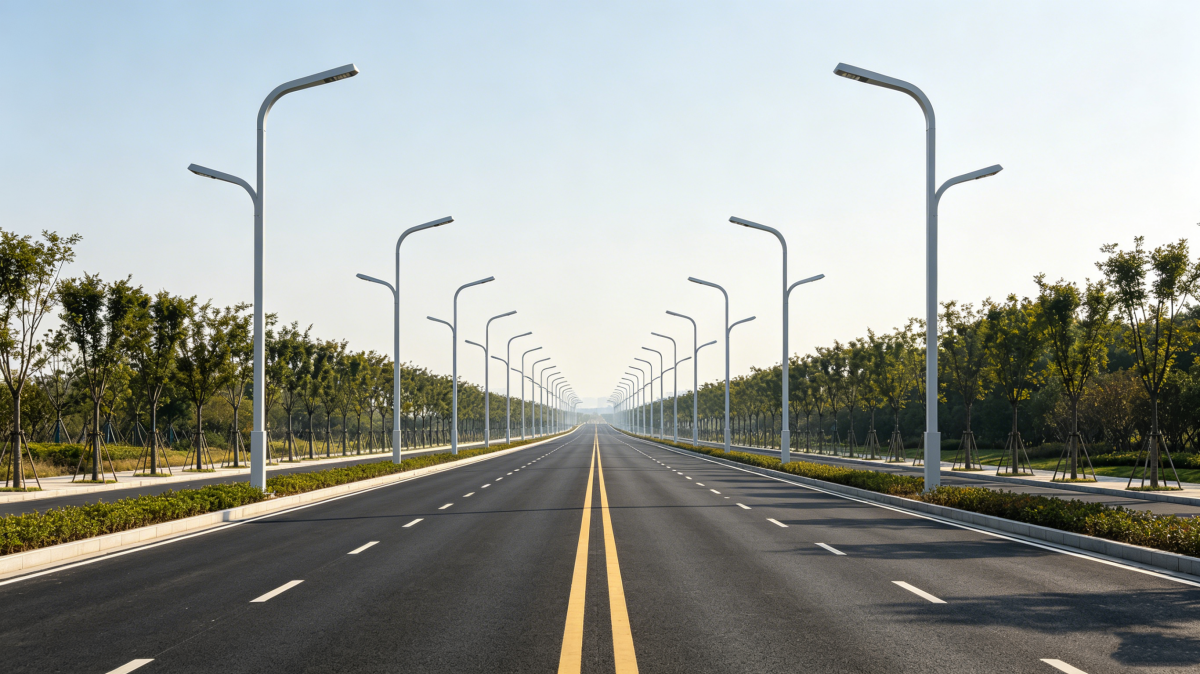
Streetlighting upgrades often focus on LED wattage, but the larger savings opportunity may be hidden in the distance between poles. A layout that is too tight wastes fixtures, materials, and power; one that is too wide can force higher-wattage luminaires and create unsafe dark zones. This article explains how engineers evaluate pole intervals using mounting height, photometric distribution, roadway geometry, uniformity, glare, and safety standards such as IES RP-8-22 and EN 13201. For cities, contractors, and infrastructure buyers, the goal is practical: achieve compliant visibility with the lowest energy density and a pole solution that can be manufactured, documented, and delivered reliably.
Why Pole Spacing Matters for Streetlight Energy
Pole spacing is a foundational element of modern municipal lighting design, directly determining both the energy footprint and the visual effectiveness of roadway infrastructure. While the transition to light-emitting diode (LED) technology has reduced baseline power consumption, pole placement is the main variable affecting overall system efficiency.
Finding the right spatial balance ensures lighting networks operate at peak photometric efficiency. This means the maximum amount of generated light reaches the intended target without inflating capital or operational costs. Evaluating these configurations requires moving beyond basic lumen-per-watt metrics to analyze how light actually distributes across the road surface.
How Pole Spacing Should Be Defined
In roadway lighting engineering, pole spacing is the longitudinal distance between adjacent luminaire mounting points along the axis of the road. It is closely linked to luminaire mounting height, forming a spacing-to-height ratio that typically ranges from 3:1 to 5:1 in optimized systems.
For example, a standard 10-meter pole generally dictates an interval of 30 to 50 meters, depending on the luminaire’s photometric distribution. Accurately defining this layout requires a three-dimensional analysis of the right-of-way, factoring in whether the design uses staggered, opposite, median-mounted, or single-sided arrangements.
Why Wider Spacing Does Not Always Save Energy
Planners often assume that maximizing the distance between poles automatically saves energy by reducing the total number of fixtures. However, the relationship between pole distance and energy density is non-linear.
When spacing extends beyond a standard fixture’s optical capacity, designers must specify significantly higher-wattage luminaires to bridge dark zones and maintain minimum uniformity ratios. Consequently, stretching the distance from 40 meters to 60 meters might reduce the pole count by 33% but could require a 60% increase in luminaire wattage. This ultimately increases the overall system power density (W/km).
Which Energy and Safety Goals Pole Spacing Affects
Spacing design directly impacts overlapping mandates for pedestrian safety, vehicular navigation, and municipal decarbonization. Safety standards, such as IES RP-8-22 or EN 13201, require strict adherence to minimum illuminance and luminance thresholds to ensure high contrast and rapid target detection for drivers.
Achieving these safety thresholds with minimal variance prevents wasted overlighting. A highly optimized configuration can often reduce a municipality’s streetlighting energy consumption by an additional 15% to 20% compared to legacy layouts, lowering the carbon footprint while maintaining required visual acuity.
Key Variables That Determine Optimal Pole Spacing

Optimizing these intervals relies on a matrix of photometric and geometric variables. Finding the ideal distance requires engineering teams to balance modern LED optics against the roadway’s specific visual requirements.
A rigorous approach evaluates both the light leaving the fixture and how it interacts with the pavement surface and the human eye.
Illuminance, Luminance, Uniformity, and Glare
The core parameters dictating spatial limits are illuminance (lux), luminance (cd/m²), uniformity, and glare. Illuminance measures the raw light falling onto the roadway. Luminance measures the light reflecting off the pavement into the driver’s eye. This depends heavily on the asphalt’s reflectance properties, classified by an “R-table” that categorizes how different pavement types scatter light.
To maintain visual safety, longitudinal uniformity (E_min/E_max) must typically remain above 0.3 or 0.4, depending on road classification. Pushing poles too far apart degrades uniformity, creating a “zebra effect” of bright and dark patches. Attempting to correct this by pushing high-angle light from the luminaire increases the veiling luminance ratio (glare), which must be kept below 0.3 to prevent temporary driver blindness.
LED Optics, Lumen Output, Tilt, and Overhang
Modern LED optics provide granular control over light distribution, using distinct patterns (such as IES Type II, Type III, or Type IV) to push light laterally along the roadway or transversely across lanes. The choice of optic directly dictates the maximum allowable distance between fixtures.
Luminaire specifications interact closely with mechanical adjustments. A slight luminaire tilt (0 to 5 degrees maximum to minimize uplight) and mast arm overhang (typically 1 to 2 meters) can shift the photometric web toward the center of the road. Theoretical models indicate these minor adjustments can allow for an estimated 5% to 10% extension in spacing without compromising uniformity.
Road Classification and Pedestrian Conflict Areas
Roadway classifications heavily constrain geometric planning. Arterial roads handling high-speed traffic demand stringent luminance levels (e.g., 1.2 cd/m² to 1.5 cd/m²) and tight uniformity, forcing intervals to remain relatively conservative compared to mounting height.
Conversely, local residential roads with low traffic volumes may only require 0.3 cd/m² to 0.5 cd/m², allowing for wider gaps. Furthermore, pedestrian conflict areas—such as crosswalks, intersections, and transit stops—require elevated vertical illuminance to ensure facial recognition and bodily visibility, necessitating highly localized adjustments to the overall layout.
How to Compare Pole Spacing Scenarios
Comparing scenarios requires a structured, quantitative analysis of performance metrics, upfront capital expenditure (CapEx), and long-term operating expenses (OpEx). Lighting designers construct comparative models to evaluate the cascading effects of geometric changes.
A holistic comparison ensures that energy efficiency gains are not offset by excessive installation costs or regulatory non-compliance.
Spacing Comparison Tables for Energy and Performance
To effectively evaluate interval planning, engineers generate performance tables that isolate system power density against visual criteria. By modeling a hypothetical 1-kilometer stretch of roadway, the tradeoffs between distance, wattage, and uniformity become quantifiable.
| Spacing (m) | Poles per km | Luminaire Power (W) | Power Density (W/km) | Avg Illuminance (lx) | Uniformity (Uo) |
|---|---|---|---|---|---|
| 30 | 33.3 | 60 | 1,998 | 15.2 | 0.48 |
| 40 | 25.0 | 90 | 2,250 | 15.0 | 0.42 |
| 50 | 20.0 | 150 | 3,000 | 14.8 | 0.31 |
As demonstrated in this illustrative model, extending the gap from 30 meters to 50 meters reduces the infrastructure count but increases the system power density from roughly 2.0 kW/km to 3.0 kW/km. This quantifies the exact point where wider placement becomes energetically detrimental.
Lifecycle Cost Tradeoffs Between Fewer Poles and Higher Output
Lifecycle Cost Analysis (LCCA) is critical when evaluating the financial tradeoff between fewer physical poles and higher-output luminaires. The installation of a new streetlight pole, including trenching, foundations, and cabling, typically ranges from $2,500 to $4,500 per unit.
Reducing the pole count by 10 units per kilometer yields an immediate, illustrative CapEx saving of approximately $35,000. However, if those remaining poles require 150W fixtures instead of 60W fixtures, the network will consume substantially more kilowatt-hours over a standard 20-year operational lifespan. The LCCA calculates the precise break-even year where the cumulative energy costs of higher-wattage fixtures eclipse the initial civil engineering savings.
Compliance Checks for Roadway Lighting Standards
Every scenario must undergo rigorous compliance checks against local and international roadway lighting standards. Photometric calculation grids are established between poles to ensure no single data point falls below the mandated threshold.
For a standard two-lane road, compliance software typically evaluates a grid of at least 10 longitudinal points by 3 transverse points between each fixture. If a proposed 45-meter spacing scenario results in a single calculation point dropping to 0.25 uniformity against a regulatory requirement of 0.30, the scenario must be redesigned, regardless of its energy efficiency.
Practical Process for Optimizing Pole Spacing
Translating theoretical optimization into field deployment demands a rigorous methodology. Theoretical models must be validated against the physical constraints of the built environment.
From initial data acquisition to final commissioning, a systematic process minimizes discrepancies between software predictions and actual photometric performance.
Site Survey Data: Road Width, Setbacks, and Obstructions
The foundation of any design project is accurate site survey data. Engineers must map the exact road width and the available setback distance from the curb.
Crucially, the survey must account for physical obstructions that disrupt theoretical placement. Mature tree canopies, underground utility conflicts, and intersecting driveways frequently force engineers to deviate from the optimal layout. A theoretical 40-meter uniform interval may require localized adjustments of ±5 meters to accommodate these physical realities.
Photometric Simulation and Field Mockups
Once site data is collected, lighting designers use photometric simulation software, such as AGi32 or DIALux, to iterate through configurations. These simulations must incorporate a precise Light Loss Factor (LLF) to account for lumen and dirt depreciation over time. However, practitioners must recognize the limitations of these simulations; real-world variables like pavement reflectance degradation, temperature fluctuations affecting LED performance, and discrepancies between catalog and actual lumen output can alter final results.
Before mass deployment, municipalities often mandate field mockups. A 100-meter to 200-meter test stretch is installed using the proposed layout and optics. This physical mockup allows stakeholders to evaluate glare and visibility, ensuring the mathematical model translates into a comfortable visual environment for drivers.
Commissioning Measurements and Final Verification
The final phase of the deployment process is field commissioning and verification. Upon completion, technicians use calibrated lux meters to measure illuminance on the calculation grid defined during the design phase.
A successful deployment requires field measurements to fall within a strict ±10% tolerance of the simulated values. If discrepancies arise, modern LED networks equipped with smart lighting controllers allow for localized tuning. Operators can digitally trim the output of specific luminaires to harmonize energy consumption with the achieved field uniformity.
How to Select the Best Pole Spacing Option
Selecting a final configuration is a strategic decision that balances theoretical ideals with infrastructural realities. Stakeholders must navigate the tension between greenfield design opportunities and the constraints of brownfield retrofits.
Establishing a clear decision-making hierarchy ensures the final layout serves the jurisdiction’s long-term economic and environmental interests.
When to Reuse Existing Poles
In retrofit scenarios, interval planning is heavily constrained by legacy infrastructure. Historical high-pressure sodium (HPS) systems were often deployed at 45-meter to 50-meter intervals. Tearing out and relocating these poles to achieve a mathematically optimal 35-meter LED spacing is rarely economically viable.
Instead, engineers optimize the system by reusing existing pole locations and applying specialized LED optics. By using luminaires with advanced backlight control and wide transverse distribution, municipalities can achieve significant savings in civil works costs while still capturing the baseline energy reductions of LED technology, even if the spacing remains slightly sub-optimal.
How Municipalities and Utilities Should Coordinate
Successful deployment requires tight coordination between municipalities, who dictate lighting standards, and utility companies, who often own the physical pole assets. Conflicting priorities can stall progress; utilities may prefer standardized, high-wattage fixtures to minimize inventory, while municipalities push for highly tuned, variable-wattage setups to maximize energy savings.
Furthermore, the tariff structure dictates the project’s financial viability. If the utility charges a flat unmetered rate based on fixture type rather than actual kWh consumption, the financial incentive for the municipality to fine-tune placement and use smart dimming controllers is severely diminished. To align incentives, municipalities should negotiate LED-specific tariff structures or implement smart-node metering, ensuring that any energy saved through optimized spacing directly translates into lower utility bills.
Decision Framework for Final Approval
To finalize the selection, engineering teams should use a weighted decision matrix that scores each spacing option against the project’s specific key performance indicators. For example, reusing existing poles (Option A) scores high on CapEx savings but lower on energy efficiency because it requires higher-wattage fixtures to bridge wider gaps. Conversely, installing new poles at optimal intervals (Option B) maximizes energy efficiency and uniformity but incurs significant upfront costs.
| Evaluation Criteria | Weighting (%) | Option A (Reuse 45m Spacing) | Option B (New 35m Spacing) |
|---|---|---|---|
| Energy Efficiency (W/km) | 35% | Moderate (Score: 6) | High (Score: 9) |
| Initial CapEx Savings | 30% | High (Score: 10) | Low (Score: 3) |
| Photometric Uniformity | 20% | Acceptable (Score: 7) | Excellent (Score: 9) |
| Regulatory Compliance | 15% | Marginal (Score: 5) | High (Score: 10) |
Ultimately, the optimal spacing configuration is rarely a one-size-fits-all metric. It is a highly localized compromise that must account for existing infrastructure, utility tariffs, and specific visual requirements.
Key Takeaways
- Use a spacing-to-height ratio of roughly 3:1 to 5:1 as an initial benchmark, then validate the layout with photometric calculations.
- For a 10-meter streetlight pole, evaluate spacing in the 30 to 50 meter range before considering wider intervals.
- Do not assume wider spacing saves energy, because longer gaps can require higher-wattage luminaires and increase total W/km.
- Check illuminance, luminance, uniformity, and glare together to avoid dark zones, over-lighting, and unsafe visual conditions.
- Design streetlight layouts to meet standards such as IES RP-8-22 or EN 13201 while targeting 15% to 20% additional energy savings over legacy layouts.
- Request engineered drawings and project-specific support early when sourcing custom steel or aluminum poles for municipal and infrastructure lighting projects.
Frequently Asked Questions
What is pole spacing in street lighting?
Pole spacing is the longitudinal distance between adjacent luminaire mounting points along a road. It works together with mounting height, road width, optics, and layout type to determine visibility, uniformity, glare control, and energy use.
What spacing-to-height ratio is commonly used?
Optimized roadway lighting systems often use a spacing-to-height ratio of about 3:1 to 5:1. For a 10-meter pole, this typically means spacing of 30 to 50 meters, depending on luminaire optics and road conditions.
Does wider pole spacing always reduce energy consumption?
No. Wider spacing can reduce pole count, but it may require higher-wattage luminaires to maintain uniformity and avoid dark zones. For example, increasing spacing from 40 to 60 meters may cut poles by 33% but require much more fixture power.
Which standards affect streetlight spacing design?
Common references include IES RP-8-22 and EN 13201. These standards help define required luminance, illuminance, uniformity, and glare limits for safe roadway and pedestrian visibility.
How much extra energy can optimized spacing save?
A well-engineered layout can often reduce municipal streetlighting energy use by an additional 15% to 20% compared with legacy layouts, while still meeting safety and visibility requirements.