Introduction
In high-bay warehouses, lighting is not just a ceiling-level utility but a structural support decision that affects visibility throughout tall racking aisles. Poorly planned illumination creates shadows, weak vertical light levels, and inconsistent sightlines that can slow picking, increase errors, and raise safety risks. This article explains why warehouse lighting support must be designed around rack height, aisle geometry, and daily operating demands, not treated as a generic retrofit. You will learn how lighting placement, vertical illuminance, and integration with racking systems influence accuracy, throughput, and maintenance planning, providing a clear foundation for the technical considerations that follow.
Why Warehouse Lighting Support Matters for High-Bay Racking Performance
Integrating warehouse lighting support directly into high-bay racking infrastructure is a critical engineering challenge. Modern logistics facilities deploy storage racks reaching 10 to 15 meters in height, creating deep, narrow aisles that heavily restrict natural light and impede standard ambient illumination. Without a highly engineered lighting layout, these vertical corridors become prone to severe shadowing and inconsistent visibility, directly undermining facility throughput and safety.
Picking accuracy and visibility
Maintaining high picking accuracy necessitates rigorous vertical illuminance. Operators reading SKU barcodes, interpreting pick tickets, and navigating dense bin locations require minimum vertical light levels of 150 to 200 lux across the entire rack face, from the floor to the top tier. Inadequate warehouse lighting support yields heavy shadowing and poor contrast, which industrial studies indicate can increase pick-path error rates by up to 12%. Furthermore, uneven lighting forces personnel to rely on auxiliary scanner lights, slowing down the overall fulfillment cycle.
Operational pressures in high-bay warehouses
High-bay environments operate under intense throughput pressures. Material handling equipment (MHE), such as turret trucks, reach trucks, and order pickers, routinely travel down narrow aisles at speeds exceeding 12 km/h. Operators traversing these high-traffic zones need uniform lighting without stark transitions between excessively bright and dark areas. Minimizing pupillary adaptation time—which can take up to 3 seconds when a forklift driver exits a dark aisle into a brightly lit loading dock—is essential for preventing collisions and maintaining fluid operational tempos.
Technical Requirements for Effective Warehouse Lighting Support
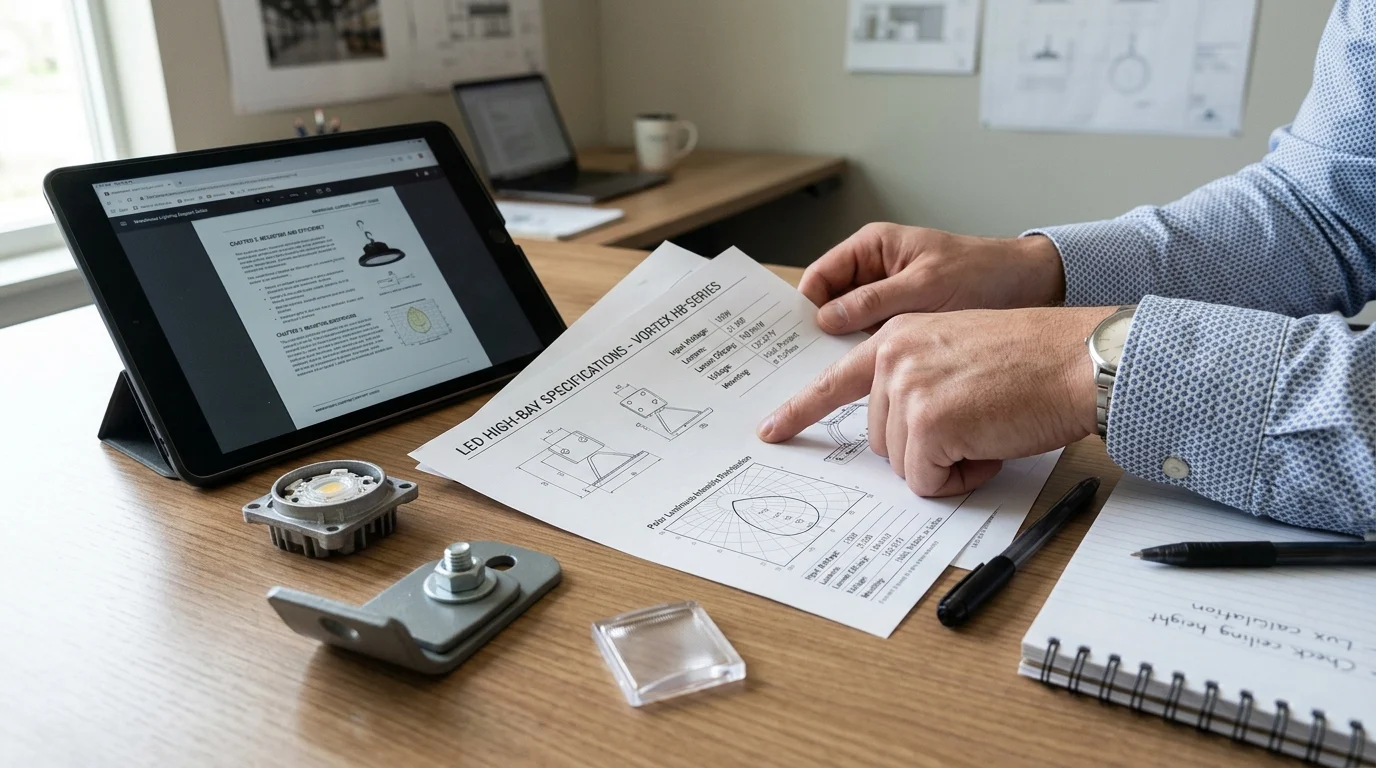
Specifying warehouse lighting support for high-bay environments demands precise photometric engineering. The extreme geometry of the space renders standard wide-beam luminaires highly inefficient, necessitating specialized optics to direct light exactly where it is needed.
Mounting height, beam distribution, and vertical illuminance
At mounting heights between 8 and 14 meters, controlling beam distribution is paramount. A standard luminaire with a 120-degree beam angle wastes up to 40% of its lumen output by casting light onto the top horizontal surfaces of the racks rather than down into the aisle. Instead, engineered linear optics utilizing narrow asymmetrical or rectangular beam distributions (e.g., 30° x 100° or 40° x 80°) push light efficiently down the vertical rack faces. This targeted distribution ensures vertical illuminance ratios remain within a strict 3:1 uniformity gradient from the top shelf down to the floor.
Comparing LED high-bay fixture options
When evaluating LED high-bay fixtures, facility managers typically choose between traditional round (UFO) and linear form factors. Linear fixtures align inherently with aisle geometry, minimizing lateral light spillage. Modern industrial LEDs deliver exceptional efficacy, often exceeding 160 to 180 lumens per watt (lm/W), making them the definitive choice for high-bay applications.
| Fixture Type | Ideal Aisle Geometry | Typical Beam Angle | Avg. Efficacy (lm/W) | Glare Control (UGR) |
|---|---|---|---|---|
| Linear LED High-Bay | Narrow / VNA (1.5m – 2.5m) | 30°x100° / 60°x90° | 150 – 180 | < 22 |
| UFO (Round) High-Bay | Open Storage / Wide Aisle (>3m) | 60° / 90° / 120° | 140 – 170 | < 25 |
Compliance, Efficiency, and Lifecycle Evaluation
Regulatory compliance and lifecycle cost analysis dictate the financial viability of any warehouse lighting support upgrade. High-bay facilities must balance strict occupational safety standards with aggressive corporate energy reduction targets.
Standards and compliance factors
Industrial lighting must adhere to established occupational safety frameworks, such as IESNA RP-7-20 (Recommended Practice for Lighting Industrial Facilities) and OSHA standard 1910.178 for forklift operations. These standards typically mandate a minimum of 300 horizontal lux in active shipping and receiving zones, and 150 to 200 lux within active storage aisles. Furthermore, lighting support systems must actively mitigate glare. Ensuring the Unified Glare Rating (UGR) remains below 22 is vital to prevent temporarily blinding operators who must frequently look upward to safely retrieve pallets from elevated 10-meter rack positions.
Energy use, maintenance, and total cost
Advanced LED systems drastically alter the Total Cost of Ownership (TCO) for logistics facilities. High-bay environments benefit immensely from networked lighting controls (NLC). By integrating Passive Infrared (PIR) or microwave occupancy sensors, facilities can dim aisle lighting to a 10% or 20% baseline during unoccupied periods, yielding energy savings of 50% to 75% compared to static “always-on” legacy systems. Additionally, premium LED drivers boasting L70 lifespans exceeding 100,000 hours virtually eliminate the operational maintenance burden of replacing failed lamps using costly scissor lifts.
Design and Installation Best Practices
Even the highest-tier luminaires will underperform without a rigorous design and installation methodology. Integrating warehouse lighting support with high-bay racking requires meticulous spatial planning to bypass physical obstructions and ensure long-term mechanical stability.
Assessing rack layout, SKUs, and traffic flow
The foundational step in lighting design is assessing the specific rack layout and material traffic patterns. Very Narrow Aisle (VNA) configurations, often measuring just 1.6 to 1.8 meters wide, demand continuous linear lighting runs positioned precisely along the aisle centerline. Misalignment by as little as 15 centimeters can cast harsh, permanent shadows on one side of the aisle. The design phase must also account for SKU density and pallet overhang, as irregularly stacked inventory can protrude up to 100 millimeters into the aisle space, further restricting light distribution and causing unpredictable shadow patterns.
Installation and commissioning to reduce shadows
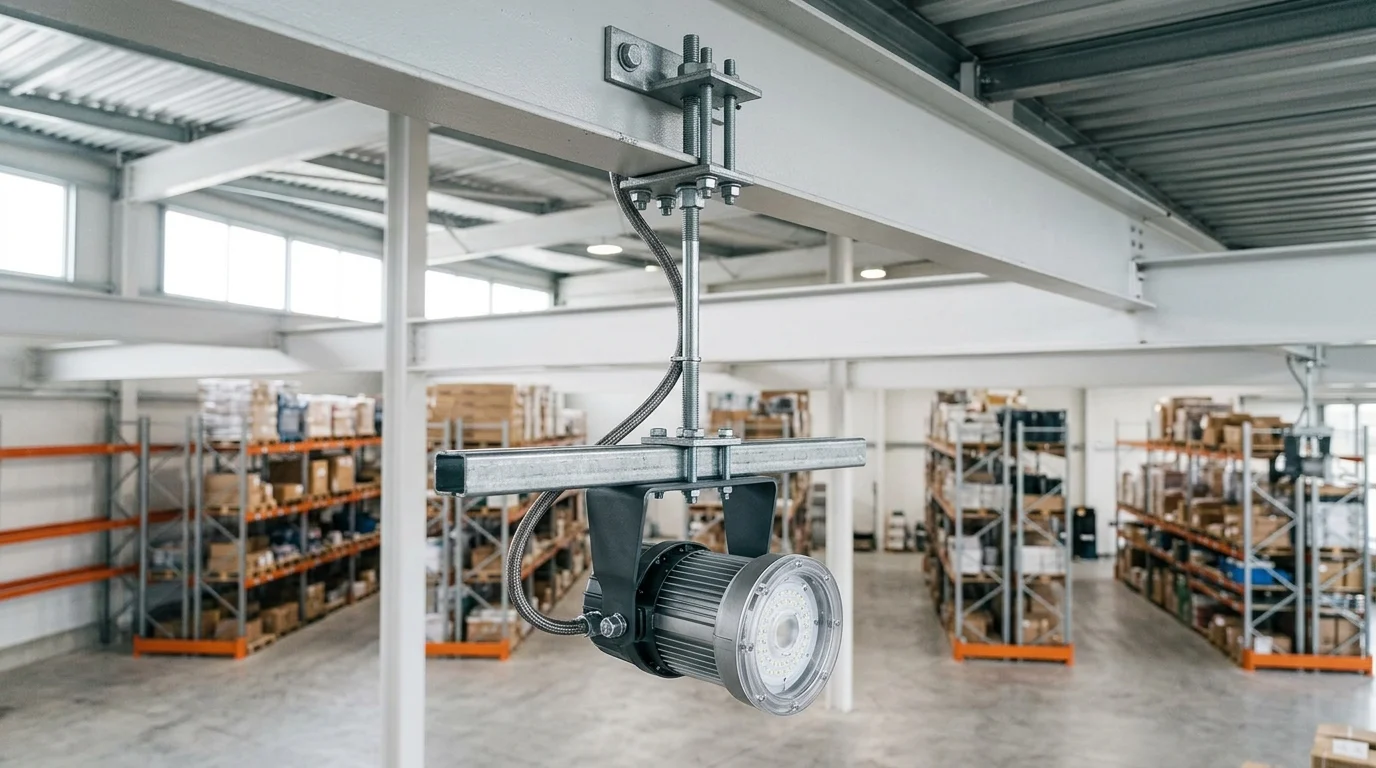
Installation mechanics directly dictate long-term reliability. High-bay luminaires are typically suspended via aircraft cables, rigid pendants, or direct surface mounting to unistrut channels spanning the roof trusses. In facilities equipped with robust HVAC systems or large high-volume low-speed (HVLS) fans, rigid mounting or specialized sway-bracing is required to prevent fixtures from oscillating. Swaying fixtures not only cause distracting dynamic shadows for MHE operators but also induce severe mechanical fatigue on the mounting hardware over a 10- to 15-year operational lifecycle.
Useful tables for specifications and retrofit planning
Proper specification requires referencing empirical data tailored to specific storage architectures. The table below outlines baseline parameters for planning a high-bay lighting retrofit or new build installation.
| Racking Configuration | Aisle Width (m) | Rack Height (m) | Recommended Optics | Target Vertical Lux (Min) |
|---|---|---|---|---|
| Very Narrow Aisle (VNA) | 1.5 – 1.8 | 10 – 15 | 30° x 100° Linear | 200 |
| Standard Selective Rack | 2.5 – 3.5 | 6 – 10 | 60° x 90° Linear | 150 |
| Bulk Storage / Open | > 4.0 | 5 – 8 | 90° or 120° Round | 100 |
| Cold Storage (Mobile) | Variable | 8 – 12 | 40° x 80° Linear | 200 |
Selecting the Right Solution for Long-Term Value
Securing long-term value from warehouse lighting support systems requires a strategic approach to procurement. Facility managers must look beyond the initial capital expenditure to evaluate systemic durability, photometric efficiency, and vendor reliability.
Procurement and vendor selection criteria
Vendor selection should prioritize manufacturers capable of providing comprehensive photometric simulations (such as AGi32 or DIALux files) to guarantee light-level performance prior to physical installation. Procurement criteria must mandate robust environmental protections. High-bay fixtures should carry a minimum ingress protection rating of IP65 to seal out industrial dust and occasional moisture, alongside an impact protection rating of IK08 or higher to survive accidental strikes from elevated MHE masts. Warranty terms should guarantee full replacement for a minimum of 5 to 7 years, explicitly covering both the LED arrays and the internal drivers.
Balancing upfront cost and photometric performance
Balancing upfront costs with photometric efficiency defines the final investment decision. While highly engineered linear fixtures with custom optics may command a 20% to 30% capital premium over generic round high-bays, the operational payback is swift. By directing light exactly where it is needed—onto the vertical rack faces—facilities can often achieve the required compliance lux levels using 15% to 20% fewer fixtures overall. Combined with utility rebates for high-efficacy DLC Premium certified units (often yielding $0.10 to $0.30 per reduced watt), the payback period for an optimized warehouse lighting support system typically falls between 18 and 36 months, securing decades of enhanced operational productivity.
Key Takeaways
- The most important conclusions and rationale for Warehouse Lighting Support
- Specs, compliance, and risk checks worth validating before you commit
- Practical next steps and caveats readers can apply immediately
Frequently Asked Questions
What lighting levels are recommended for high-bay racking aisles?
Active storage aisles typically need 150–200 lux vertical light on rack faces, while shipping and receiving zones often require about 300 lux horizontal illumination.
Which fixture type works best for narrow high-bay aisles?
Linear LED high bays usually perform best in narrow or VNA aisles because their beam shape follows aisle geometry and reduces wasted light on rack tops.
Why is beam distribution important in warehouse lighting support?
At 8–14 m mounting heights, narrow rectangular optics direct light down the aisle and rack faces, improving visibility, uniformity, and picking accuracy.
How can glare be reduced for forklift and picker operators?
Use fixtures with controlled optics and keep UGR below 22 where possible. This helps operators see upper rack levels without uncomfortable brightness.
Can Morelux support custom warehouse lighting pole or mounting projects?
Yes. Morelux supports project buyers with custom steel or aluminum pole solutions, technical drawings, engineer support, and fast quotations for industrial installations.