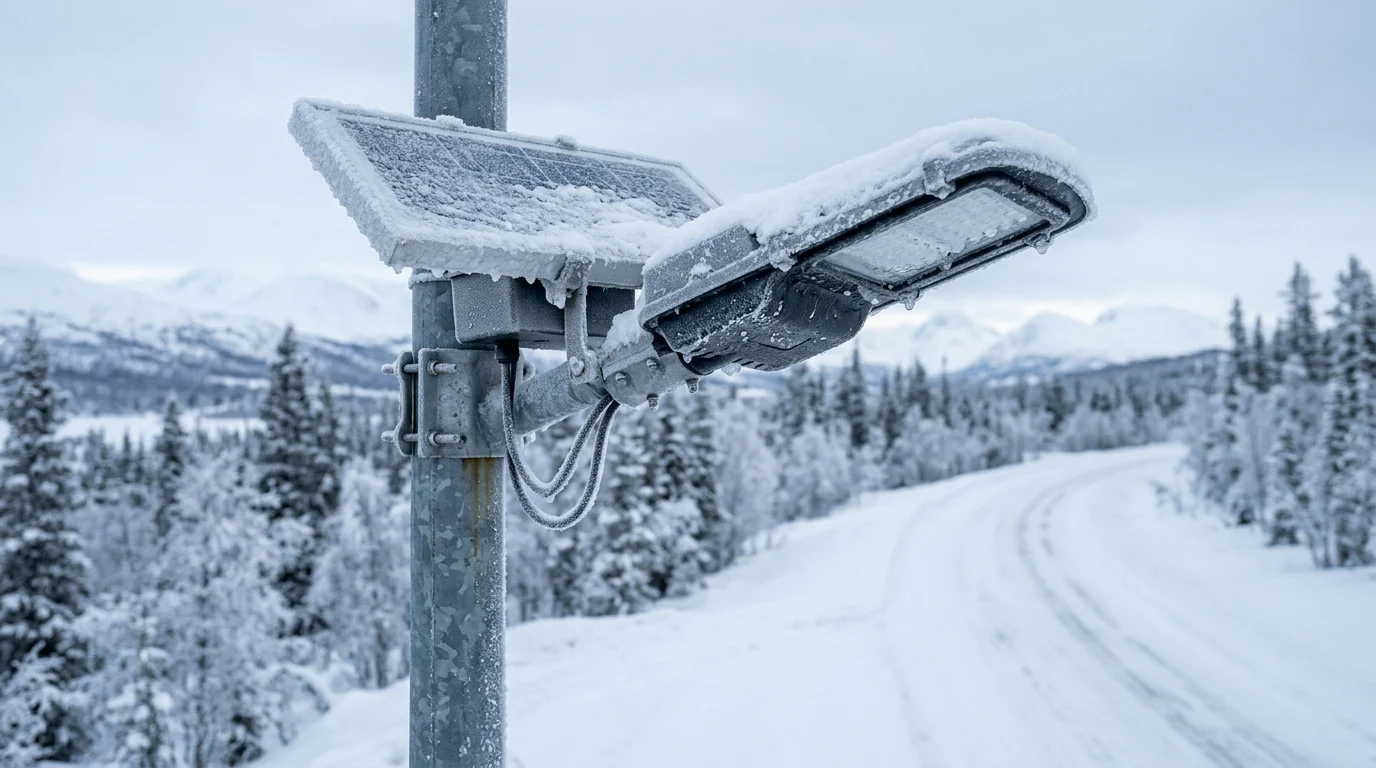
Solar street lights that perform reliably in mild winters can fail quickly when temperatures drop far below standard design limits. In severe subzero conditions, reduced battery efficiency, slower charging, panel snow coverage, brittle materials, and stressed control electronics can combine to shorten runtime or stop the system entirely. This article explains the main failure mechanisms behind extreme cold solar street light failure, how low temperatures affect each critical component, and which engineering fixes improve reliability. By understanding these causes and solutions, readers can better evaluate product specifications, installation choices, and cold-climate design strategies before moving into the technical details.
Why extreme cold causes solar street light failure
Extreme cold solar street light failure is a multifaceted engineering challenge driven by the thermodynamic limitations of off-grid lighting components. When ambient temperatures plunge below standard operating thresholds, the delicate balance of energy harvesting, storage, and consumption is disrupted. Standard commercial units are typically rated for -20°C, but high-latitude or high-altitude deployments frequently experience conditions far exceeding these limits, necessitating specialized thermal management and component selection.
High-risk operating conditions
High-risk operating conditions typically manifest in regions experiencing prolonged periods below -30°C, such as Northern Canada, Scandinavia, and high-altitude transit routes. In these environments, the absence of radiant solar heating during extended winter nights exacerbates the thermal stress on internal electronics. Unlike grid-tied infrastructure, off-grid solar street lights rely entirely on isolated thermal mass. When ambient temperatures remain at -40°C for consecutive days, the internal enclosure temperature reaches equilibrium with the outside air, stripping away any operational thermal buffer and exposing bare chemical and solid-state components to critical freezing thresholds.
System impacts in subzero weather
The systemic impacts of subzero weather are counterintuitive across different components. While photovoltaic module efficiency theoretically improves by approximately 0.4% for every degree Celsius below the standard test condition of 25°C, this advantage is frequently negated by optical blockages from ice and snow accumulation. Furthermore, the extreme cold induces mechanical contraction in structural elements, leading to micro-fractures in solar panel lamination and compromised IP-rated seals. The most severe systemic impact, however, occurs within the energy storage and power management subsystems, where low thermal kinetic energy halts the electrochemical reactions necessary for charge acceptance and delivery.
Main failure causes in extreme cold
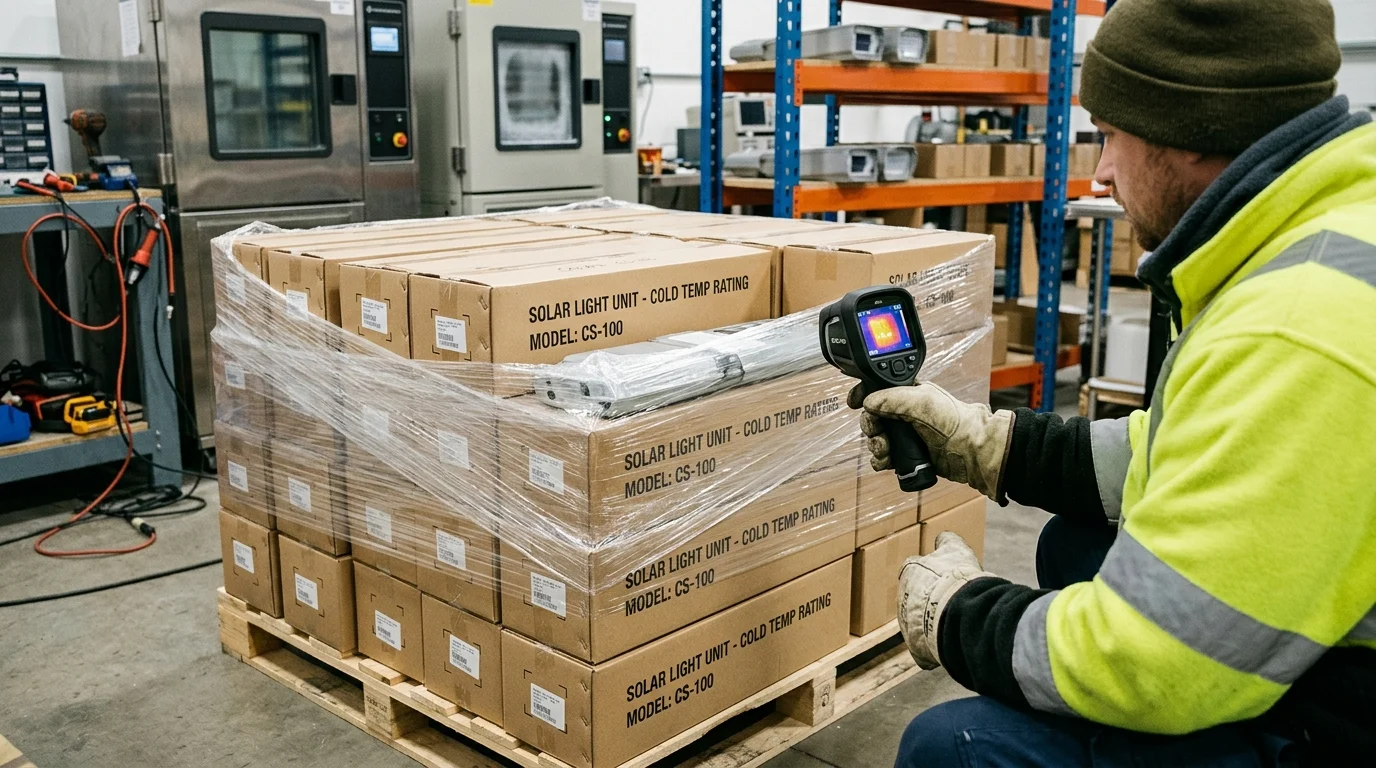
Diagnosing extreme-cold solar street light failure requires analyzing the specific vulnerabilities of individual sub-assemblies. The architecture of a standalone solar luminaire inherently exposes its electrochemical and mechanical parts to continuous thermal cycling, resulting in predictable, yet catastrophic, points of failure when temperatures plummet.
Battery and charging limits
The primary catalyst for system failure is the electrochemical limitation of the battery bank. Standard Lithium Iron Phosphate (LiFePO₄) batteries suffer severe degradation if charged below 0°C. Attempting to force a charge current into a cold lithium cell causes lithium plating on the anode, permanently reducing capacity and creating a severe risk of internal short circuits. While discharge is permissible down to -20°C, the available capacity drops by up to 50% due to increased internal resistance. Alternatively, Absorbed Glass Mat (AGM) lead-acid batteries offer better cold-charge tolerance but face a critical risk of electrolyte freezing; a fully discharged AGM battery’s electrolyte turns primarily to water, which can freeze and crack the casing at just -10°C.
| Battery Chemistry | Min Charge Temp | Min Discharge Temp | Cold Capacity Retention (-20°C) | Primary Failure Mode in Extreme Cold |
|---|---|---|---|---|
| Standard LiFePO4 | 0°C | -20°C | ~50% | Lithium plating during charging |
| Heated LiFePO4 | -30°C | -30°C | ~90% | Heating pad / sensor failure |
| Deep Cycle AGM | -15°C | -40°C | ~40% | Electrolyte freezing (if discharged) |
| Lithium Titanate (LTO) | -30°C | -40°C | ~80% | High capital cost limits deployment |
Enclosure, wiring, and weather exposure
Beyond the energy storage constraints, physical infrastructure vulnerabilities account for a significant percentage of system failures. Standard PVC-insulated wiring becomes highly brittle at temperatures below -15°C, leading to micro-cracking during wind-induced pole vibration and subsequent electrical shorts. Additionally, the differential thermal contraction between aluminum housings and silicone or EPDM gaskets compromises IP65 and IP67 weather seals. When the luminaire heats up slightly during daytime operation and cools rapidly at night, a vacuum effect draws moisture-laden air into the enclosure. This moisture condenses and freezes on the printed circuit boards of the charge controller, leading to corrosive bridging and catastrophic logic failure. Structural failure also occurs when horizontal solar panel orientations accumulate heavy snow loads, exceeding the standard 2400 Pa mechanical load rating and fracturing the photovoltaic glass.
How to prevent cold-weather failures
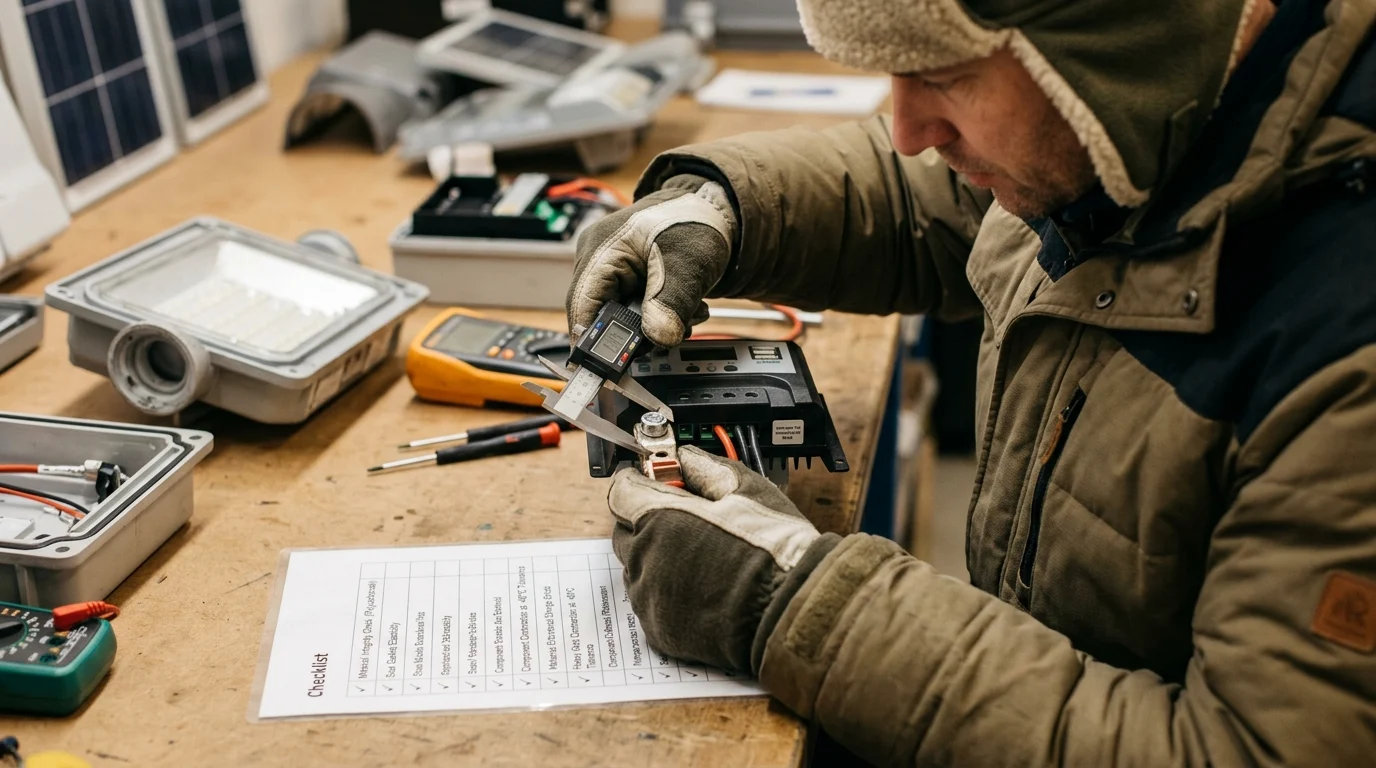
Mitigating extreme-cold solar street light failure demands a proactive engineering approach during the procurement and system sizing phases. Off-the-shelf commercial luminaires are fundamentally inadequate for subarctic environments; therefore, project engineers must mandate specialized cold-weather configurations that address both electrochemical preservation and mechanical durability.
Key specification and validation criteria
The most critical specification for subzero environments is a cold-weather battery management system (BMS) paired with integrated thermal regulation. For lithium-based systems, engineers should specify self-heating battery enclosures utilizing silicone heating pads. These systems use the morning’s initial solar array output to heat the battery core above 5°C before allowing the Maximum Power Point Tracking (MPPT) controller to initiate the charging cycle. For environments routinely dropping below -30°C, specifying Lithium Titanate (LTO) batteries eliminates the need for heating pads entirely, as LTO chemistry safely accepts charge down to -30°C and discharges at -40°C. Furthermore, all external and internal wiring must be upgraded from PVC to polytetrafluoroethylene (PTFE) or cross-linked polyethylene (XLPE), which maintain flexibility and dielectric strength down to -60°C. Charge controllers must feature conformal coating and be potted in epoxy to achieve an IP68 rating, ensuring absolute immunity to internal frost and condensation.
Buyer decision checklist
Procurement teams must evaluate cold-weather solar street lights against a stringent environmental checklist. First, verify the solar panel tilt angle; adjustable brackets must allow for a steep tilt of 45 to 60 degrees to facilitate passive snow shedding and optimize energy capture from low winter sun angles. Second, require a minimum system autonomy of 5 to 7 days, calculated explicitly using the battery’s derated capacity at -20°C, rather than its optimal 25°C baseline. Finally, demand third-party validation of structural integrity, ensuring the luminaire and mounting arms are rated to withstand extreme wind loads of at least 150 km/h, factoring in the increased aerodynamic drag caused by heavy ice accumulation on the fixture.
Key Takeaways
- The most important conclusions and rationale for extreme-cold solar street light failure
- Specs, compliance, and risk checks worth validating before you commit
- Practical next steps and caveats readers can apply immediately
Frequently Asked Questions
Why do solar street lights fail in extreme cold?
The main causes are batteries that cannot charge below 0°C, reduced battery capacity, brittle wiring, failed seals, and snow blocking the panel. In very cold regions, use a cold-climate system design instead of standard models.
What battery works best for solar street lights below -30°C?
Heated LiFePO4 or LTO batteries are the safer options. For project buyers, ask suppliers like Morelux for verified low-temperature charge and discharge specs before approval.
How can I prevent battery damage during winter charging?
Specify a battery management system with low-temperature charge cut-off and heating control. This stops lithium plating and protects capacity during long subzero periods.
Can snow and ice reduce solar street light performance?
Yes. Snow and ice can block sunlight and add mechanical load to panels. Use mounting angles that shed snow more easily and confirm the panel load rating for local winter conditions.
What should project buyers request from a supplier for cold-climate solar poles?
Request thermal design details, battery temperature limits, wiring material specs, IP sealing data, snow-load ratings, and technical drawings. Morelux also supports custom pole solutions and engineer review for infrastructure projects.