Introduction
Cities often rely on weather stations that miss the sharp temperature differences felt from one block to the next, leaving urban heat patterns poorly understood at street level. Smart light poles offer a practical alternative by turning existing lighting infrastructure into dense networks of microclimate sensors that measure heat, humidity, radiation, and airflow where people actually live and move. This article explains why pole-mounted monitoring is well suited to capturing the fine-scale dynamics of the urban heat island effect, what kinds of data it can generate, and how that information can support more targeted cooling strategies, smarter planning decisions, and better heat resilience across neighborhoods.
Why smart light poles work as urban microclimate monitoring stations
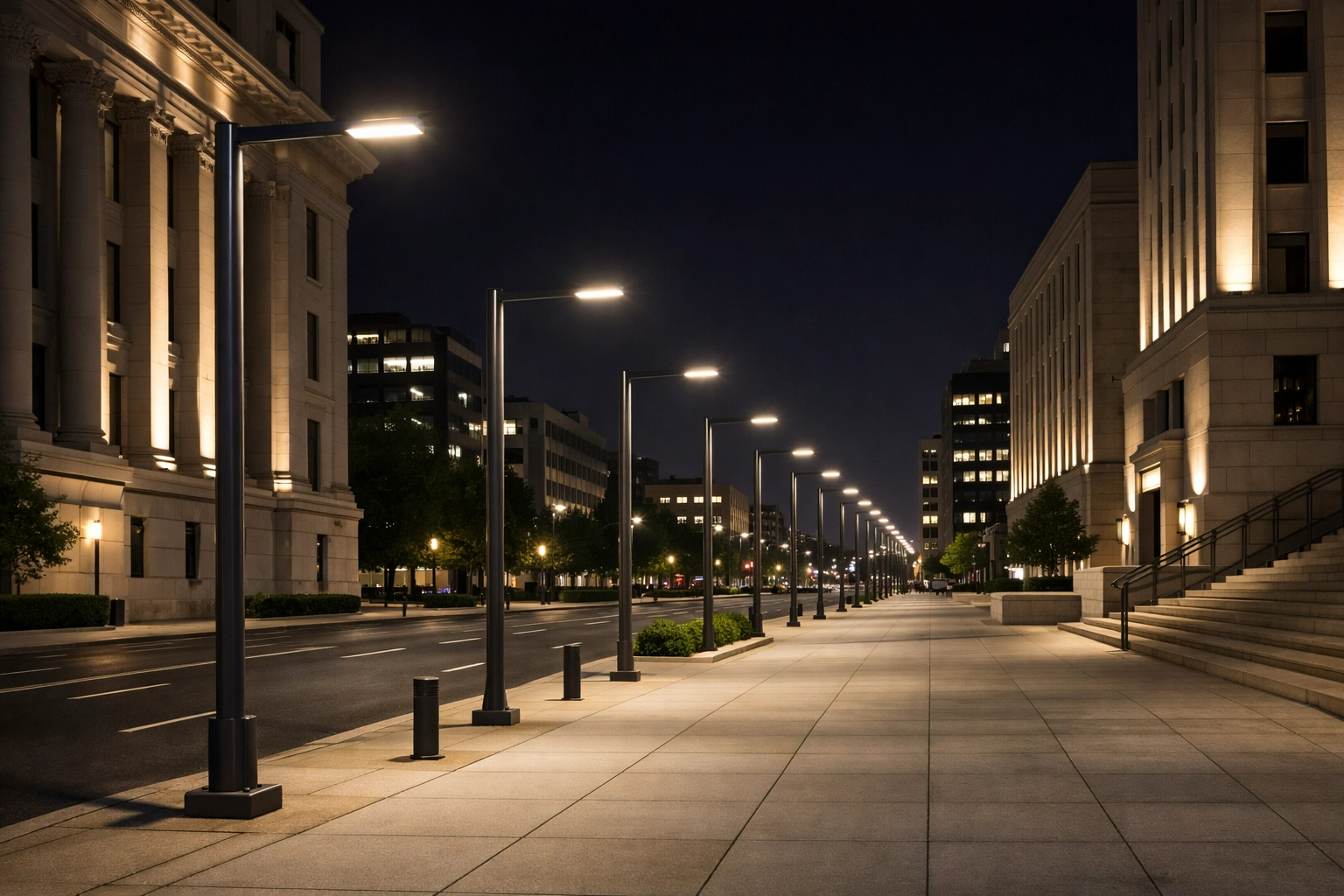
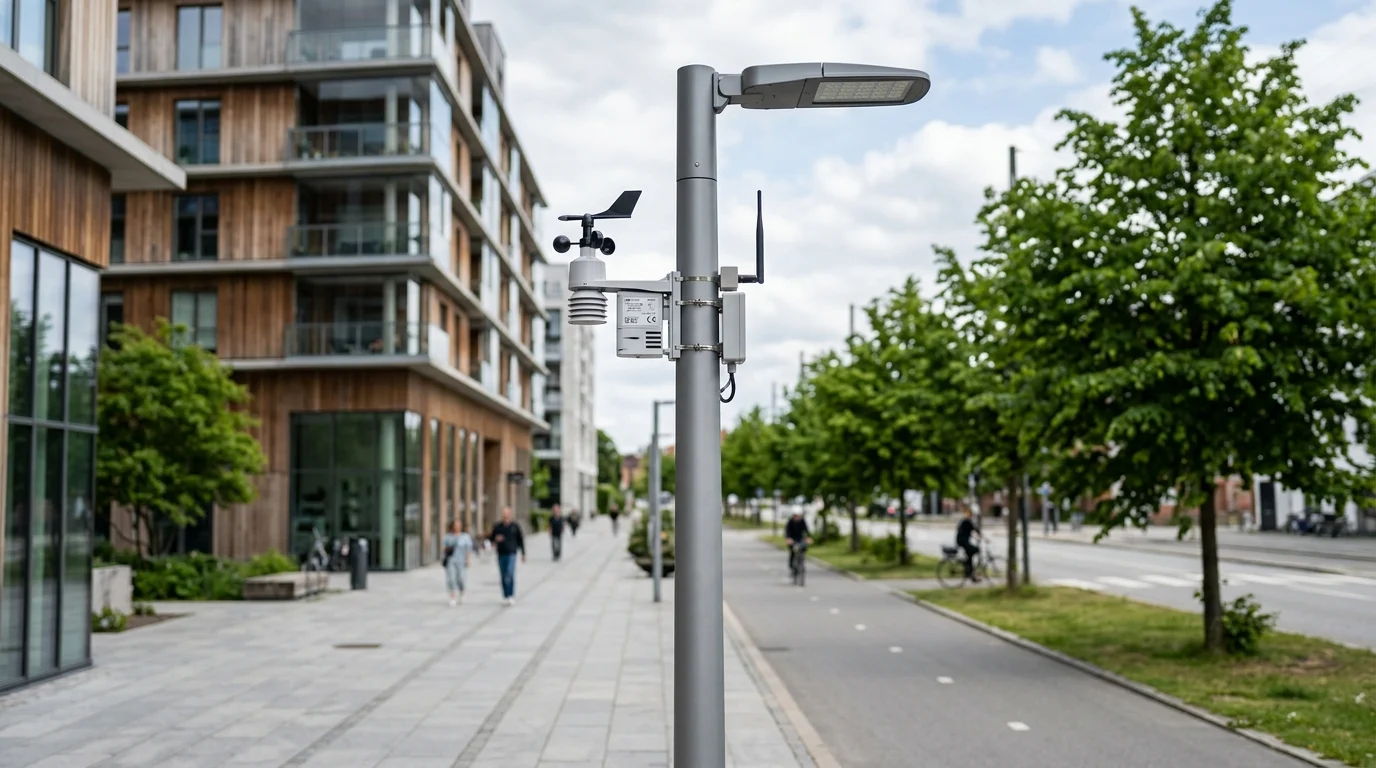
Urban infrastructure is undergoing a fundamental transition from passive utility to active environmental management. Among existing municipal assets, the street lighting network presents an optimal physical matrix for high-density environmental monitoring. Positioned at ideal heights of 4 to 8 meters above street level, smart light poles bypass ground-level thermal interference while remaining entrenched in the pedestrian microclimate. This spatial advantage makes them highly effective for tracking and mitigating the Urban Heat Island (UHI) effect, a phenomenon where dense built environments absorb and retain solar radiation.
Key urban drivers and use cases
Traditional meteorological stations are typically located at airports or large parks, offering a spatial resolution of roughly one station per 100 square kilometers. This macro-level data is entirely insufficient for mapping UHI anomalies, which can cause localized temperature spikes of 5 to 7°C within a single city block. Smart light poles resolve this spatial deficit by allowing municipalities to deploy sensors at 50- to 100-meter intervals.
This granular data enables highly dynamic use cases. Real-time temperature and humidity mapping allows for the automated triggering of localized cooling interventions, such as misting systems or responsive smart shading. Furthermore, continuous data streams inform long-term urban canopy restoration projects by identifying exact heat vulnerability zones, ensuring that tree-planting initiatives are deployed where they yield the highest thermal mitigation ROI.
Commercial, operational, and policy pressures
The shift toward pole-mounted microclimate monitoring is accelerating due to stringent environmental, social, and governance (ESG) mandates alongside new climate resilience policies. At the regulatory level, frameworks such as the European Green Deal and various municipal climate action plans require verifiable, high-fidelity data to justify public spending on climate adaptation. Cities must empirically demonstrate progress toward targets, such as a 30% reduction in peak summer heat stress metrics.
Commercially, integrating environmental sensors into lighting infrastructure aligns perfectly with broader smart city funding models. By consolidating lighting controls, traffic analytics, and microclimate monitoring into a single utility footprint, municipalities can secure multi-departmental funding. Operational pressures also dictate this hardware convergence; maintaining a unified power and data backhaul network significantly reduces the Mean Time To Repair (MTTR) and minimizes the logistical overhead of servicing disparate, siloed sensor networks.
Technical specifications and deployment models

Transforming standard municipal lighting into high-fidelity microclimate stations requires a rigorous systems architecture. The physical integration of sensitive meteorological instruments onto light poles demands careful consideration of thermal isolation, continuous power draw, and reliable data transmission capabilities.
Sensors, hardware, power, connectivity, and data architecture
A standard microclimate array requires a suite of precision instruments: ambient temperature sensors with a minimum accuracy of ±0.2°C, relative humidity probes, pyranometers for solar radiation, and ultrasonic anemometers capable of measuring wind speeds up to 60 m/s without moving parts. To prevent the pole’s own thermal mass or the LED driver’s heat emission from corrupting environmental readings, sensors must be housed in actively aspirated radiation shields mounted on lateral extension arms.
Power architectures typically leverage the existing 110V/220V grid infrastructure, utilizing step-down converters to provide stable 12V or 24V DC to the sensor payload. Connectivity relies on tiered data architectures: low-bandwidth environmental telemetry is efficiently transmitted via LoRaWAN or NB-IoT, while high-frequency datasets—such as acoustic or particulate matter (PM2.5/PM10) readings—often require 5G or fiber-optic backhauls. Edge computing nodes featuring industrial-grade microprocessors process raw data locally, transmitting only aggregated payloads via MQTT or CoAP protocols to reduce overall network bandwidth consumption.
Deployment options and comparison criteria
Municipalities face two primary deployment models when establishing a smart pole network: retrofitting existing infrastructure or undertaking full-scale modular pole replacements. The decision hinges on existing asset age, structural wind-load capacity, and municipal budget constraints.
| Deployment Model | Initial CapEx per Pole | Deployment Time | Sensor Payload Capacity | Expected Lifespan |
|---|---|---|---|---|
| Retrofit (Clip-on / NEMA socket) | $500 – $1,200 | < 1 hour | Limited (3-5 sensors, <5kg) | 5–7 years |
| Modular Smart Pole Replacement | $3,500 – $8,000 | 4–8 hours | High (Integrated arrays, >15kg) | 15–20 years |
Retrofits utilizing standard 7-pin NEMA receptacles offer rapid scalability and immediate data yields, making them ideal for agile pilot programs. Conversely, full modular replacements provide superior structural integrity, internal cable routing, and the capacity to house larger edge-computing servers, presenting a much more robust long-term solution for comprehensive smart city master plans.
Costs, compliance, procurement, and implementation

While the technical parameters of microclimate monitoring are well-established, the administrative and financial execution of these networks dictates their ultimate viability. Transitioning from isolated pilot projects to city-wide deployments requires strict adherence to procurement standards, interoperability protocols, and lifecycle cost management.
Lifecycle cost, interoperability, privacy, and security
Financial modeling for smart pole networks must account for a total cost of ownership (TCO) spanning 10 to 15 years. While initial hardware and installation (CapEx) are significant, ongoing operational expenditures (OpEx)—including cloud data transit, API maintenance, and periodic sensor calibration—typically consume 10% to 15% of the initial CapEx annually. To avoid vendor lock-in, procurement specifications must mandate strict interoperability standards, such as compliance with the TALQ Consortium protocol, ensuring that microclimate data can seamlessly integrate into any central management software (CMS).
Security and privacy are equally critical components of the data architecture. While raw temperature and humidity data lack personally identifiable information (PII), the network infrastructure transporting this data must utilize end-to-end AES-256 encryption to prevent unauthorized network access. If the poles also house optical sensors for localized pedestrian density mapping—often used to correlate heat stress with foot traffic—edge-based anonymization is legally required to maintain compliance with privacy frameworks like GDPR and CCPA.
Phased rollout and decision guidance
Mitigating financial and operational risk necessitates a highly structured, phased rollout strategy.
Key Takeaways
- The most important conclusions and rationale for smart light poles as urban microclimate monitoring stations: a new tool for combating the urban heat island effect.
- Specs, compliance, and risk checks worth validating before you commit
- Practical next steps and caveats readers can apply immediately
Frequently Asked Questions
Why use smart light poles instead of traditional weather stations?
They capture block-level heat differences that airport or park stations miss. Installed every 50–100 meters, smart poles provide practical microclimate data for cooling actions, tree planting, and heat-risk mapping.
What sensors are typically mounted on a microclimate smart pole?
Common sensors include temperature, humidity, solar radiation, and wind sensors. Many projects also add PM2.5/PM10, noise, or traffic modules depending on city goals and data network capacity.
Should a city retrofit existing poles or choose full smart pole replacement?
Retrofit is faster and lower cost for pilots. Full replacement is better for heavier sensor payloads, longer service life, and integrated smart city functions when the existing poles lack capacity.
How does Morelux support customized smart pole projects?
Morelux provides custom aluminum or steel pole solutions, technical drawings, engineer support, and dependable manufacturing. Project buyers can request fast quotes and align pole structure, finish, and mounting details to sensor needs.
What should buyers check before specifying a smart microclimate pole?
Confirm pole height, wind-load capacity, sensor arm layout, thermal isolation, power conversion, and connectivity options. Also review corrosion protection, access for maintenance, and whether the structure supports future module expansion.