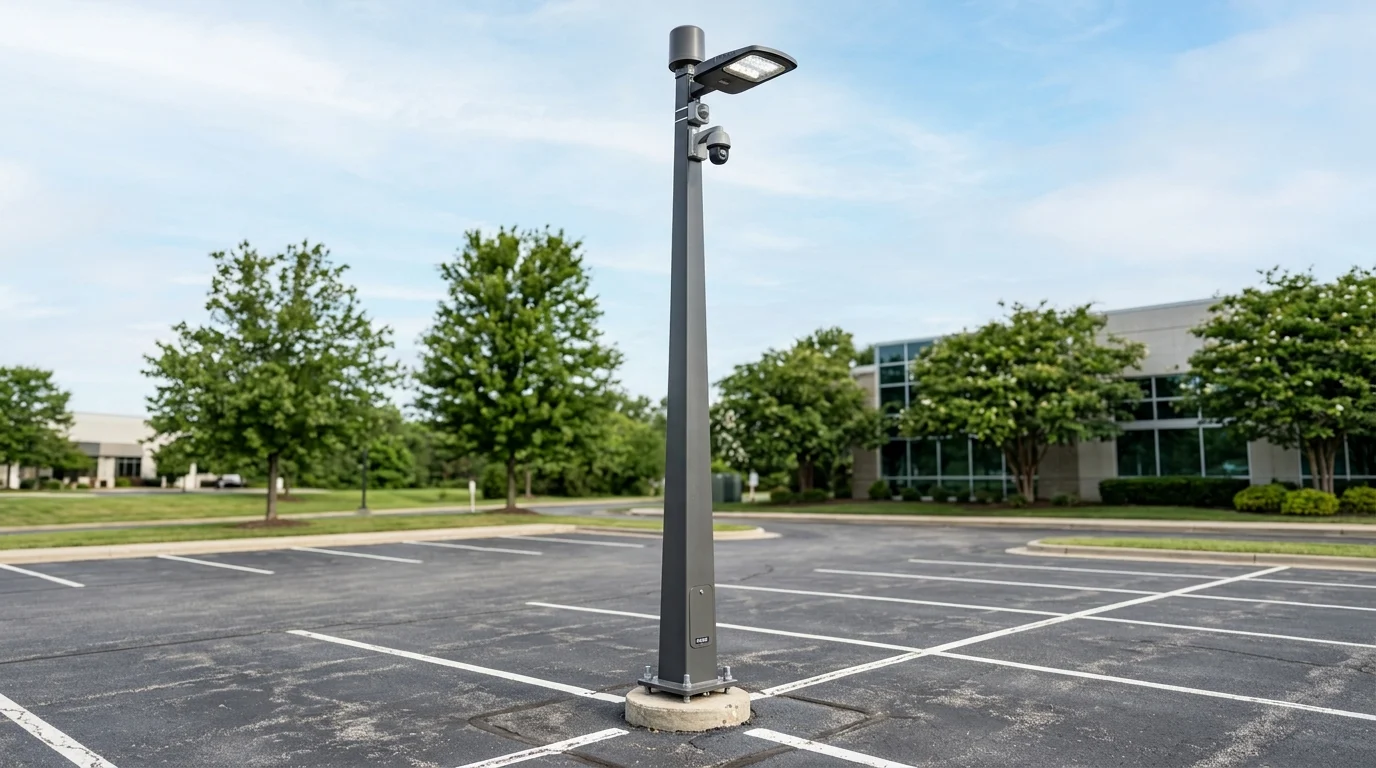
Parking lot lighting is no longer just about visibility after dark. A parking lot smart lighting pole can combine adaptive illumination, sensors, cameras, communications hardware, and control software into a single infrastructure point that improves safety, lowers energy use, and supports more efficient site management. For commercial properties, campuses, and municipal facilities, this shift matters because parking areas are often the first place where security risks, maintenance issues, and operating costs become visible. This article explains what makes these poles “smart,” why they have become essential in modern parking facilities, and how they create a practical foundation for connected, scalable outdoor operations.
Why Smart Lighting Poles Matter in Parking Lots
The modernization of commercial and municipal parking facilities increasingly relies on deploying the parking lot smart lighting pole. No longer mere illumination assets, these structures serve as decentralized nodes for the Internet of Things (IoT), transforming static real estate into dynamic, data-driven environments.
As urban density increases and facility management trends toward automation, standard lighting infrastructure struggles to meet modern operational demands. Upgrading to intelligent pole networks provides a scalable foundation for both current facility requirements and future technological integrations.
Safety, energy, and asset management drivers
Facility operators face mounting pressure to optimize energy consumption while simultaneously enhancing physical security. Smart lighting poles address these dual mandates through adaptive illumination and integrated surveillance. By utilizing motion sensors, radar, and ambient light detection, adaptive dimming protocols can yield energy reductions of 40% to 60% compared to legacy high-pressure sodium or static LED fixtures. Because the lighting responds dynamically to pedestrian and vehicular traffic, facilities eliminate the wasted power of illuminating empty zones.
Concurrently, integrating high-definition pan-tilt-zoom (PTZ) cameras and automated license plate recognition (ALPR) modules establishes a comprehensive perimeter defense. This continuous monitoring deters vandalism, reduces liability claims, and provides actionable forensics to local law enforcement or private security teams in the event of an incident.
System definition and scope
A comprehensive smart pole system extends significantly beyond standard luminaire assemblies. The architecture typically comprises a reinforced physical mast, a primary high-efficacy LED luminaire, an edge computing module, and robust network backhaul capabilities. Depending on the site topology and data bandwidth requirements, backhaul is achieved via 5G/LTE cellular routers, Wi-Fi 6 access points, or LoRaWAN protocols for low-bandwidth telemetry.
Furthermore, these systems frequently encompass modular peripherals. A single parking lot smart lighting pole can house electric vehicle (EV) charging interfaces, environmental monitoring sensors for air quality, public address speakers, and digital signage. These subsystems are aggregated and governed by a centralized, cloud-based management platform, allowing facility managers to monitor the entire parking campus from a single dashboard.
Key Technical and Compliance Considerations

Transitioning from traditional lighting to intelligent infrastructure requires rigorous engineering and compliance oversight. Integrating sensitive electronics and networking equipment into outdoor environments mandates structural and environmental specifications that far exceed those of conventional poles.
Core specifications beyond basic LED poles
The primary engineering challenge involves accommodating the increased Effective Projected Area (EPA) and physical weight of IoT peripherals. A parking lot smart lighting pole must feature elevated structural load capacities to prevent oscillation, harmonic vibration, and subsequent fatigue failure. Standard aluminum or steel poles may be engineered to support a basic 15-pound luminaire, whereas a smart pole must frequently support an additional 40 to 60 pounds of payload while withstanding sustained wind gusts up to 130 mph.
| Specification Category | Traditional Lighting Pole | Smart Lighting Pole |
|---|---|---|
| Payload Capacity | 15 – 25 lbs | 50 – 150 lbs |
| Wind Load Rating | 90 mph | 130 – 150+ mph |
| Power Distribution | Single-circuit (120/277V) | Multi-circuit (AC/DC) with POE+ |
| Data Backhaul | None | 5G, LTE, Fiber, Wi-Fi 6 |
Beyond physical strength, power distribution within the pole must be re-engineered. Smart poles require multi-circuit architectures to deliver continuous power to cameras and sensors, alongside Power over Ethernet (PoE+) capabilities, independent of the photocell-controlled lighting circuit.
Lifecycle cost, maintenance, and cybersecurity
Lifecycle management and system security represent critical vulnerability vectors for outdoor electronics. Enclosures housing edge computing nodes and power converters must carry stringent environmental ratings, typically requiring IP66 certification against high-pressure water ingress. Additionally, ground-level components demand an IK08 or IK10 impact resistance rating to survive accidental vehicular collisions or targeted vandalism.
From a network perspective, these poles represent exposed endpoints. Procurement specifications must mandate rigorous cybersecurity frameworks to protect the facility’s data network. These include AES-256 encryption for data in transit, secure boot protocols for edge devices, and zero-trust network architectures. Implementing these standards ensures that a physically compromised parking lot node cannot serve as a backdoor gateway into the enterprise’s broader local area network or payment processing systems.
Procurement, Deployment, and ROI

Executing a smart pole deployment necessitates a strategic approach to capital expenditure and vendor selection. Facility managers and procurement teams must balance immediate hardware costs against long-term operational efficiencies, maintenance reductions, and potential revenue generation.
Vendor evaluation and pilot planning
Navigating the vendor landscape requires prioritizing interoperability and open standards to avoid proprietary lock-in. Hardware and software platforms should comply with industry benchmarks such as the TALQ Consortium standards for smart city device management and DALI-2 protocols for granular lighting control. Evaluating vendors based on their API accessibility ensures the lighting network can integrate with existing building management systems (BMS) or parking enforcement software.
Before committing to a site-wide rollout, organizations should execute a structured pilot program. Deploying a constrained test cluster of 5 to 10 units over a 90-day evaluation period allows operators to validate network latency, sensor accuracy, and the functional integration of the central management software under real-world weather and traffic conditions.
Deployment models, site conditions, and business case
Deployment models generally fall into two categories: complete infrastructure replacements or modular retrofits applied to existing masts. While new builds offer optimal structural integrity, internal cable routing, and aesthetic uniformity, retrofits significantly reduce initial capital outlays by utilizing existing structural foundations and conduit runs. Site conditions, such as the degradation of existing concrete bases and the availability of fiber optic backhaul, heavily influence this decision.
The business case for a parking lot smart lighting pole deployment hinges on a multi-faceted return on investment (ROI).
Key Takeaways
- The most important conclusions and rationale for parking lot smart lighting pole
- Specs, compliance, and risk checks worth validating before you commit
- Practical next steps and caveats readers can apply immediately
Frequently Asked Questions
What makes a parking lot smart lighting pole essential today?
It combines lighting, sensors, cameras, and connectivity in one asset, improving safety, cutting energy use, and supporting future upgrades like EV charging or digital signage.
How much energy can smart parking lot poles save?
With motion sensing and adaptive dimming, many sites reduce lighting energy use by about 40% to 60% versus static legacy systems.
What load and wind ratings should buyers specify?
For parking lot smart poles, specify higher payload capacity for cameras and sensors, plus wind ratings around 130 to 150+ mph based on local code and site exposure.
Which protection ratings are important for outdoor smart poles?
Ask for IP66 enclosures to resist water and dust, and IK08 or IK10 impact resistance for vulnerable ground-level components in busy parking areas.
Can Morelux support customized parking lot smart lighting pole projects?
Yes. Morelux provides custom steel or aluminum pole solutions, technical drawings, engineer support, and fast quotes for municipal, commercial, and infrastructure projects.