Introduction
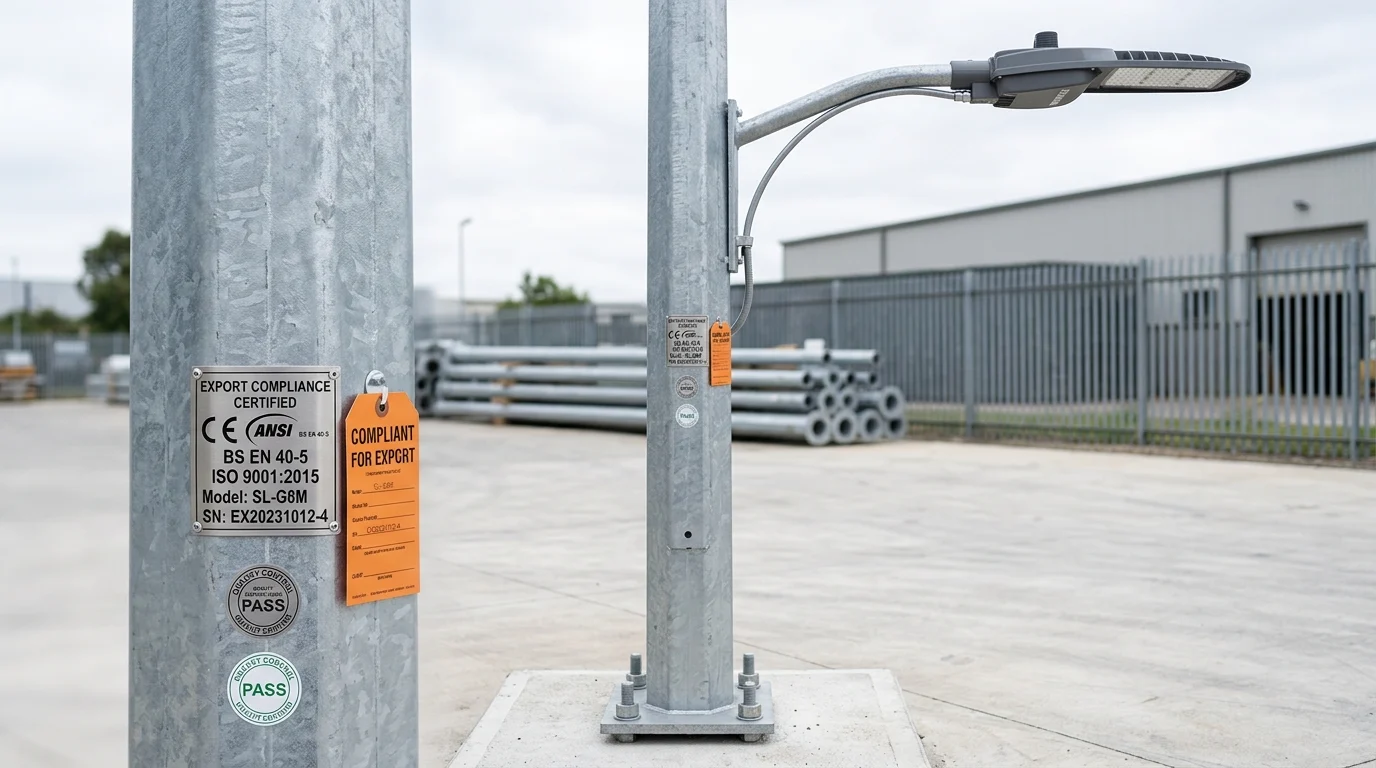
Exporting street light poles requires more than meeting a buyer’s specification; it means demonstrating compliance with the regional standards that govern structural design, materials, wind loading, and safety performance. EN 40, AASHTO, and GB/T each reflect different engineering assumptions and approval practices, so a design accepted in one market may face delays, redesign, or rejection in another. This article explains how these frameworks differ, where exporters most often encounter compliance gaps, and what documentation manufacturers and EPC teams need to prepare before bidding, shipping, or installation. With that context, the following sections examine the key technical and commercial implications of each standard.
Why Street Light Pole Export Compliance Shapes Market Access
Navigating street light pole export compliance is a mandatory gateway for manufacturers and engineering, procurement, and construction (EPC) firms executing international infrastructure projects. Securing market access relies on proving structural integrity, material quality, and safety through recognized frameworks.
With typical municipal lighting tenders demanding volumes ranging from 1,000 to 5,000 poles per phase, non-compliance is not merely a technical failure; it represents a profound financial risk. Customs rejections or site-level failures due to inadequate certification can introduce project delays of 30 to 60 days, triggering severe liquidated damages and stalling urban development initiatives.
How EN 40, AASHTO, and GB/T requirements differ
The global street lighting market is heavily fragmented by regional engineering traditions, primarily governed by EN 40, AASHTO, and GB/T standards. EN 40, the European standard, places a strong emphasis on passive safety—ensuring poles yield predictably during vehicular impact—and utilizes highly localized wind load maps defined in EN 40-3-1. It categorizes terrain and mandates specific deflection classes (Class A, B, or C) based on urban density and safety requirements.
AASHTO, the governing standard in North America, prioritizes structural resilience under extreme environmental stress. Its specifications for structural supports for highway signs, luminaires, and traffic signals focus heavily on fatigue design, particularly for high-mast poles, requiring a standard 50-year design life baseline. In contrast, China’s GB/T standards (such as GB/T 2694 for transmission and structural poles) align closely with ISO methodologies but specify domestic material grades like Q235 and Q355 steel. While GB/T provides a robust structural foundation, exporting these poles often requires translating domestic material yield strengths into EN or AASHTO equivalents to satisfy foreign buyers.
Which stakeholders review compliance
Export compliance is scrutinized by a complex matrix of stakeholders throughout the project lifecycle. Procurement engineers and EPC contractors act as the first line of defense, evaluating supplier technical submittals against tender specifications. They analyze structural calculation reports to ensure the proposed pole geometry can withstand local wind loads without exceeding allowable stress limits.
Once manufacturing is complete, third-party inspection agencies and customs authorities take over. Customs agencies in jurisdictions like the European Union mandate the presence of a valid CE mark, which certifies adherence to EN 40. In North America, municipal transport authorities require drawings stamped by a registered Professional Engineer (PE). Failure to satisfy these stakeholders at any checkpoint results in immediate port quarantine or rejection at the installation site.
What Street Light Pole Export Compliance Requires
Achieving export compliance requires a rigorous translation of environmental variables into precise manufacturing specifications. A street light pole must act as a resilient cantilevered structure, engineered to support specific luminaires while resisting dynamic forces. Depending on the destination, base wind speed requirements can vary drastically from a moderate 25 m/s in inland urban areas to over 50 m/s in coastal hurricane zones.
Design loads, materials, corrosion protection, and tolerances
The core of pole design revolves around managing wind loads and dead loads. The Effective Projected Area (EPA) and the weight of the luminaire and bracket dictate the bending moments applied to the shaft. To handle these stresses, manufacturers utilize carbon steel with specific yield strengths, typically ranging from 235 MPa for standard residential poles to 355 MPa or higher for high-mast and highway applications.
Corrosion protection is equally critical for ensuring the pole’s design life. Export standards universally mandate hot-dip galvanization, generally adhering to ISO 1461 or ASTM A123. For standard environments, a minimum zinc coating thickness of 85 microns is required, though highly saline coastal environments often necessitate 100 microns or an additional powder-coated duplex system. Furthermore, dimensional tolerances—such as a maximum allowable deviation of +/- 3mm on the shaft diameter and strict limits on straightness (typically 3mm per meter)—must be strictly controlled during the brake press and welding phases.
Required documentation for export compliance
Physical compliance must be backed by an unbroken chain of documentation. Exporters must provide Mill Test Certificates (MTCs) compliant with EN 10204 Type 3.1, tracing the chemical composition and mechanical properties of the raw steel coil back to the foundry.
Additionally, structural calculation reports generated by specialized software (e.g., PLS-POLE or SAP2000) must accompany the shipment. Welding procedure specifications (WPS) and welder qualification test records (WQTR) per AWS D1.1 or EN ISO 15614 are also mandatory to prove that the longitudinal seams and base plate joints meet international fusion standards.
EN 40 vs AASHTO comparison points
While EN 40 and AASHTO both aim to ensure structural safety, their methodological approaches to wind behavior and material stress diverge significantly. Exporters must understand these technical nuances to avoid over-engineering or under-designing their products.
| Feature / Parameter | EN 40 (Europe & Adopting Regions) | AASHTO (North America) |
|---|---|---|
| Wind Load Methodology | Uses a 10-minute mean wind speed with specific terrain categories (I-IV). | Utilizes a 3-second gust wind speed map, factoring in height and exposure. |
| Deflection Limits | Categorized into Class A, B, or C; strictly limits horizontal and vertical displacement. | Deflection is limited primarily by aesthetic and functional luminaire requirements. |
| Fatigue Design | Not explicitly mandated for standard lighting columns, focused on static loads. | Mandatory for high-mast and traffic poles; strict rules for vortex shedding and galloping. |
| Passive Safety | Highly emphasized (EN 12767); poles must yield or break away upon vehicle impact. | Addressed via breakaway slip bases or transformer bases rather than shaft yielding. |
How Exporters Verify Compliance Before Shipment
Quality assurance cannot be retrofitted. Exporters must embed verification protocols into every stage of the manufacturing process, from raw material intake to final packaging. Data indicates that when rigorous pre-shipment verification frameworks are applied, structural and cosmetic defect rates drop below 0.5%, virtually eliminating the risk of cross-border rejection.
Pre-order technical review steps
Verification begins long before steel is cut. During the pre-order technical review, manufacturers must validate the buyer’s local wind codes and cross-reference them with the specific luminaire EPA, which typically ranges from 0.1 to 0.3 square meters for modern LED fixtures.
Engineering teams must also evaluate the soil conditions and anchor bolt specifications provided by the EPC contractor. A mismatch between the pole’s base plate bolt circle diameter (BCD) and the foundation’s cast-in-place anchor bolts is a common, costly error that can be entirely prevented through precise pre-production drawing approvals.
Inspection and test plan requirements
The Inspection and Test Plan (ITP) serves as the operational roadmap for compliance. The ITP outlines specific hold points and witness points during fabrication. Visual and dimensional inspections ensure the pole taper and base plate geometry meet the +/- 2mm to 3mm tolerances.
Crucially, the ITP dictates the Non-Destructive Testing (NDT) requirements for welds. Depending on the standard, Ultrasonic Testing (UT) or Magnetic Particle Inspection (MPI) is required on 10% to 100% of the critical base-plate-to-shaft circumferential welds, ensuring no subsurface cracks or porosity compromise the pole’s structural integrity under high wind shear.
When third-party inspection or witness testing is needed
For high-stakes projects—typically government tenders exceeding $500,000 USD in value or involving more than 1,000 units—self-certification is rarely sufficient. Buyers will mandate the involvement of recognized third-party inspection (TPI) agencies such as SGS, Bureau Veritas, or Intertek.
These agencies perform witness testing during raw material sampling, galvanization thickness checks using Elcometer gauges, and final load testing. A TPI release note is often a prerequisite for the issuance of the Letter of Credit (LC) and the subsequent release of the shipping manifest.
Which Commercial and Logistics Decisions Affect Compliance
Exporting oversized steel structures introduces complex logistical and commercial variables that directly intersect with physical compliance. The journey from the factory floor to the installation site involves multiple handling points, each presenting a risk to the pole’s structural and cosmetic integrity.
Packaging, marking, container loading, and port handling
Shipping 10-meter to 12-meter poles requires strategic container utilization. A standard 40-foot High Cube (40HQ) container can typically accommodate 80 to 120 standard 8-meter poles, depending on the taper and base plate dimensions. To maximize space without causing damage, poles are often nested.
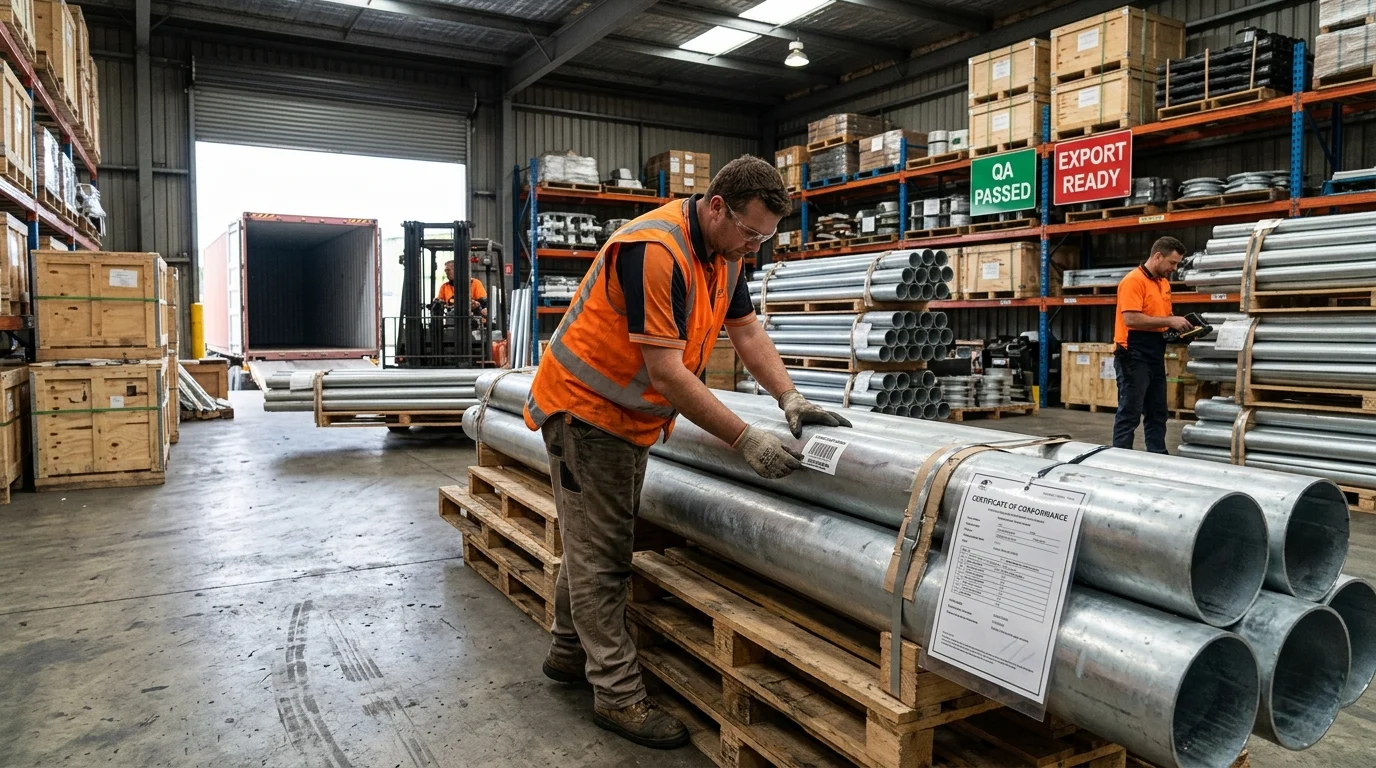
However, improper nesting can scratch the critical 85-micron galvanized layer, leading to premature oxidation. Compliance requires strict packaging protocols: using timber dunnage, heavy-duty bubble wrap, or felt sleeves to separate the shafts. Furthermore, customs compliance dictates that CE or AASHTO markings must be permanently stamped on the pole base or securely attached via metallic tags prior to loading.
Key cost drivers in compliant pole design
Designing a pole that meets international standards invariably impacts the unit cost. Manufacturers and buyers must transparently navigate these cost drivers to maintain project feasibility while ensuring strict adherence to the governing code.
| Compliance Cost Driver | Impact on Total Pole Cost | Condition Requiring Investment |
|---|---|---|
| Material Grade Upgrade (e.g., Q235 to Q355) | +10% to +15% | High wind zones or AASHTO fatigue design requirements. |
| Increased Base Plate Thickness | +5% to +8% | High luminaire dead loads or severe deflection limits. |
| Advanced Galvanization (100+ microns / Duplex) | +8% to +12% | Coastal, high-salinity, or heavily industrialized environments. |
| Third-Party NDT & Witness Testing | +3% to +5% | EN 40 CE marking or specific municipal tender mandates. |
How Buyers and Manufacturers Choose the Right Compliance Path

Selecting the appropriate compliance pathway requires strategic alignment between the buyer’s regional mandates and the manufacturer’s certified capabilities. Misalignment during the procurement phase is catastrophic, potentially costing up to 20% of the total project value in rework, delayed installation, or outright replacement of non-compliant assets.
Decision criteria by market and project class
The decision criteria are heavily dictated by the project’s geographic location and infrastructure class. In the Middle East, for instance, procurement bodies often accept both EN 40 and AASHTO standards, provided the engineering calculations account for extreme ambient temperatures (up to 50°C) and high sand abrasion. Therefore, buyers prioritize enhanced coating thicknesses alongside structural compliance.
Conversely, North American highway projects strictly demand AASHTO compliance with PE-stamped documentation, leaving no room for EN 40 substitutions. In regions like Southeast Asia or parts of Africa, project developers frequently blend GB/T material standards with EN 40 load methodologies to optimize costs while maintaining acceptable safety margins. Buyers must explicitly define these acceptable standard crossovers in the initial tender documents.
Procurement and supplier qualification checklist
To mitigate export risks, buyers must execute a stringent supplier qualification checklist before issuing purchase orders. This begins with auditing the manufacturer’s quality management system, ensuring they hold a valid ISO 9001 certification and possess specific welding accreditations like EN 1090 or AWS equivalent.
Procurement teams should request historical Mill Test Certificates and a sample structural calculation report for a baseline product—such as a 10-meter pole supporting a 0.2 square meter EPA luminaire at a 35 m/s wind speed. Verifying the manufacturer’s ability to seamlessly generate compliant engineering calculations, backed by verifiable material traceability, is the definitive test of their capability to navigate the complexities of street light pole export compliance.
Key Takeaways
- The most important conclusions and rationale for street light pole export compliance
- Specs, compliance, and risk checks worth validating before you commit
- Practical next steps and caveats readers can apply immediately
Frequently Asked Questions
What standard should I use for a street light pole export project?
Match the destination market: EN 40 for EU projects, AASHTO for U.S. highway and municipal work, and GB/T for China-based requirements unless the tender states otherwise.
What documents are usually needed to clear street light pole compliance?
Prepare MTCs to EN 10204 3.1, structural calculations, technical drawings, galvanizing or coating reports, dimensional inspection records, and any required CE or PE-backed documents.
Can GB/T steel grades be accepted for EN 40 or AASHTO projects?
Yes, if the material properties are clearly mapped to the required foreign standard and supported by test certificates, calculations, and buyer-approved technical review.
How does Morelux support project buyers with compliance submittals?
Morelux can provide fast quotes, technical drawings, engineer support, and manufacturing documentation to help sourcing teams review pole design, materials, and finishing before shipment.
What is the biggest risk of shipping non-compliant street light poles?
The main risks are customs holds, tender rejection, and site delays. These issues can stop installation, increase costs, and force urgent redesign or replacement orders.