Introduction
In resort landscapes, every structural element must support a premium visual identity while enduring sun, humidity, salt air, and constant public use. Wood-grain aluminum poles meet that demand by combining the warm appearance of timber with the low-maintenance strength of engineered metal. This article explains how the finish is achieved, why aluminum outperforms natural wood in exposed hospitality settings, and where these poles work best across pathways, lighting, signage, and shaded outdoor spaces. It also sets up the practical considerations behind selecting them for projects that need durability, lighter installation loads, and a consistent upscale look over time.
Strategic Value of Wood-Grain Aluminium Poles
Resort landscapes demand materials that synthesize aesthetic warmth with rigorous structural integrity. The wood-grain aluminum pole has emerged as a cornerstone component for commercial outdoor architecture, replacing traditional timber in high-exposure environments. By utilizing advanced metallurgy and surface finishing technologies, these engineered poles eliminate the high maintenance overhead associated with natural wood while preserving the desired organic visual profile critical for luxury hospitality settings.
Balancing premium appearance with aluminium durability
Achieving the precise look of natural timber on an aluminum substrate relies on a sophisticated polyurethane powder coating followed by a wood grain sublimation process. This thermal transfer technique, operating at temperatures exceeding 200°C, embeds specialized ink directly into the powder layer, preventing peeling or delamination under severe environmental stress. Unlike natural hardwoods, which require biannual sealing and remain permanently susceptible to biological degradation, a sublimated wood-grain aluminum pole offers total immunity to termites, fungal decay, and moisture ingress. From a structural standpoint, aluminum’s density of approximately 2.7 g/cm³ ensures the material weighs roughly 30% as much as dense hardwoods like teak or mahogany. This drastic reduction in dead load minimizes the requirement for heavy concrete landscape foundations and significantly accelerates on-site installation logistics.
Best-fit applications in resorts and outdoor projects
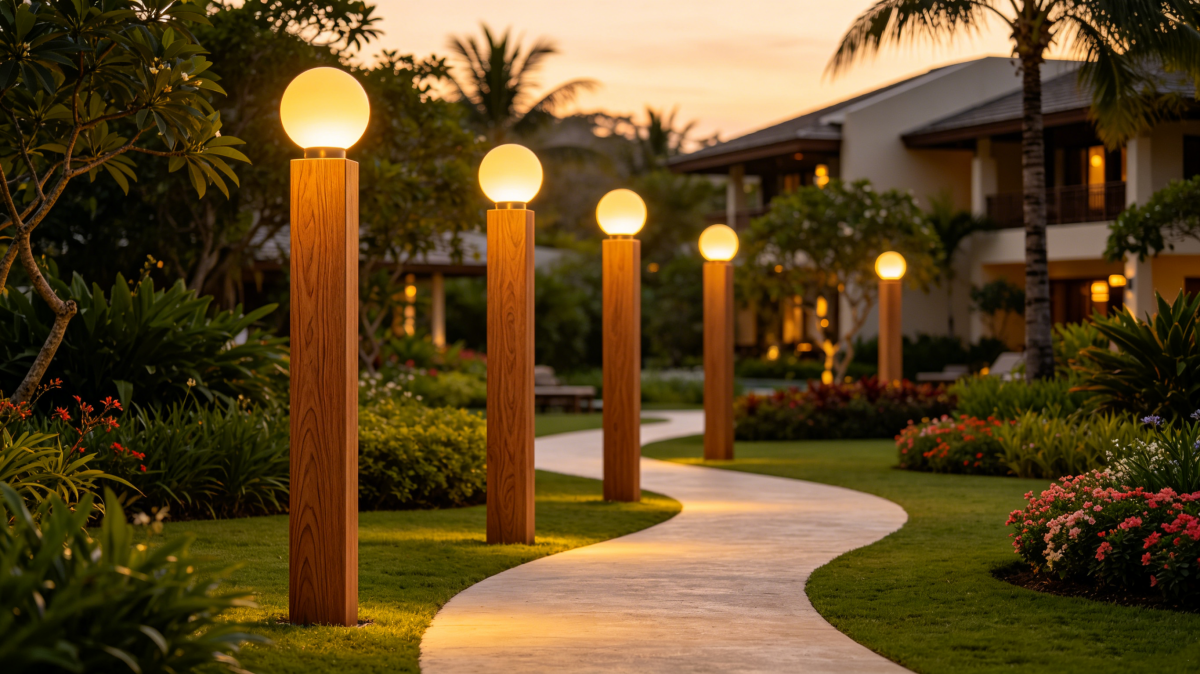
In the resort and hospitality sectors, these poles are deployed across a wide spectrum of functional and decorative applications. Primary use cases include structural supports for luxury cabanas, architectural trellises, exterior lighting stanchions, and integrated wayfinding signage posts. Coastal and island resorts particularly benefit from this material substitution, as the poles can be engineered to withstand cyclic wind loads exceeding 130 mph without the risk of splintering or catastrophic brittle failure. Furthermore, the non-combustible nature of aluminum fulfills strict commercial fire safety codes, making it an optimal choice for high-density guest areas, fire pit perimeters, and outdoor dining pavilions where natural timber might be heavily restricted by local building authorities.
Technical Specifications and Quality Factors
Specifying a wood-grain aluminum pole requires a precise understanding of metallurgical properties and finishing standards. Commercial buyers must evaluate physical extrusions alongside the chemical resilience of the applied wood finish to guarantee long-term performance in aggressive, high-salinity, or high-UV climates.
Material grades, wall thickness, and surface treatments
The foundation of a reliable architectural pole lies in the selection of the aluminum alloy and its corresponding temper. For architectural applications requiring complex extruded profiles and moderate load-bearing capacity, the 6063-T5 alloy serves as the industry baseline. When superior structural yield strength is necessary, such as in high-clearance lighting poles or heavy-duty pergola uprights, structural engineers typically specify 6061-T6. Wall thickness operates as a critical performance metric; commercial resort applications demand a minimum wall thickness of 1.5mm to 2.0mm for decorative elements, scaling up to 3.0mm to 5.0mm for primary structural supports. The surface treatment must comply with stringent architectural standards, typically utilizing AAMA 2604 or AAMA 2605 certified powder coatings. These high-performance, fluoropolymer-based finishes ensure the sublimated wood grain retains precise color fidelity and chalk resistance for 10 to 15 years, even under the intense ultraviolet radiation typical of tropical resort latitudes.
Key comparison points for supplier evaluation
Supplier evaluation should hinge on verifiable quality control metrics rather than relying solely on aesthetic showroom samples. Procurement teams must systematically assess the uniformity of the sublimation transfer, checking for pattern repetition limits, seamless edge-wrap consistency, and the absence of thermal distortion.
| Feature | Natural Hardwood | Standard Powder-Coated Aluminium | Wood Grain Sublimated Aluminium |
|---|---|---|---|
| Lifespan (Outdoor) | 5–10 years (with maintenance) | 15–20+ years | 15–20+ years |
| Maintenance Frequency | High (Bi-annual sealing) | Low (Periodic washing) | Low (Periodic washing) |
| Termite/Rot Resistance | Poor to Moderate | Excellent | Excellent |
| Aesthetic Profile | Authentic organic | Monolithic/Flat | High-fidelity organic simulation |
| Weight Profile | Heavy (High dead load) | Lightweight | Lightweight |
Beyond visual inspections, buyers must demand rigorous documentation on accelerated weathering and salt spray testing. For coastal resort deployments, suppliers should provide laboratory test reports demonstrating a minimum of 3,000 hours of salt spray exposure without finish blistering, undercutting, or filiform corrosion.
Sourcing, Specification, and Approval
Successfully integrating a wood-grain aluminum pole into a large-scale landscape project necessitates a strategic approach to sourcing, specification, and rigorous compliance tracking. Navigating custom extrusion capabilities, international supply chains, and site-specific engineering approvals is paramount for procurement professionals to ensure project viability.
Steps to improve custom procurement outcomes
Optimizing the procurement process begins with understanding supplier manufacturing constraints and commercial lead times. Custom profile dies typically require an initial capital investment ranging from $500 to $2,500, depending heavily on cross-sectional complexity and die diameter. Manufacturers generally impose a Minimum Order Quantity (MOQ) between 500 kg and 1,000 kg per extrusion profile to justify the setup costs associated with the intricate sublimation film transfer process. Project managers should factor in a standard production lead time of 4 to 6 weeks, plus an additional 3 to 5 weeks for ocean freight if sourcing internationally. Requesting a physical prototype—often a 300mm to 500mm cut sample—is a mandatory validation step. This allows stakeholders to verify the grain pattern realism, confirm color matching against actual timber elements on-site, and measure dimensional tolerances before authorizing mass production.
Approval criteria for buyers and project stakeholders
Final approval criteria must explicitly satisfy both aesthetic designers and structural engineering teams. By ensuring that the visual fidelity meets design expectations and the metallurgical properties comply with safety codes, stakeholders can confidently deploy these engineered poles to achieve a lasting, premium resort landscape.
Key Takeaways
- The most important conclusions and rationale for the wood grain aluminum pole
- Specs, compliance, and risk checks worth validating before you commit
- Practical next steps and caveats readers can apply immediately
Frequently Asked Questions
Why choose a wood-grain aluminum pole instead of real timber for resort landscapes?
It delivers a wood-like appearance with lower maintenance, no termite or rot risk, and lighter weight for easier installation in resort projects.
What aluminum grades are best for wood grain aluminum poles?
6063-T5 suits decorative architectural poles, while 6061-T6 is better for higher structural loads such as lighting or pergola supports.
What wall thickness is recommended for resort applications?
Use 1.5–2.0mm for decorative poles and 3.0–5.0mm for primary structural supports, depending on load, height, and wind conditions.
How can buyers verify finish quality before ordering?
Request AAMA 2604 or 2605 coating data, salt spray and weathering test reports, plus sample checks for grain consistency, edge wrap, and distortion.
Can Morelux provide customized wood grain aluminium pole solutions for projects?
Yes. Morelux supports custom sizes, drawings, engineer review, and fast quotations for project buyers needing dependable manufacturing and responsive communication.