Introduction
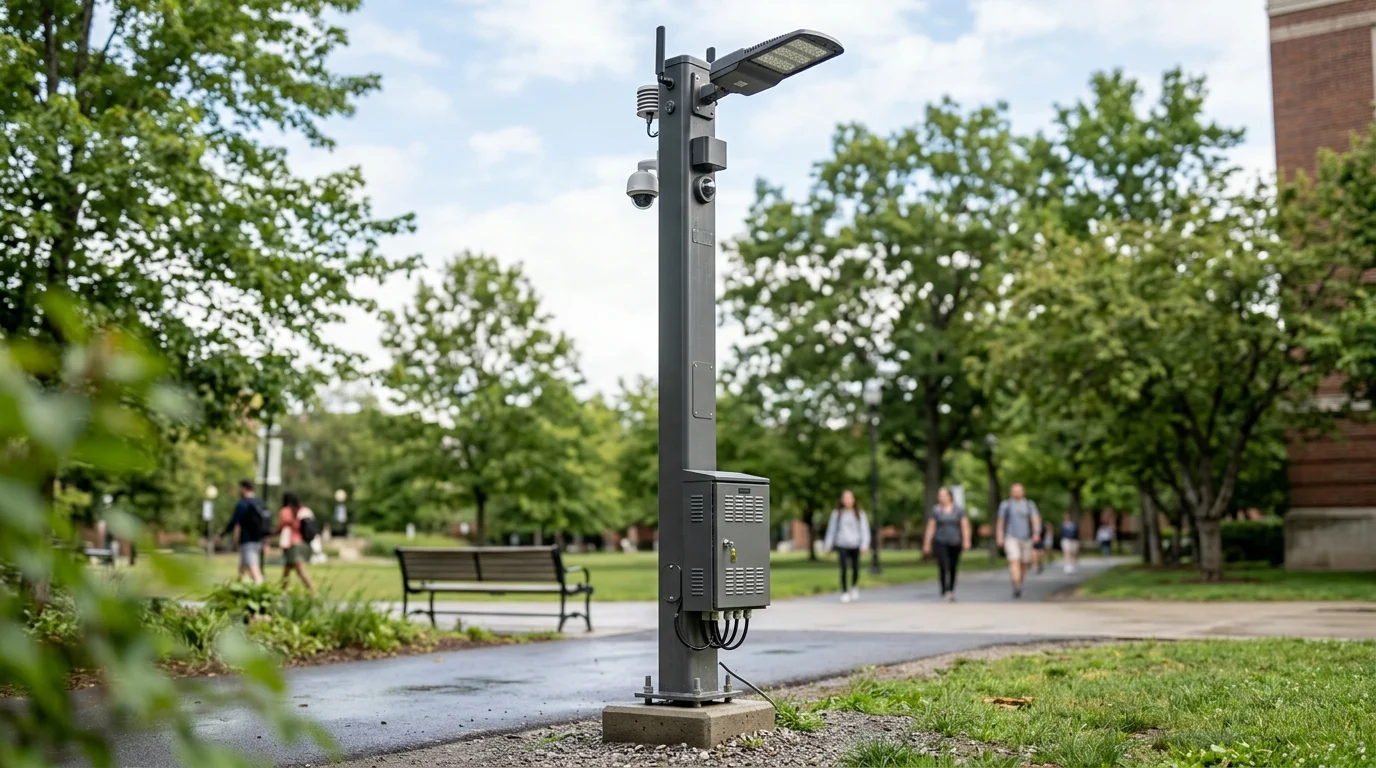
Modern intersections cannot wait on distant cloud servers when signal timing, pedestrian detection, and collision warnings must be decided in milliseconds. An edge computing smart pole brings sensing, processing, and communications into a single streetside platform, allowing traffic data to be analyzed where it is generated and reducing both latency and backhaul demand. This article explains how smart pole design supports real-time traffic response, what hardware and networking choices matter most, and why cities are using localized compute to improve safety, operational efficiency, and infrastructure return on investment before those design tradeoffs are explored in detail.
Why Edge Computing Smart Pole Design Matters
The deployment of the edge computing smart pole represents a critical evolution in urban infrastructure, shifting data processing from centralized cloud architectures directly to the street level. By embedding high-performance compute nodes within municipal lighting structures, city planners eliminate bandwidth bottlenecks and transmission delays inherent in traditional networks, creating a highly responsive digital canopy over the roadway. This shift is crucial in dense urban intersections, where vehicular and pedestrian data volumes easily overwhelm conventional telecommunications infrastructure.
Traffic, Safety, and ROI Drivers
Implementing localized compute capabilities fundamentally alters the operational economics of intelligent transportation systems. Traditional cloud-dependent traffic cameras require a constant high-bandwidth uplink, incurring substantial recurring data transmission costs and risking packet loss during network congestion. By processing video feeds and LiDAR point clouds locally, an edge computing smart pole transmits only actionable metadata—such as vehicle counts, trajectory predictions, or collision alerts—reducing backhaul bandwidth requirements by up to 95%. This consolidation of telecommunications, lighting, and computing hardware typically yields a return on investment (ROI) within 36 to 60 months. The financial recovery is driven heavily by reduced cellular data expenditures, streamlined maintenance routing, and the elimination of redundant trenching for independent sensor masts.
Use Cases Requiring Millisecond Response
The primary catalyst for moving computational power to the physical edge is the strict latency requirement of advanced traffic management and autonomous mobility. Standard cloud architectures generally introduce 100 to 250 milliseconds of round-trip latency, which is unacceptably slow for critical safety interventions. Cellular Vehicle-to-Everything (C-V2X) protocols demand sub-20 millisecond localized response times to effectively alert autonomous vehicles of pedestrian incursions or red-light runners. At a vehicle speed of 60 km/h, a 100-millisecond network delay translates to 1.6 meters of travel distance before an automated system even receives a warning. Reducing that network latency to 10 milliseconds via pole-mounted edge nodes cuts this blind travel distance to just 16 centimeters, providing the critical reaction margin necessary for automated emergency braking systems to prevent collisions.
Key Technical Design Choices for Smart Poles
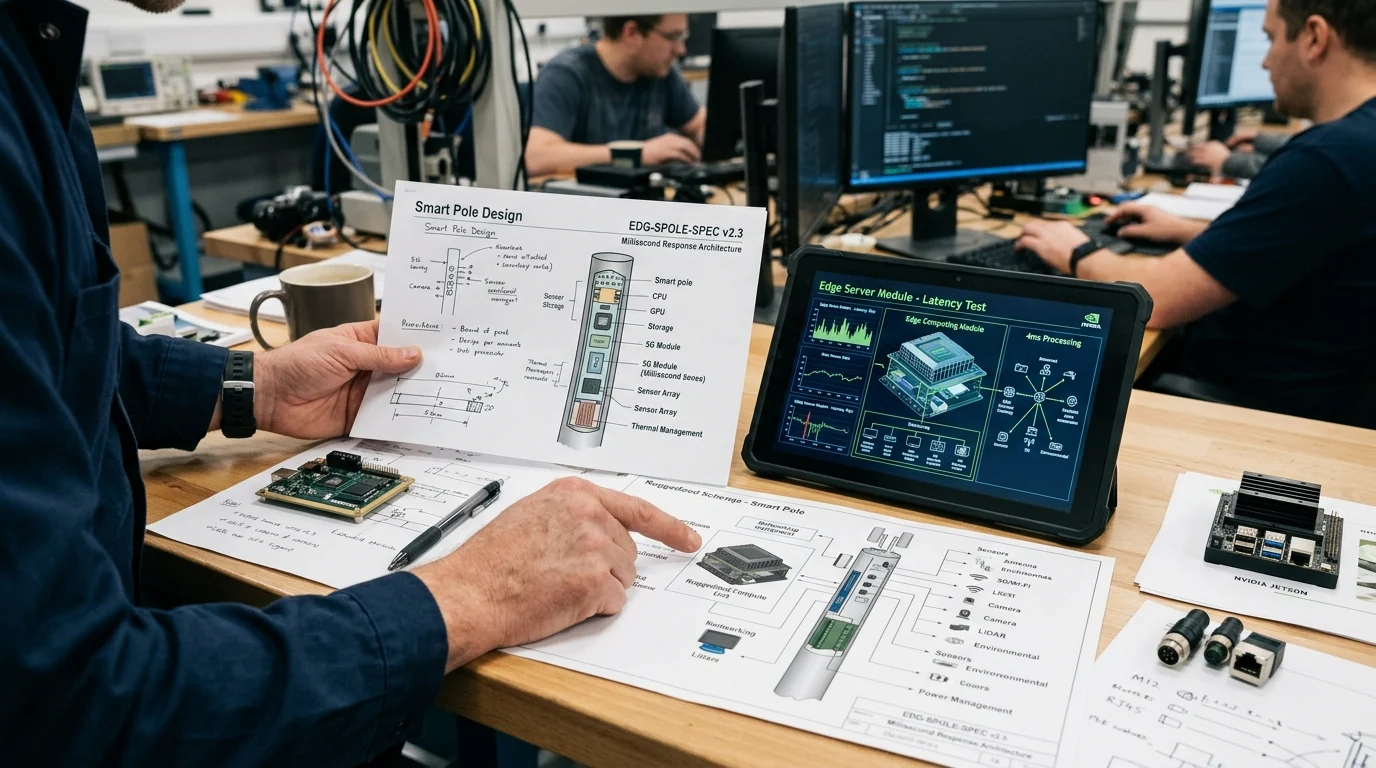
Transforming a static structural asset into a high-availability micro-data center necessitates complex systems engineering. The architecture of an edge computing smart pole must balance extreme processing demands with severe environmental and physical constraints at the street level.
Compute, Sensors, Connectivity, Power, and Thermal Design
A fully equipped intelligent pole integrates neural processing units (NPUs) for multi-stream video analytics, solid-state LiDAR, environmental sensors, and 5G small cell transceivers. Using industrial-grade hardware such as specialized AI accelerators ensures the system can handle concurrent computer vision tasks without dropping frames. However, this dense aggregation of hardware fundamentally alters the power and thermal dynamics of the structure. While a standard LED luminaire draws roughly 50 to 80 watts, an edge computing smart pole routinely demands an aggregated power budget exceeding 500 watts. Dissipating the resulting heat without active cooling fans—which are highly prone to mechanical failure in outdoor environments—requires advanced thermal management. Engineers must design custom passive heat sinks and thermally conductive enclosures capable of dissipating 150 to 300 watts of compute-generated heat while maintaining internal ambient temperatures below 65°C to prevent CPU thermal throttling.
How to Evaluate Smart Pole Performance
Validating the operational efficacy of these structures requires analyzing both computational throughput and environmental resilience. Key performance indicators include AI inference speeds, measured in Tera Operations Per Second (TOPS), and network packet latency under heavy-payload conditions. Furthermore, the enclosure must meet stringent ingress protection ratings, typically IP66 or IP67, and high impact resistance ratings like IK10 to survive extreme weather events and physical vandalism.
| Performance Metric | Cloud-Dependent Smart Pole | Edge Computing Smart Pole |
|---|---|---|
| Data Processing Location | Centralized Data Center | Localized Micro-Data Center |
| Round-Trip Latency | 100 – 250 milliseconds | 5 – 20 milliseconds |
| Backhaul Bandwidth Required. | >50 Mbps (Continuous Video) | <1 Mbps (Metadata Only) |
| Compute Capability | Minimal (Basic MCU) | 20 – 100+ TOPS (AI NPUs) |
How to Specify, Validate, and Procure Smart Poles
The procurement of advanced urban infrastructure requires a complete departure from traditional civil engineering purchasing models. Municipalities and system integrators must approach the acquisition of an edge computing smart pole as an enterprise IT investment, prioritizing strict interoperability, lifecycle management, and a highly scalable architecture.
Vendor Selection and Interoperability Requirements
Navigating the fragmented smart city ecosystem demands strict adherence to open standards to avoid crippling vendor lock-in. Procurement specifications should mandate compliance with established interoperability frameworks, such as the TALQ Consortium standards for central management software and O-RAN architecture for 5G small cell integration. At the hardware level, structural interfaces must utilize standardized mechanical and electrical connections. Specifying ANSI C136.41 7-pin receptacles or the newer Zhaga Book 18 standards ensures that sensor payloads and communication nodes can be swapped or upgraded independently of the primary pole chassis. Furthermore, edge operating systems should support containerized microservices via Docker or Kubernetes, allowing municipalities to deploy third-party traffic analytics software securely via zero-trust network architectures.
Balancing Performance, Upgradeability, and Cost
Capital expenditure (CAPEX) for intelligent street infrastructure scales significantly with computational capacity. While a traditional galvanized steel light pole costs between $2,000 and $4,000, a fully equipped edge computing smart pole with integrated LiDAR, 5G transceivers, and AI inference modules requires an initial investment ranging from $8,000 to $15,000 or more per unit. To justify this premium, the physical infrastructure must outlast the rapid obsolescence cycle of IT hardware. Financial modeling must account for this dual-lifecycle reality. Utilizing standardized, modular payload bays allows engineers to replace computing blades and network switches every 3 to 5 years without incurring the heavy civil engineering costs of replacing the 20-year structural steel asset. This modularity minimizes long-term operational expenditures (OPEX) and ensures the network can continuously scale to meet future autonomous transit demands.
Key Takeaways
- The most important conclusions and rationale for edge computing smart poles
- Specs, compliance, and risk checks worth validating before you commit
- Practical next steps and caveats readers can apply immediately
Frequently Asked Questions
What latency should an edge computing smart pole achieve for traffic safety?
For C-V2X and collision alerts, target a localized response of 5–20 milliseconds. This supports faster warnings for pedestrian detection, red-light violations, and automated braking near busy intersections.
How much bandwidth can edge processing save on a smart pole?
By analyzing video and LiDAR locally and sending only metadata, bandwidth demand can drop by up to 95%. This helps cities reduce recurring backhaul and cellular data costs.
What protection ratings are recommended for outdoor edge computing smart poles?
Specify at least IP66 or IP67 for enclosure sealing and IK10 for impact resistance. These ratings help protect electronics from rain, dust, vandalism, and harsh street environments.
Can Morelux customize edge computing smart poles for project requirements?
Yes. Morelux supports custom steel and aluminum smart pole solutions with technical drawings, engineer support, and in-house manufacturing for infrastructure, city, and commercial projects.
What should buyers request before procuring an edge computing smart pole?
Ask for technical drawings, load and enclosure details, power budget, thermal design, IP/IK ratings, and manufacturing lead time. Fast project quotes and engineering review help reduce procurement risk.