Streetlight poles often fade into the background until corrosion, vibration fatigue, or foundation damage turns them into a public safety and budget problem. As many municipal and commercial lighting assets approach or exceed a 30-year design life, project teams need a clear way to decide whether to repair, reinforce, or replace them. This guide breaks down the cost logic behind pole retrofits, including typical budget ranges, structural warning signs, material impacts, and foundation-related cost drivers. For cities, campuses, utilities, and infrastructure buyers, the goal is practical: reduce liability, extend service life where safe, and reserve full replacement budgets for poles that truly require it.
How to Frame Aging Streetlight Pole Retrofits
Municipalities and commercial facility managers face mounting infrastructure deficits as millions of streetlight poles approach or exceed their original 30-year design lifespans. Addressing these aging assets requires a systematic approach to asset management, balancing capital expenditure with strict public safety mandates.
Rather than defaulting to expensive full-scale replacements, infrastructure operators are increasingly turning to engineered retrofits. This approach mitigates liability while optimizing municipal and private budgets.
Why aging streetlight poles create safety and reliability risks
The primary degradation mechanisms for aging streetlight poles include base-level corrosion, metal fatigue from wind-induced vibration, and concrete foundation spalling. For carbon steel poles, soil-to-air interface corrosion is particularly aggressive due to the accumulation of moisture, road salts, and debris around the base plate.
Engineering assessments indicate that a localized wall thickness loss exceeding 15% to 20% severely compromises the structural integrity of the pole. Once this threshold is crossed, the asset becomes highly susceptible to catastrophic failure during high-wind events. Furthermore, micro-cracking around the handhole or base plate weldments introduces significant liability, escalating the probability of sudden collapse and secondary electrical hazards.
How to distinguish repair, retrofit, and replacement projects
Infrastructure managers must establish strict operational definitions to categorize pole interventions accurately and allocate funding. Repair projects are strictly localized corrective actions, such as re-welding a minor base plate crack, replacing a missing handhole cover, or applying touch-up paint. These are low-cost, low-complexity tasks typically costing under $150 per unit.
Retrofit projects involve structural reinforcement or comprehensive barrier applications designed to extend the asset’s functional life by 10 to 20 years without extracting the foundation. This includes installing steel sleeves or structural composite wraps. Replacement projects mandate the complete removal of the existing pole and luminaire, often requiring new anchor bolts, poured concrete footings, and extensive civil engineering work, representing the highest capital and labor outlay.
Key Cost Drivers for Streetlight Pole Retrofits
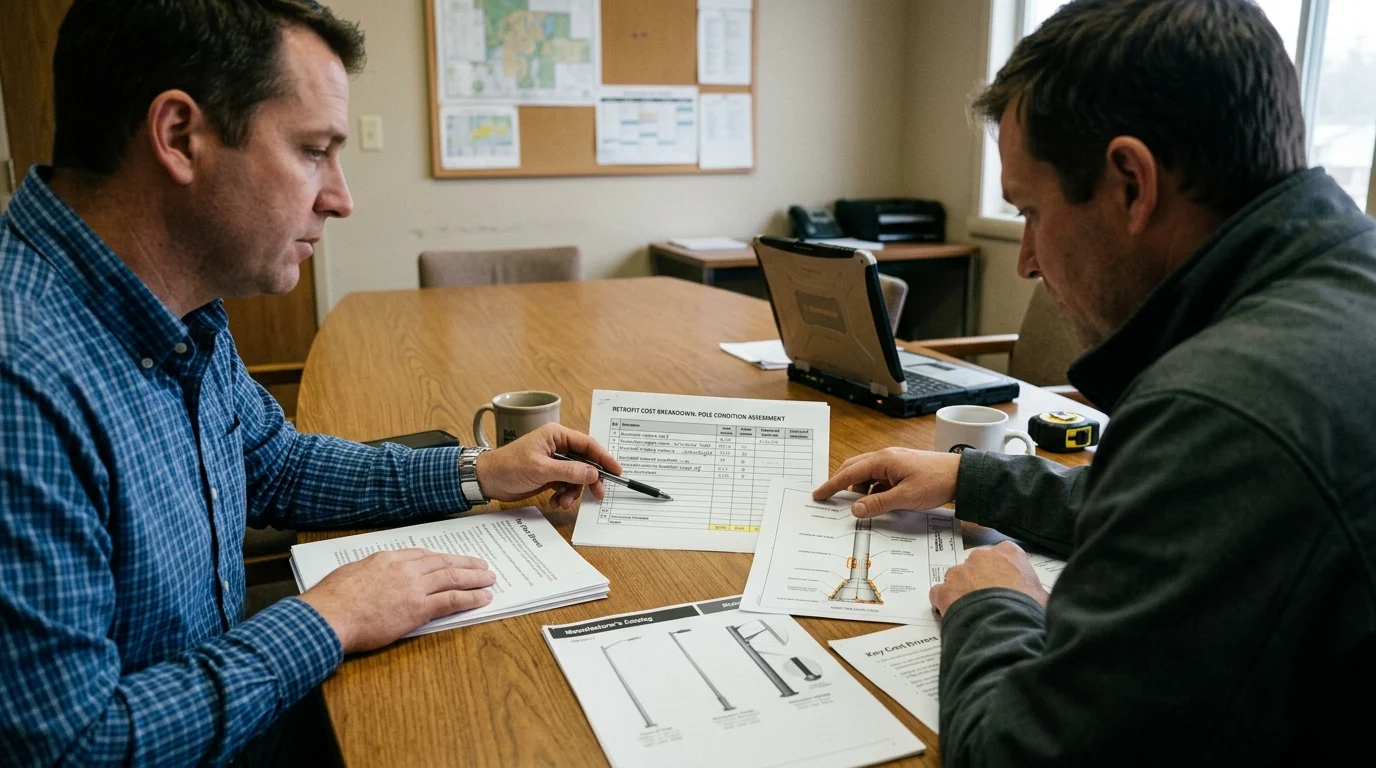
A comprehensive cost analysis is critical when evaluating streetlight rehabilitation at scale. While unit costs vary significantly based on regional labor markets and material availability, a standard structural retrofit typically commands an investment of $300 to $1,200 per pole, compared to the $2,500 to $4,500 baseline required for complete replacement.
How pole material, height, and foundation condition affect cost
The physical characteristics of the existing infrastructure dictate the baseline retrofit expenses. Steel poles generally offer the most cost-effective retrofit pathways, as carbon steel readily accepts weld-on sleeves and heavy-duty epoxy coatings. Aluminum poles, while resistant to standard oxidation, are highly susceptible to galvanic corrosion and require specialized TIG welding for structural repairs, driving up material and labor costs by 20% to 30%.
Height is another critical multiplier; poles exceeding 30 feet necessitate Class 7 or 8 bucket trucks and introduce stricter wind-loading compliance requirements during the retrofit process. Finally, foundation condition plays a massive role. If the anchor bolts exhibit more than 10% section loss, the retrofit requires expensive base modification or drilling.
| Pole Material | Typical Degradation | Retrofit Complexity | Est. Retrofit Cost Band |
|---|---|---|---|
| Carbon Steel | Base corrosion, rust scaling | Low to Moderate | $300 – $750 |
| Aluminum | Galvanic corrosion, fatigue | High (Specialized welding) | $600 – $1,100 |
| Concrete | Spalling, exposed rebar | Moderate (Epoxy injection) | $450 – $900 |
How labor, access, traffic control, and outages affect cost
Logistical and operational variables frequently eclipse the cost of the physical materials. Prevailing wage requirements for municipal contracts directly inflate labor expenditures, while site accessibility dictates hourly productivity. A crew might retrofit six poles a day in a sprawling suburban parking lot, but only two per day in a congested downtown corridor.
Traffic control is a primary cost driver in urban environments. Securing lane closure permits, deploying crash attenuator trucks, and hiring certified flaggers can add $500 to $1,500 per day to the project overhead. Additionally, if the retrofit necessitates de-energizing the local grid, utility coordination fees and night-work premiums—often 20% to 30% above standard daytime rates—must be factored into the final unit cost.
Retrofit Options to Compare
Selecting the appropriate technical intervention requires aligning the specific degradation mechanism with a proven engineering solution. The goal of any retrofit is to restore the pole’s structural capacity to its original design specification while neutralizing active corrosion cells.
How to evaluate sleeve reinforcement, base repairs, and coatings
Structural sleeve reinforcement is the premier methodology for addressing severe base deterioration. This involves welding or bolting a custom-fabricated steel half-shell around the compromised lower section of the pole, effectively transferring the load from the weakened shaft directly to the base plate. This method is highly effective for poles suffering up to 50% wall loss at the base.
For non-structural surface degradation, high-build industrial coatings provide an excellent mitigation strategy. Polyurethane or two-part epoxy systems, applied at a minimum dry film thickness (DFT) of 10 to 15 mils, create a robust barrier against moisture and road salts. Base repair techniques utilizing specialized high-strength grout or concrete encasement can also stabilize the foundation interface, preventing further moisture ingress at the anchor bolts.
When retrofitting provides better value than replacement
Financial prudence dictates that retrofitting is not a universal remedy. The value proposition of a retrofit is strongest when the underground infrastructure—specifically the concrete foundation, anchor bolts, and electrical conduit—remains structurally sound. If a pole requires a $800 sleeve retrofit to yield 15 additional years of service, the annualized cost is highly favorable compared to a $3,500 replacement yielding 30 years.
| Evaluation Metric | Retrofit Intervention | Full Replacement |
|---|---|---|
| Upfront Capital Cost | $300 – $1,200 | $2,500 – $4,500+ |
| Asset Life Extension | 10 to 20 years | 30 to 40 years |
| Civil Work Required | Minimal to None | Extensive (Excavation/Concrete) |
| Grid Outage Duration | 1 to 3 hours | 1 to 2 days |
Compliance and Engineering Requirements
Modifying public infrastructure carries significant liability. All retrofit protocols must adhere to stringent structural engineering codes and local municipal specifications to ensure public safety and mitigate legal exposure for the facility owner.
Which structural standards and wind loading checks apply
In North America, streetlight pole structural integrity is heavily governed by the AASHTO LTS (Standard Specifications for Structural Supports for Highway Signs, Luminaires, and Traffic Signals). Any applied retrofit must not compromise the pole’s ability to withstand localized wind loads, which are dictated by regional wind maps.
For example, poles situated in coastal hurricane zones must be certified to withstand basic wind speeds of 130 to 150 mph, whereas inland commercial poles may only be rated for 90 mph. The addition of a structural sleeve or concrete encasement alters the pole’s aerodynamic profile, weight, and stiffness. This modification requires a registered professional engineer (PE) to recalculate the base shear and overturning moments, ensuring the retrofitted structure remains within allowable deflection limits under peak gust conditions.
How to source qualified contractors and approved materials
Sourcing strictly vetted materials and personnel is imperative for maintaining code compliance. Structural welding performed during a retrofit must be executed by personnel certified under AWS D1.1 (Structural Welding Code – Steel) or AWS D1.2 for aluminum applications. Improper field welds can introduce new stress risers that accelerate fatigue failure.
Materials utilized in the retrofit must meet exact metallurgical specifications, such as ASTM A595 for structural steel tubes or ASTM A123 for hot-dip galvanizing. Furthermore, procurement managers should mandate that contractors submit detailed Inspection and Test Plans (ITPs), utilizing NACE-certified inspectors to verify coating adhesion and ultrasonic testing (UT) technicians to validate weld penetration before signing off on the completed project.
How to Build a Practical Retrofit Plan
Executing a large-scale streetlight rehabilitation initiative requires transitioning from theoretical engineering to a phased, data-driven deployment strategy. Unplanned emergency replacements severely disrupt capital budgets, making proactive asset management essential.
How to prioritize inspections, pilot testing, and budgeting
A successful retrofit program begins with a comprehensive, risk-based inspection regimen. Utilizing ultrasonic thickness (UT) gauges, technicians should baseline the remaining wall thickness of the inventory, prioritizing poles situated near high-traffic intersections, pedestrian zones, or in corrosive coastal environments.
Once the field data is aggregated, facility managers should execute a pilot program, applying the selected retrofit methodologies to a representative 5% sample of the compromised inventory. This pilot phase establishes precise labor times, validates traffic control requirements, and uncovers site-specific challenges. It also allows budget analysts to establish a standard deviation for the project, typically necessitating a 15% to 20% contingency fund to absorb unforeseen subsurface complications discovered during excavation.
How to choose between urgent repair, retrofit, and replacement
The final phase of planning requires a rigid decision matrix to route each pole into the correct intervention category. Urgent repairs are reserved for superficial damage that poses no immediate structural threat, such as missing handhole covers exposing high-voltage wiring, which must be addressed within 48 hours to mitigate shock hazards.
The threshold for retrofitting versus replacement relies heavily on the 60% rule: if the total cost of the engineering assessment, traffic control, and structural retrofit exceeds 60% of the cost of a complete replacement, capital is better deployed toward a new installation. Poles exhibiting anchor bolt failure, severe internal shaft corrosion exceeding 30% wall loss, or foundation cracking automatically bypass the retrofit category and mandate immediate replacement to neutralize public safety hazards.
Key Takeaways
- Inspect wall thickness early because localized metal loss above 15% to 20% can severely compromise pole strength in high-wind events.
- Use repair for minor localized issues under about $150 per unit, but choose retrofit when structural reinforcement or barrier protection is needed.
- Budget roughly $300 to $1,200 per pole for structural retrofit compared with about $2,500 to $4,500 for full replacement.
- Evaluate anchor bolts carefully because more than 10% section loss can trigger costly base modification or drilling.
- Expect aluminum pole retrofits to cost 20% to 30% more than comparable steel work due to specialized welding and corrosion controls.
- Plan retrofits as life-extension projects that may add 10 to 20 years of service when the foundation and main pole structure remain viable.
Frequently Asked Questions
When should an aging streetlight pole be retrofitted instead of replaced?
Retrofit is appropriate when the pole and foundation remain structurally viable but need reinforcement, corrosion protection, or life extension. If anchor bolts, base plates, or foundations are severely compromised, full replacement may be safer and more economical.
How much does a typical streetlight pole retrofit cost?
A standard structural retrofit often costs about $300 to $1,200 per pole, depending on material, height, access, corrosion level, and foundation condition. Full replacement can cost roughly $2,500 to $4,500 per pole.
What are the biggest safety risks with aging streetlight poles?
Common risks include base-level corrosion, wind-induced metal fatigue, foundation spalling, cracked welds, and handhole damage. Localized wall thickness loss above 15% to 20% can significantly reduce structural integrity.
Are steel or aluminum poles easier to retrofit?
Steel poles are usually more cost-effective to retrofit because they accept weld-on sleeves and epoxy coatings well. Aluminum poles may require specialized TIG welding and galvanic corrosion controls, increasing costs by 20% to 30%.
How long can a retrofit extend pole service life?
A properly engineered retrofit can often extend functional service life by 10 to 20 years, provided the existing pole, anchor bolts, and foundation meet structural requirements after inspection.