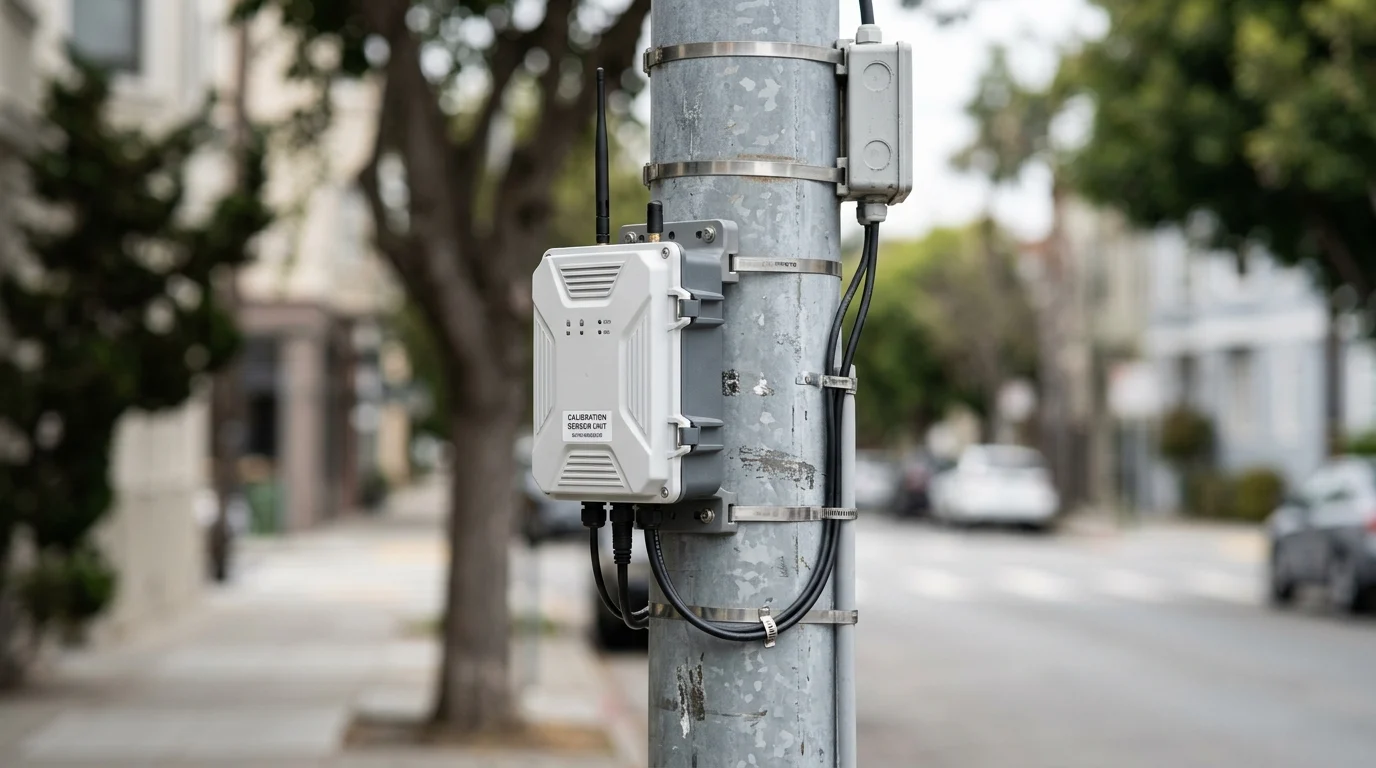
Reliable pole-mounted sensing depends less on device count than on whether each sensor stays calibrated under real street conditions. In street pole deployments, vibration, height, solar loading, traffic turbulence, and seasonal drift can all skew readings for air quality, noise, weather, and motion monitoring. This article explains where calibration errors typically emerge, how those errors affect data trustworthiness and regulatory usefulness, and what engineers should evaluate before and after installation. The goal is to help readers distinguish between nominal sensor specifications and field accuracy, so the discussion can move directly into the deployment pitfalls that most often compromise street-level IoT data.
Why IoT Sensor Calibration Matters for Street Pole Applications
Urban infrastructure relies heavily on distributed intelligence, making IoT sensor calibration for street pole applications a critical engineering mandate. As municipalities transition from pilot projects to city-wide deployments, the integrity of localized data—ranging from environmental air quality to acoustic traffic monitoring—depends entirely on sustained sensor accuracy.
Deployment goals and measurement accuracy
The primary objective of deploying pole-mounted sensor arrays is to capture hyper-local, actionable data that informs public policy and automated traffic systems. However, measurement accuracy degrades rapidly without rigorous calibration protocols. For environmental monitoring, such as particulate matter (PM2.5) and nitrogen dioxide (NO₂) detection, indicative sensors must maintain an accuracy threshold of ±15% relative to federal reference monitors to remain legally and operationally viable.
When sensors operate outside this tolerance band, the resulting datasets trigger false regulatory alarms or fail to detect localized pollution spikes. Ultimately, uncalibrated hardware feeds compromised data into civic management platforms, effectively neutralizing the return on investment for multi-million-dollar smart city infrastructure.
Common calibration pitfalls in pole-mounted sensors
Engineers frequently encounter systemic pitfalls when managing pole-mounted hardware. A primary vulnerability is zero-drift, where the baseline reading shifts over time due to sensor aging or continuous exposure to background pollutants. Electrochemical gas sensors, for example, typically exhibit a baseline drift of up to 5% per month if left uncorrected.
Another critical pitfall is cross-sensitivity. Sensors calibrated in isolated laboratory environments may register false positives when exposed to complex urban gas mixtures. Furthermore, operators often deploy identical calibration coefficients across an entire network, ignoring the reality that a sensor mounted at a heavily congested intersection experiences vastly different degradation rates than an identical unit in a quiet residential cul-de-sac.
Factors That Distort Calibration in Street Pole Environments
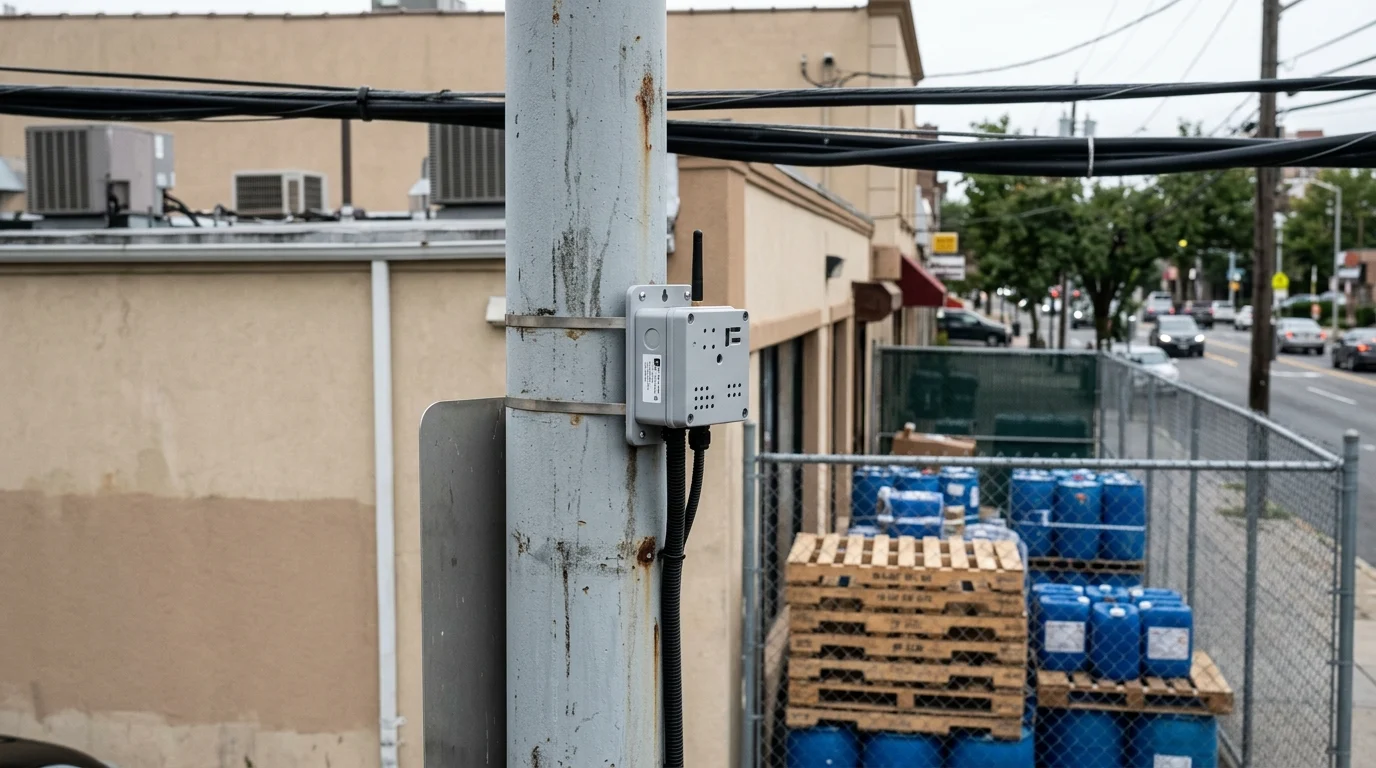
The physical realities of street-level infrastructure introduce severe environmental stressors that systematically dismantle sensor accuracy. Unlike controlled laboratory settings, street poles expose delicate micro-electromechanical systems (MEMS) and optical arrays to extreme, fluctuating conditions that distort baseline measurements.
Mounting, heat, vibration, and enclosure effects
Pole-mounted enclosures frequently act as thermal traps. Direct solar radiation and heat dissipation from co-located hardware—such as 5G small cells or high-output LED luminaires—can elevate internal enclosure temperatures by 15°C to 25°C above ambient levels. This thermal loading directly alters the kinetic properties of electrochemical sensors and shifts the wavelength of optical components.
Additionally, structural vibration from heavy commercial traffic transmits low-frequency mechanical shocks, typically between 10 Hz and 50 Hz, directly up the pole structure. Over continuous months, these micro-vibrations can misalign optical particle counters and loosen internal interconnects, leading to erratic signal-to-noise ratios and accelerated calibration loss.
Factory vs field calibration considerations
Relying solely on factory calibration is a common architectural flaw in smart city planning. Factory settings provide a baseline established under standard temperature and pressure (STP) using clean reference gases. Field calibration, conversely, adjusts the sensor response based on the specific microclimate and mounting orientation of the street pole.
| Parameter | Factory Calibration | Field Calibration |
|---|---|---|
| Environment | Controlled laboratory (STP) | Unpredictable urban microclimates |
| Interference | Single-gas or clean particulate | Complex mixed-gas cross-sensitivity |
| Frequency | Once prior to deployment | Periodic (typically every 6 to 12 months) |
| Drift Correction | None | Compensates for aging and thermal stress |
Transitioning from factory defaults to dynamic field calibration is essential for maintaining data integrity over the multi-year lifespan expected of modern street furniture deployments.
How to Specify, Validate, and Maintain Calibration
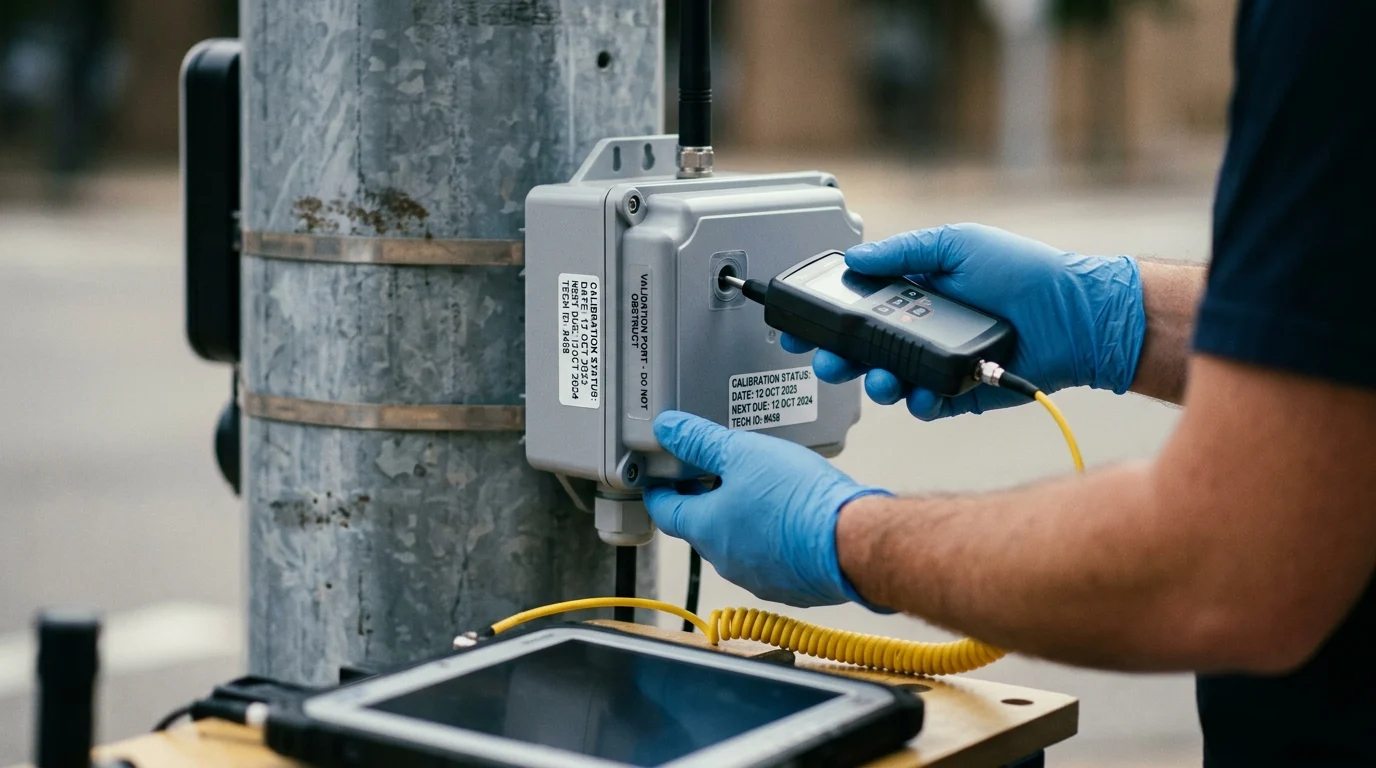
Establishing a robust framework for IoT sensor calibration dictates the long-term operational success of smart pole networks. Engineers and project managers must define precise specifications, validation methodologies, and maintenance schedules before hardware is ever bolted to a municipal asset.
Calibration workflow, acceptance criteria, and traceability
A defensible calibration workflow requires strict traceability to recognized metrological standards, such as ISO/IEC 17025. Procurement specifications must mandate that initial sensor calibrations are traceable to National Institute of Standards and Technology (NIST) reference materials or equivalent global standards. In the field, acceptance criteria typically require deployed nodes to demonstrate less than a 5% variance when co-located with a mobile reference monitor.
To reduce physical maintenance, network operators are increasingly adopting over-the-air (OTA) calibration techniques. These systems utilize edge-based machine learning algorithms to continuously analyze data feeds, identifying and mathematically correcting baseline drift without requiring manual intervention or physical gas challenges.
Choosing service models for municipalities and utilities
The financial logistics of maintaining street pole sensors often dictate the chosen operational model. Traditional maintenance involves dispatching technicians for physical recalibration or sensor swapping, resulting in truck roll costs ranging from $150 to $300 per site visit. For a network of 5,000 poles, these recurring expenses rapidly become unsustainable.
Consequently, municipalities and utility operators are shifting toward calibration-as-a-service (CaaS) models. Under a CaaS agreement, the hardware vendor guarantees data accuracy through a combination of OTA algorithmic corrections and scheduled modular replacements. This proactive approach effectively extends the physical maintenance cycle from an industry-standard 6 months to a highly efficient 18 to 24 months, significantly lowering the total cost of ownership.
Key Takeaways
- The most important conclusions and rationale for IoT sensor calibration on a street pole
- Specs, compliance, and risk checks worth validating before you commit
- Practical next steps and caveats readers can apply immediately
Frequently Asked Questions
Why is field calibration necessary for sensors on street poles?
Factory calibration is only a starting point. Pole height, sun exposure, traffic vibration, and nearby LED or telecom equipment can shift readings, so field calibration keeps data within project accuracy targets.
How often should pole-mounted IoT sensors be recalibrated?
A practical interval is every 6 to 12 months, with shorter cycles at high-traffic or high-heat sites. Recalibrate sooner if drift, false alarms, or large reference-check deviations appear.
What specification should buyers request for calibration traceability?
Ask for calibration records traceable to ISO/IEC 17025 and NIST or equivalent standards. Also require field acceptance criteria, such as less than 5% variance against a reference monitor after installation.
Can pole design affect sensor calibration accuracy?
Yes. Enclosure heat buildup, mounting orientation, vibration, and equipment spacing all affect sensor stability. Morelux can support custom pole layouts and technical drawings to reduce thermal and mechanical calibration risks.
What is a common procurement mistake in smart pole sensor projects?
Using one calibration setup for every location. Busy intersections, coastal roads, and quieter streets age sensors differently, so buyers should specify site-based validation and maintenance plans from the start.