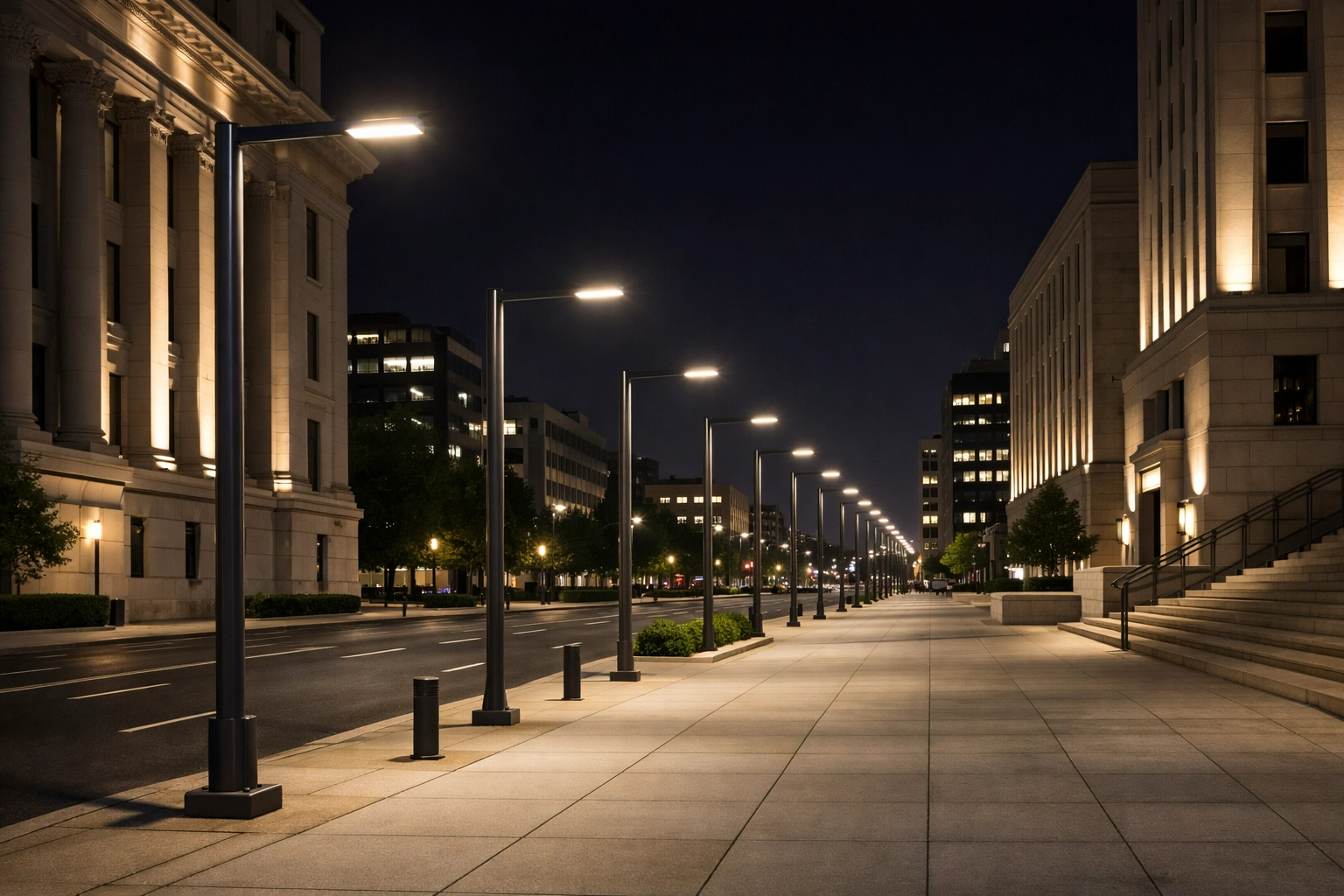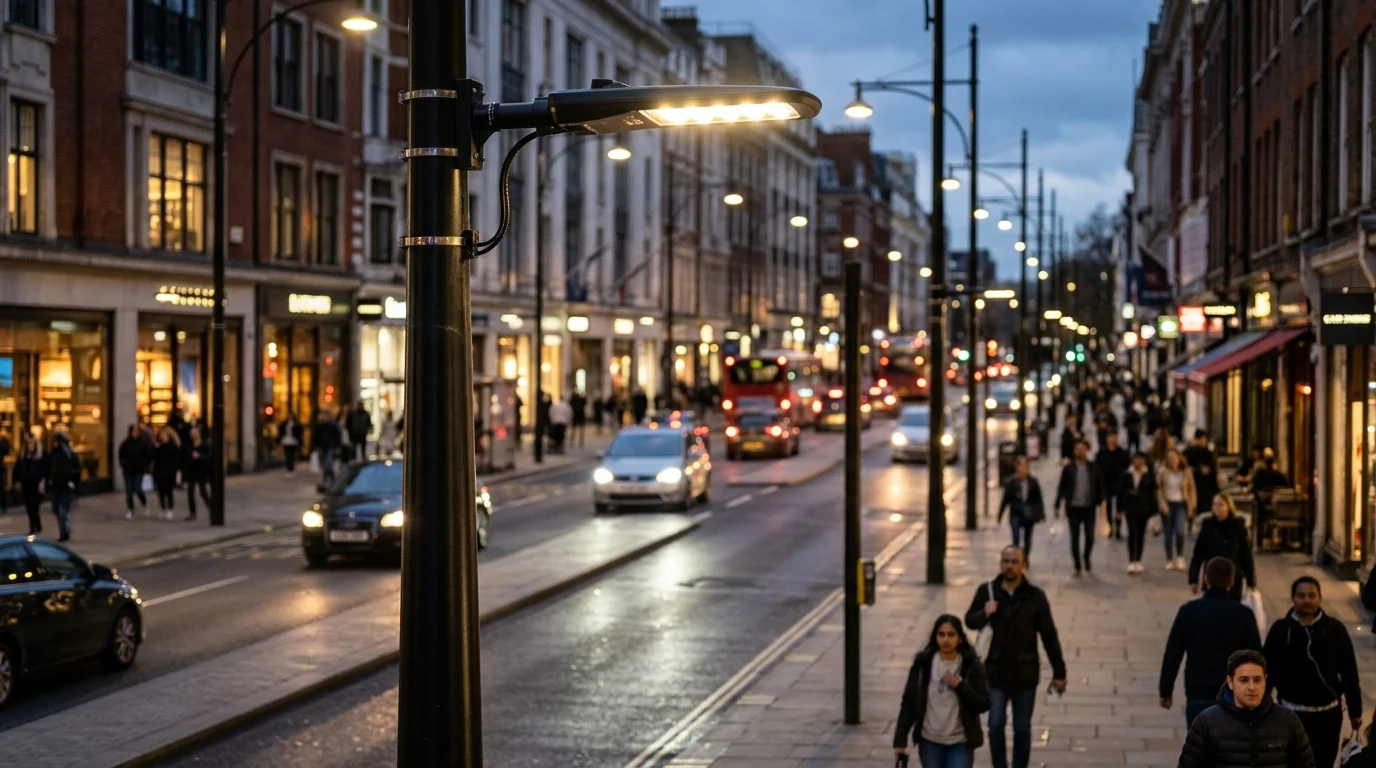
Well-designed commercial street lighting does far more than brighten roads after dark. It shapes how safely people walk, drive, wait, and work in urban spaces, while influencing maintenance budgets, energy use, and public confidence. This article explains why modern lighting systems are treated as core safety infrastructure, not just utility assets. Readers will see how fixture performance, light distribution, and technology choices affect collision risk, visibility, and crime deterrence, and why cities are replacing older systems with more precise, efficient alternatives. With that foundation, the discussion can move into the practical safety benefits and planning factors that define effective commercial street lighting.
Why Commercial Street Lighting Is a Strategic Urban Safety Investment
Strategic urban safety relies heavily on robust commercial street lighting infrastructure. Moving beyond mere illumination, modern municipal lighting networks act as critical safety assets that protect pedestrians, optimize vehicular traffic flow, and deter illicit activities. The transition from legacy high-pressure sodium (HPS) fixtures to advanced solid-state LED lighting has fundamentally altered the economics and efficacy of urban safety planning.
This paradigm shift not only drastically reduces ongoing maintenance requirements but also provides superior optical control. By ensuring that light is directed precisely where it is needed, municipalities can maximize civic security while minimizing environmental light pollution.
How commercial street lighting reduces collision risk and crime
Strategic deployment of commercial street lighting yields measurable reductions in urban hazards. Empirical studies consistently demonstrate that upgrading to high-uniformity LED fixtures can reduce nighttime pedestrian collisions by up to 30%. By improving mesopic vision for drivers through optimized spectral distribution, advanced optics ensure faster reaction times to peripheral movement.
Furthermore, adequate vertical illuminance—typically targeting 2.0 to 5.0 vertical lux at 1.5 meters above grade—enhances facial recognition capabilities for pedestrians and closed-circuit television (CCTV) systems. This specific metric is vital for crime deterrence, as high-visibility environments directly correlate with reduced opportunistic crime rates in complex metropolitan zones. Proper illumination eliminates shadow corridors, thereby increasing the perceived and actual safety of public transit hubs and commercial districts.
Which performance metrics and baselines matter
Evaluating the efficacy of a lighting network requires rigorous adherence to established photometric baselines. Correlated Color Temperature (CCT) and Color Rendering Index (CRI) are primary considerations for visual acuity. Urban planners increasingly specify CCTs between 3000K and 4000K to balance sharp visibility with minimized blue-light scatter, mitigating circadian disruption for local residents. CRI values must exceed 70 to ensure accurate color distinction for vehicles, signage, and clothing.
Additionally, average maintained illuminance levels must align with specific road classifications. For instance, major arterial roads typically require an average of 15 to 20 lux, while local residential streets operate effectively between 5 and 8 lux. Uniformity ratios (average-to-minimum illuminance) should not exceed 3:1 on major roadways to prevent hazardous dark spots that cause pupillary adaptation delays for drivers.
How to Evaluate Commercial Street Lighting Specifications

Selecting the optimal commercial street lighting hardware demands a comprehensive analysis of photometrics, mechanical durability, and electronic architecture. Procurement engineers must scrutinize component-level specifications, including thermal management systems, to ensure long-term reliability in harsh environmental conditions.
Heat dissipation directly impacts the degradation curve of LED diodes, making the physical housing design just as critical as the internal electronics when evaluating overall fixture quality.
Which criteria to compare across fixtures, optics, poles, and controls
Fixture durability is strictly quantified by Ingress Protection (IP) and Impact Protection (IK) ratings. Commercial street lighting typically mandates an IP66 rating to prevent dust and moisture intrusion, alongside an IK08 to IK10 rating to withstand vandalism and debris impact. Electrical resilience is equally crucial; fixtures require robust surge protection devices, typically rated for 10kV/10kA, to survive transient voltage spikes.
Optically, modern luminaires must deliver high luminous efficacy, generally exceeding 130 lumens per watt (lm/W), while utilizing precision lenses (such as Type II, III, or IV distribution patterns) to direct light strictly where needed, minimizing backlight, uplight, and glare (measured via BUG ratings). Furthermore, future-proofing requires fixtures equipped with standard 7-pin NEMA or Zhaga Book 18 receptacles to support adaptive control nodes.
How comparison tables clarify product options
Utilizing standardized comparison frameworks accelerates the specification process and ensures alignment with infrastructural requirements. Comparing form factors enables specifiers to match optical geometry with the physical environment. The following table delineates common commercial street lighting form factors, their typical operational parameters, and deployment scenarios:
| Fixture Type | Typical Mounting Height | Lumen Output Range | Primary Application | Target Uniformity Ratio |
|---|---|---|---|---|
| Cobra Head | 8m – 12m | 8,000 – 30,000 lm | Arterial and collector roadways | < 3:1 |
| Post Top | 4m – 6m | 3,000 – 10,000 lm | Pedestrian walkways, plazas | < 4:1 |
| High Mast | 15m – 30m | 40,000 – 100,000+ lm | Highway interchanges, ports | < 3:1 |
This structured comparison highlights how differing vertical geometries dictate lumen requirements. For instance, high mast installations require exponential lumen output increases to maintain surface illuminance across vast areas, whereas lower post-top fixtures prioritize glare reduction and aesthetic integration within dense pedestrian zones.
How Procurement, Compliance, and Implementation Improve Results
Successful commercial street lighting deployments extend far beyond hardware selection. They require a holistic approach encompassing stringent procurement protocols, regulatory compliance, and systematic implementation strategies to maximize the return on investment.
Focusing purely on capital expenditure often obscures the Total Cost of Ownership (TCO), which is heavily influenced by energy consumption, maintenance cycles, and system interoperability.
How to align design with codes and project goals
Design frameworks must strictly adhere to national and international lighting standards, such as the Illuminating Engineering Society (IES) RP-8-22 for roadway lighting and the ANSI C136 series for physical and electrical interoperability. Compliance ensures that installations meet minimum safety thresholds while avoiding over-illumination, which wastes energy and exacerbates light pollution.
Municipalities increasingly mandate International Dark-Sky Association (IDA)-approved fixtures, requiring a 0% uplight rating (U0 in the BUG system) to preserve nocturnal ecosystems. Aligning these technical codes with overarching project goals—such as achieving a 50% reduction in municipal energy expenditure or complying with strict energy codes like ASHRAE 90.1—requires sophisticated photometric modeling during the early design phases to optimize pole placement and wattage.
Which steps support vendor selection, commissioning, and maintenance
The vendor selection process must prioritize long-term asset lifecycle metrics. Procurement teams should mandate a minimum 10-year comprehensive warranty and an L70 lumen maintenance rating exceeding 100,000 hours. This guarantees the luminaire will retain at least 70% of its initial output after a decade of continuous operation.
During the commissioning phase, meticulous execution is critical; this involves GIS mapping
Key Takeaways
- The most important conclusions and rationale for Commercial Street Lighting
- Specs, compliance, and risk checks worth validating before you commit
- Practical next steps and caveats readers can apply immediately
Frequently Asked Questions
What lighting levels are suitable for safer urban streets?
Major roads usually target 15–20 lux, while residential streets often need 5–8 lux. Keep uniformity tight, ideally under 3:1 on main roads, to reduce dark spots and improve driver reaction time.
Which commercial street lighting specs matter most in procurement?
Focus on IP66, IK08–IK10, surge protection around 10kV/10kA, efficacy above 130 lm/W, and the right optical distribution. Also confirm control readiness with 7-pin NEMA or Zhaga options.
How does commercial street lighting help reduce crime and collisions?
Better uniform LED lighting improves visibility for drivers, pedestrians, and CCTV. It reduces shadowed areas, supports facial recognition with adequate vertical illuminance, and can help lower nighttime collision and opportunistic crime risk.
Can Morelux support custom poles for street lighting projects?
Yes. Morelux supplies custom aluminum and steel poles for roadway, traffic, solar, and smart lighting projects, with technical drawings, engineer support, and in-house manufacturing for reliable project delivery.
How quickly can Morelux provide quotes and technical support?
Morelux emphasizes responsive B2B service, including fast quotations within 24 hours for many inquiries. Project buyers can also request technical drawings and engineering support to speed specification and approval.