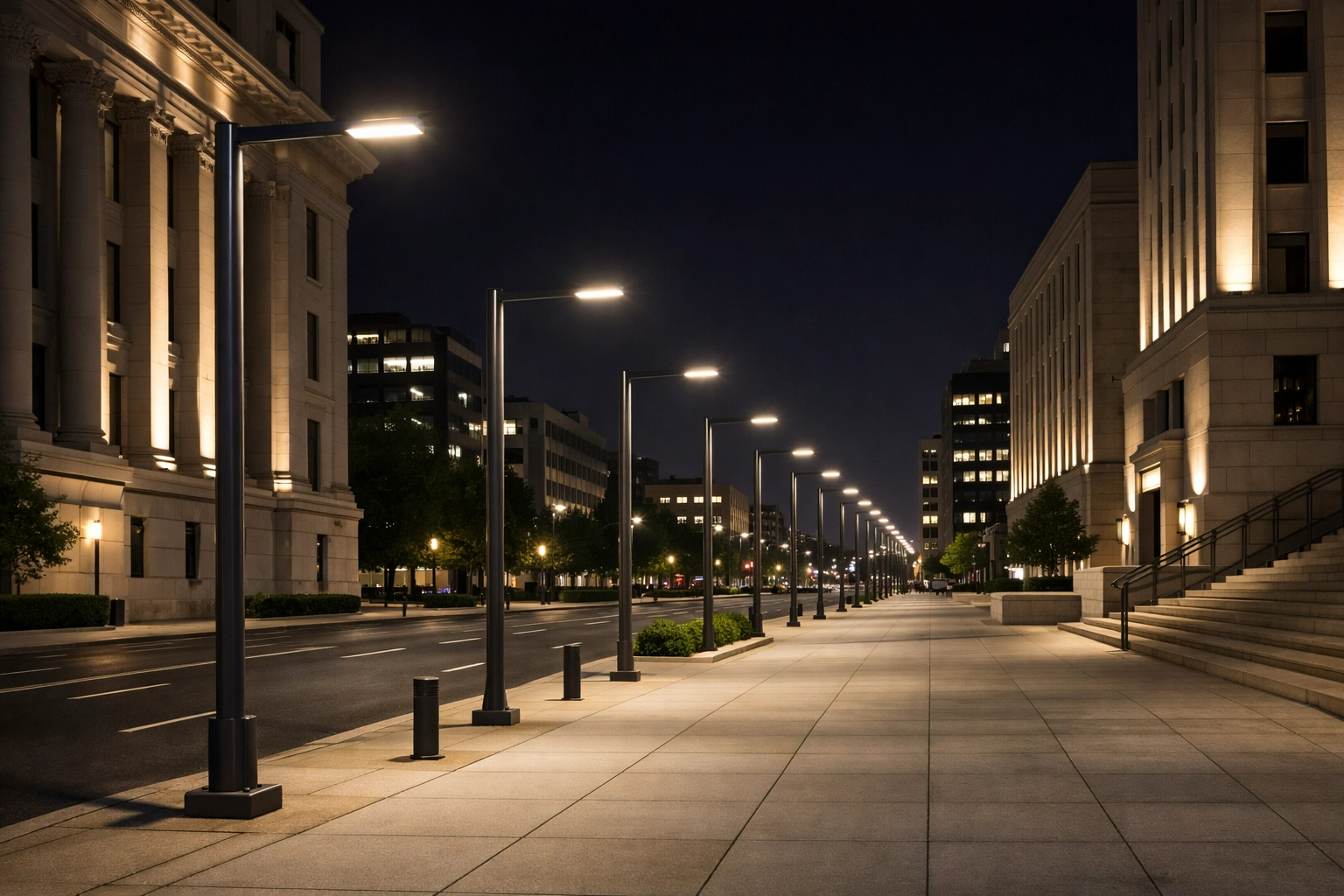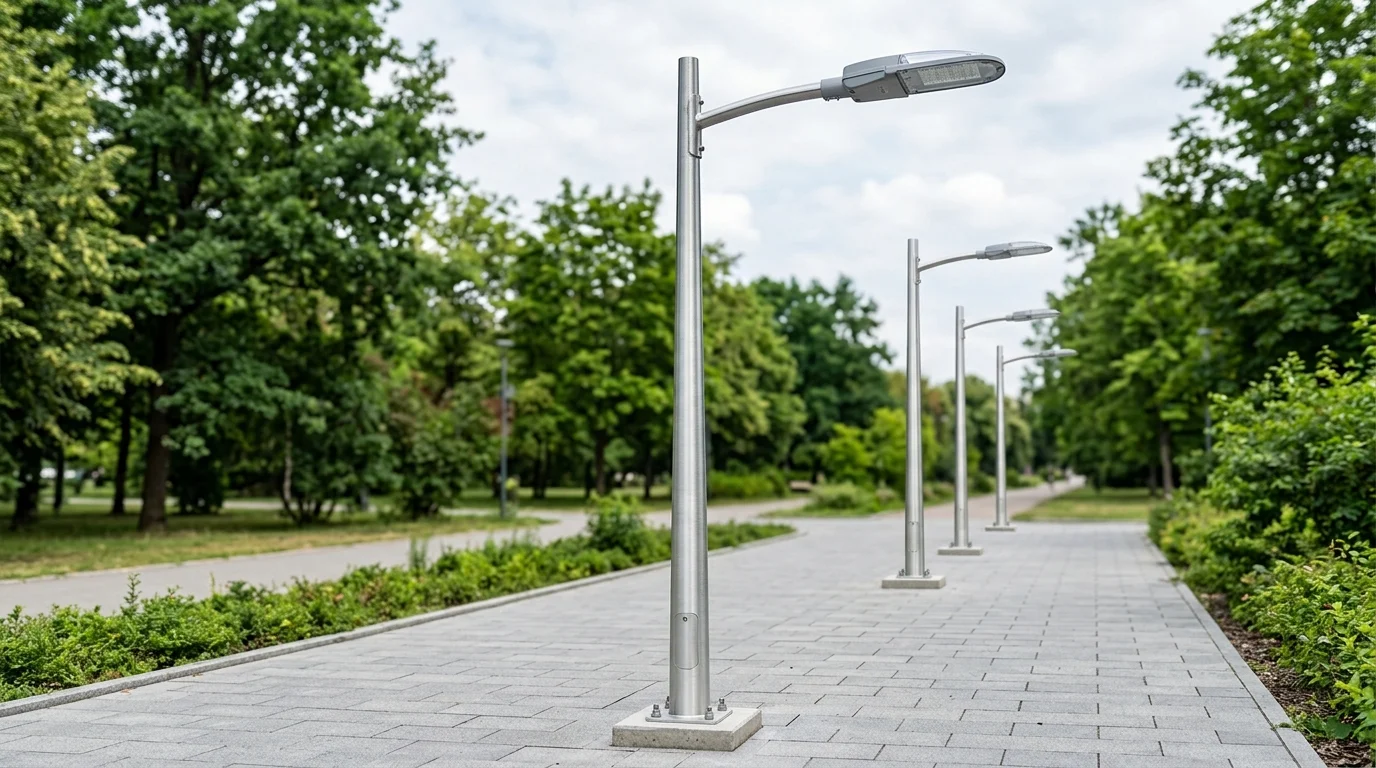
Municipal lighting decisions are shaped by more than upfront price: planners must weigh durability, maintenance demands, installation logistics, safety standards, and the growing need to support smart-city equipment. Aluminum street light poles stand out because they combine corrosion resistance, low weight, and reliable structural performance in a way that suits both dense urban streets and harsh coastal environments. This article explains why municipalities often specify aluminum over alternatives, focusing on lifecycle cost, engineering advantages, and practical deployment benefits. It also sets up the key considerations behind material selection so the technical details in the rest of the article are easier to evaluate.
Why Municipalities Choose Aluminium Street Light Poles
Urban infrastructure planners increasingly prioritize materials that balance structural integrity with long-term economic viability. In the domain of public lighting, aluminium street light poles have emerged as the preferred specification for municipalities seeking to optimize Total Cost of Ownership (TCO) while meeting stringent safety and aesthetic standards.
Municipal requirements and use cases
Modern municipalities face complex environmental and logistical challenges that dictate specific infrastructure requirements. Coastal cities require materials impervious to saline corrosion, while urban centers demand infrastructure that can support the additional weight and windage of smart city peripherals, such as 5G micro-cells, surveillance cameras, and environmental sensors. Aluminium addresses these challenges intrinsically through its natural passivation process, which forms a protective aluminium oxide layer without the need for secondary applied coatings.
Furthermore, structural engineering mandates require poles to withstand extreme weather events. Extruded aluminium poles, particularly those utilizing 6063-T6 alloys, can be engineered to meet continuous wind load resistance requirements exceeding 140 mph. Despite this high tensile strength, these poles remain 30% to 50% lighter than their steel equivalents. This significant weight reduction minimizes heavy machinery requirements during installation, lowers freight costs, and reduces traffic disruption during municipal upgrades.
Scope and application differences
The application scope of street lighting materials varies heavily based on the functional and aesthetic demands of the installation zone. While galvanized steel remains common in industrial parks due to its high shear strength and lower initial cost, aluminium dominates residential subdivisions, historic districts, and coastal promenades. This dominance is driven by the material’s superior extrudability, allowing for complex fluted or decorative profiles that are structurally compromised or cost-prohibitive to achieve with steel or concrete.
Additionally, application differences are evident in passive safety engineering. Aluminium poles are frequently specified for high-speed arterial roads because their energy-absorbing characteristics make them highly compatible with breakaway base systems. Upon vehicular impact, a properly engineered aluminium pole shears or yields in a predictable manner, reducing the transfer of kinetic energy to the vehicle occupants and satisfying strict highway safety administration mandates.
Lifecycle Cost and Performance Comparison
An objective evaluation of street light poles requires shifting the focus from initial capital expenditure to a comprehensive total cost of ownership (TCO) model. While the upfront procurement cost of aluminium is typically higher than basic alternatives, its lifecycle performance aggressively offsets this premium over decades of public service.
Technical and commercial evaluation points
From a technical standpoint, the degradation curve of aluminum is exceptionally flat. Unlike galvanized steel, which relies on a sacrificial zinc coating that eventually depletes and exposes the substrate to rust, aluminum maintains its structural cross-section indefinitely in standard atmospheric conditions. When enhanced with a Class 1 architectural anodized finish of 18 to 25 microns, the surface becomes virtually immune to peeling, blistering, or ultraviolet degradation.
Commercially, this technical superiority translates into a near-zero maintenance budget. Municipalities utilizing steel poles must allocate funds for periodic ultrasonic thickness testing and field repainting cycles every 10 to 15 years. Aluminum installations eliminate these recurring operational expenditures, allowing public works departments to reallocate labor and financial resources to other critical infrastructure needs over the pole’s 50-year design life.
Comparison table criteria
To quantify the lifecycle advantages, procurement officers utilize standardized comparison matrices. Evaluating materials side-by-side allows municipal engineers to justify the initial capital outlay by pointing to long-term operational savings and logistical benefits.
The following table illustrates typical baseline metrics used in municipal evaluations, assuming a standard 30-foot functional lighting installation:
| Material Specification | Expected Useful Life | Approx. Weight (30ft) | Maintenance Frequency | Initial CapEx Index |
|---|---|---|---|---|
| Aluminium (6063-T6) | 50+ Years | 120 – 150 lbs | Minimal (None required) | 1.3x – 1.5x |
| Galvanized Steel | 25 – 30 Years | 250 – 300 lbs | Moderate (Coating checks) | 1.0x (Baseline) |
| Pre-stressed Concrete | 40 – 50 Years | 1,200+ lbs | Low (Spalling checks) | 0.8x – 0.9x |
| Fiberglass (FRP) | 30 – 40 Years | 80-100 lbs | Moderate (UV degradation) | 1.4x – 1.6x |
Evaluation, Procurement, and Approval
Transitioning a municipality’s infrastructure standard to aluminum requires a rigorous evaluation and procurement methodology. Public procurement officers must balance competitive bidding mandates with strict engineering specifications to ensure long-term public safety and regulatory compliance.
Specification and procurement steps
The procurement cycle begins with the drafting of precise technical specifications, typically referencing the AASHTO LTS-6 standard for Structural Supports for Highway Signs, Luminaires, and Traffic Signals. Municipal engineers must specify alloy grades, temper, wall thickness, and base plate welding requirements. To ensure vendor reliability, tenders frequently mandate a strict maximum allowable defect rate of less than 0.5% across the delivered batch.
During the bidding phase, commercial terms are established. Given the custom extrusion profiles often required by specific municipal districts, manufacturers generally enforce a minimum order quantity (MOQ). For standard arterial poles, an MOQ of 50 to 100 units is typical, while custom decorative assemblies may require higher volume commitments to offset initial tooling costs. Procurement teams must aggregate demand across multiple development phases to achieve favorable economies of scale.
Final decision guidance
The final approval of an aluminum street light pole contract hinges on independent engineering verification. Municipalities require certified structural calculations, stamped by a registered Professional Engineer (PE), confirming that the specific pole and luminaire combination will withstand local EPA (Effective Projected Area) wind loads, gust factors, and regional ice-loading criteria.
Furthermore, environmental impact assessments are increasingly influencing final committee decisions. Aluminum is 100% recyclable without loss of elemental properties, offering high end-of-life scrap value that can be factored into municipal asset recovery plans. This circular economy aspect, combined with the reduced carbon footprint associated with transporting lighter materials, provides a compelling final justification for municipal sustainability boards approving the higher initial capital expenditure.
Key Takeaways
- The most important conclusions and rationale for aluminum street light poles
- Specs, compliance, and risk checks worth validating before you commit
- Practical next steps and caveats readers can apply immediately
Frequently Asked Questions
Why do municipalities prefer aluminum street light poles over steel?
They offer lower lifetime cost, better corrosion resistance, and less maintenance. Aluminum also weighs 30%–50% less, which reduces transport, crane time, and road closure impact during installation.
Are aluminum street light poles suitable for coastal or high-humidity areas?
Yes. Aluminum forms a natural oxide layer that resists salt-air corrosion. For harsher environments, anodized finishes further improve durability and help municipalities avoid repainting cycles.
Can aluminum poles support smart city equipment?
Yes, when properly engineered. Aluminum poles can be designed for luminaires, cameras, sensors, and small-cell devices while meeting wind-load and structural requirements for municipal projects.
How long do aluminum street light poles typically last?
A well-specified aluminum pole often delivers 50+ years of service. Its stable corrosion performance helps cities reduce inspections, recoating work, and long-term replacement planning.
Can Morelux provide custom aluminum street light poles for public projects?
Yes. Morelux supports project buyers with custom pole designs, technical drawings, engineer support, and fast quotations, helping municipalities and contractors speed up specification and procurement.