Introduction
Cities are no longer treating street poles as passive lighting assets. By integrating emergency broadcast capabilities into smart poles, municipalities can deliver faster, block-level alerts through on-site speakers, visual signals, and resilient communication links when traditional sirens or mobile networks fall short. This article explains how that integration fits into modern urban infrastructure, why local governments are prioritizing it for public safety, and what technical and planning factors shape a reliable deployment. From notification speed to network design and system coordination, the discussion sets up the key requirements for turning existing streetscapes into responsive emergency communication platforms.
How Emergency Broadcast Smart Pole Integration Is Reshaping Urban Infrastructure
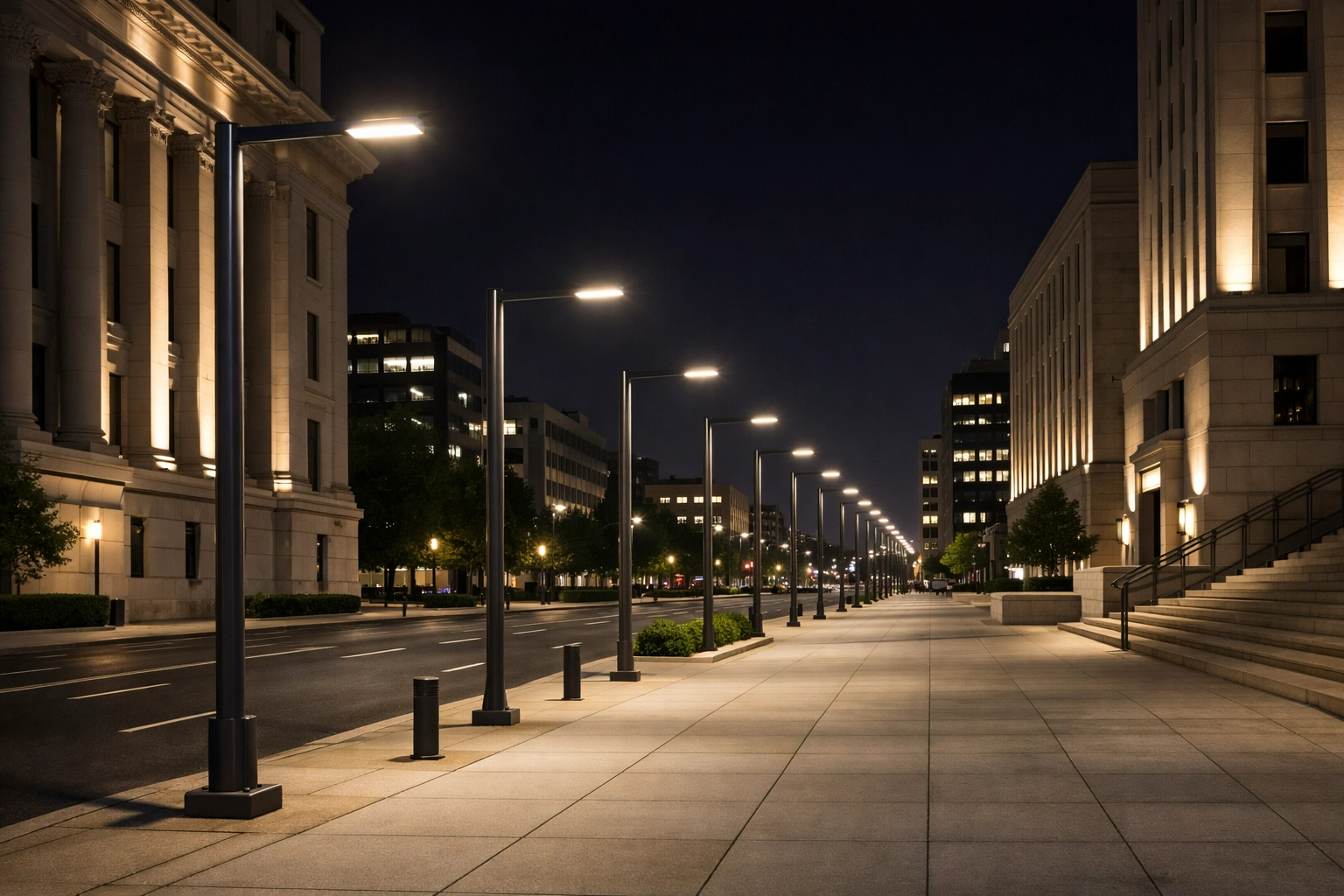
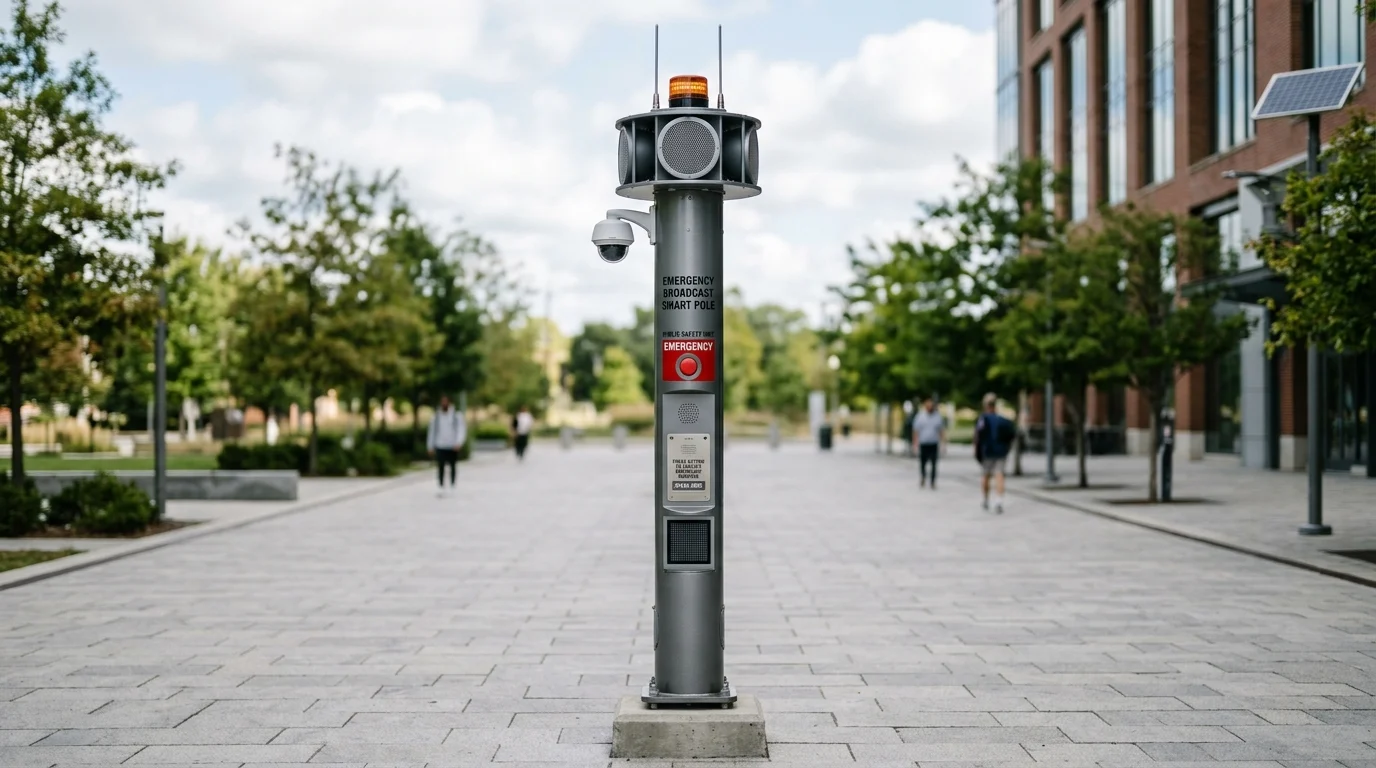
Urban infrastructure is rapidly evolving, transitioning legacy street lighting networks into highly integrated, multi-functional digital assets. At the forefront of this shift is emergency broadcast smart pole integration, a critical advancement in municipal public safety. By embedding high-fidelity acoustic arrays, visual warning beacons, and redundant communication backhauls directly into street-level infrastructure, municipalities can bypass the limitations of centralized siren systems and mobile network congestion during crisis events.
Why Cities Are Prioritizing Deployment
Cities are accelerating these deployments to address widening gaps in localized public warning systems. Traditional mass notification systems often suffer from poor acoustic penetration in dense urban canyons, while SMS alerts rely on cellular networks that frequently experience throttling during mass casualty or severe weather events. By deploying smart poles equipped with direct-to-public broadcast capabilities, emergency management agencies can reduce notification latency from the typical 3 to 5 minutes down to sub-10 seconds. Furthermore, localized broadcasting allows for hyper-targeted evacuations, isolating instructions to specific city blocks without inducing panic in adjacent districts.
How Projects Should Be Defined
Structuring a successful deployment requires defining the project beyond mere hardware procurement; it must be approached as a unified IoT ecosystem integration. Project definitions should mandate seamless interoperability with existing Computer-Aided Dispatch (CAD) platforms and national alert aggregators. Specifications must outline environmental resilience, requiring at least IP65-rated enclosures and independent localized power reserves capable of sustaining broadcast operations for a minimum of 48 hours during grid failures. Defining these parameters early prevents isolated, proprietary systems from creating operational silos within municipal control centers.
Technical, Compliance, and Cost Factors in Emergency Broadcast Smart Poll
The transition from conceptual planning to physical deployment requires a rigorous evaluation of hardware specifications, regulatory compliance, and capital expenditure. An emergency broadcast smart pole must function flawlessly in hostile environmental conditions while meeting stringent federal and regional communication standards.
Key Specifications and Subsystem Choices
Hardware selection dictates the efficacy of the entire system. Acoustic performance is paramount; broadcast units must achieve a Speech Transmission Index (STI) of 0.5 or higher to ensure intelligibility over urban background noise, typically requiring an output capacity of 110 dB at a 10-meter radius. Communication subsystems demand equal scrutiny, necessitating dual-path architecture—usually a primary fiber-optic backhaul paired with an LTE/5G cellular fallback.
| Subsystem Component | Minimum Specification | Advanced/Enterprise Specification |
|---|---|---|
| Acoustic Array | 100 dB @ 10m, STI > 0.45 | 110+ dB @ 10m, STI > 0.55 (Phased Array) |
| Network Backhaul | Single LTE/4G | Dual-path: Fiber + 5G/LTE Fallback |
| Power Redundancy | 12-hour battery backup | 48-hour localized battery + solar trickle |
| Visual Indicators | Standard LED strobe | 360-degree programmable RGB LED matrix |
How Municipalities Should Compare Options
When comparing vendor offerings, municipalities must evaluate both immediate capital expenditures (CAPEX) and long-term operational costs (OPEX). Standard smart poles with basic environmental sensors typically cost between $3,000 and $5,000 per unit. However, a fully integrated emergency broadcast smart pole—featuring edge computing, phased-array acoustics, and redundant power—will command a premium, ranging from $12,000 to $18,000 per node. Procurement teams should prioritize Total Cost of Ownership (TCO) models over a 10-to-15-year lifecycle, factoring in software licensing, API access fees, and hardware maintenance. Compliance with frameworks such as FEMA’s Integrated Public Alert and Warning System (IPAWS) should be a non-negotiable benchmark to ensure eligibility for federal grant funding.
Planning Emergency Broadcast Smart Pole Integration
Successful emergency broadcast smart pole integration demands meticulous spatial planning and phased execution. Because these systems intersect with public works, IT, and emergency services, cross-departmental governance is essential to align operational workflows and infrastructure modification schedules.
Implementation Steps and Deployment Sequencing
Deployment sequencing should follow a risk-based spatial analysis rather than a blanket municipal rollout. Phase one typically targets high-density vulnerability zones, such as transit hubs, stadium districts, and central business corridors. To maintain continuous acoustic coverage without dead zones, engineers must calculate precise spacing metrics; in high-density urban environments, poles are optimally spaced 150 to 200 meters apart, accounting for acoustic reflection and attenuation caused by architectural facades. Subsequent phases can then expand outward into residential and suburban arterial roads, leveraging existing light pole foundations to minimize trenching and civil engineering costs.
Decision Criteria for Vendor Selection and Pilots
Selecting the right integration partner requires evaluating both hardware durability and software ecosystem openness. Decision criteria must heavily weight Open API architectures, ensuring the hardware can ingest triggers from third-party gunshot detection systems, flood sensors, and traffic management platforms. Hardware reliability is equally critical; municipalities should demand a Mean Time Between Failures (MTBF) of greater than 50,000 hours for all critical broadcast components. Before committing to a city-wide contract, agencies should execute a 90-to-120-day pilot program. This localized test phase allows engineers to measure actual acoustic intelligibility under diverse weather conditions, validate failover network switching, and refine the digital interface used by dispatchers. Ultimately, rigorous pilot testing transforms theoretical acoustic models into proven, life-saving urban infrastructure.
Key Takeaways
- The most important conclusions and rationale for Emergency Broadcast Smart Pole
- Specs, compliance, and risk checks worth validating before you commit
- Practical next steps and caveats readers can apply immediately
Frequently Asked Questions
What should an emergency broadcast smart pole include?
Specify clear audio, visual warning lights, dual-path communications, and backup power for at least 48 hours. Cities should also require CAD and alert-platform compatibility from the start.
How fast can emergency broadcast smart poles deliver alerts?
Well-designed systems can reduce warning latency to under 10 seconds. That helps municipalities issue block-level instructions faster than overloaded SMS networks or centralized sirens.
What technical benchmarks matter most for procurement?
Focus on STI 0.5+ for speech clarity, about 110 dB at 10 meters, IP65 protection, fiber plus LTE/5G fallback, and resilient battery backup for outage conditions.
How should buyers compare emergency broadcast smart pole suppliers?
Compare total lifecycle cost, not unit price alone. Check engineering support, custom drawings, manufacturing control, compliance readiness, and response speed for quotes and technical revisions.
Can Morelux support customized emergency broadcast smart pole projects?
Yes. Morelux supports custom steel and aluminum pole solutions with technical drawings, engineer assistance, in-house production, and fast quotes for infrastructure and public safety projects.