Introduction
Perimeter lighting around a stadium is more than a visibility upgrade; it is a coordinated system that affects safety, surveillance performance, energy use, and long-term maintenance. This article examines how LED technology changes perimeter lighting economics and why thermal integration between luminaires and poles is essential for reliability at high output levels. Readers will see how heat management, structural design, and control strategies work together to protect lumen performance, extend service life, and reduce operating costs. With that foundation, the discussion moves into the technical role of perimeter lighting and the engineering choices that determine whether an installation performs consistently under real venue conditions.
Strategic Role of Stadium Perimeter Lighting
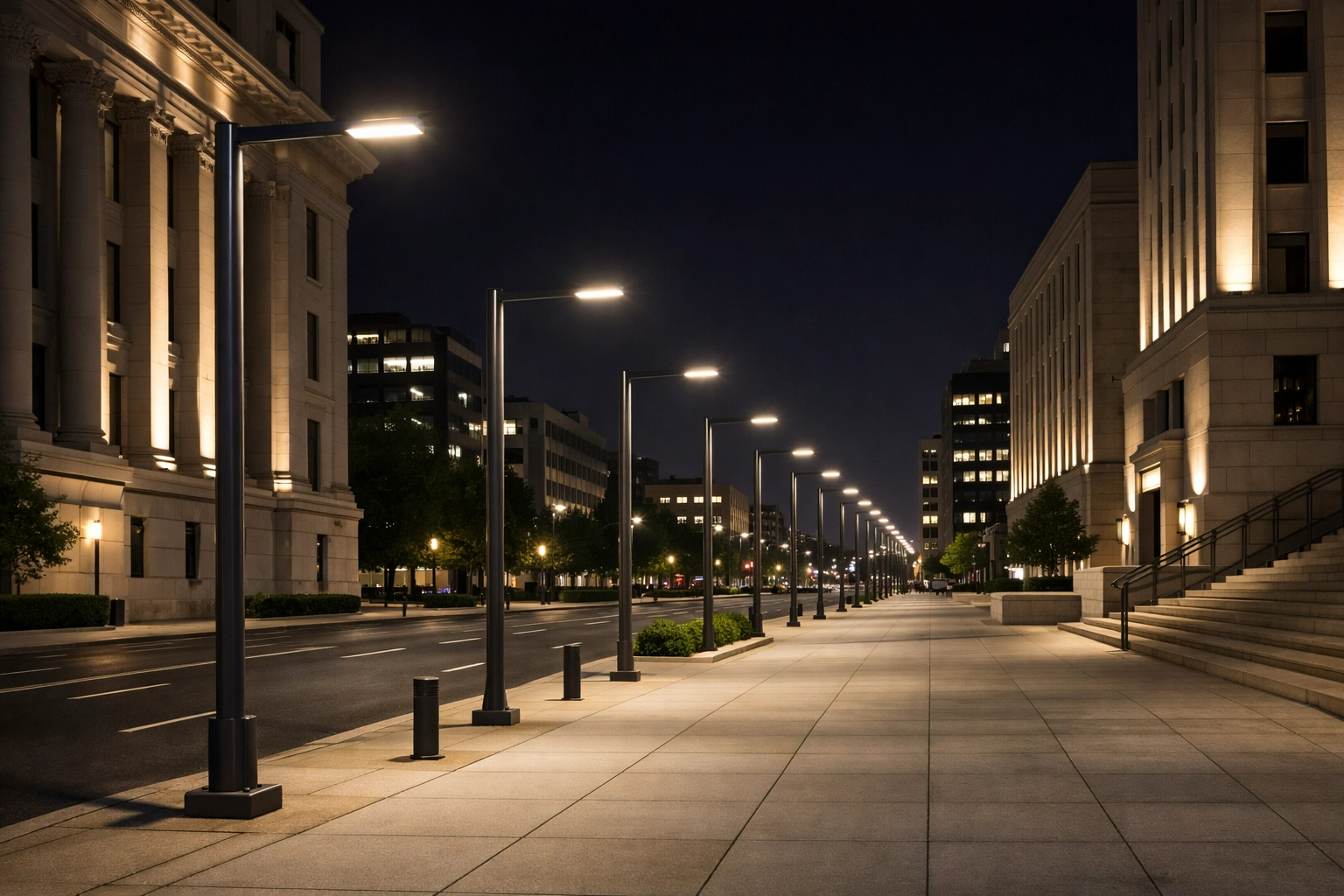
Modern stadium perimeter lighting serves as the critical transition zone between public infrastructure and secure venue environments. Beyond basic illumination, these systems dictate crowd flow dynamics, enhance facial recognition capabilities for security cameras, and ensure safe egress during emergency scenarios.
The evolution of these installations has shifted from decentralized, high-intensity discharge (HID) fixtures to highly networked, structurally integrated architectures. This transition demands a rigorous approach to both electrical efficiency and mechanical stability, treating the luminaire and its mounting structure as a unified system.
LED impact on operating cost
The deployment of solid-state lighting technology has fundamentally restructured the operating expenditure (OPEX) models for sports venues. High-output LED arrays routinely deliver energy reductions of 60% to 75% when replacing legacy 1000W metal halide fixtures while also maintaining a power factor greater than 0.95 and a Total Harmonic Distortion (THD) below 15%.
Beyond direct utility savings, extended L70 lumen maintenance thresholds—frequently exceeding 100,000 operating hours—virtually eliminate mid-cycle lamp replacements. When these fixtures are paired with networked controls, facility managers can implement adaptive dimming schedules that reduce baseline energy consumption by an additional 20% to 30% during non-event periods, drastically lowering the total cost of ownership.
Thermal integration of luminaires and poles
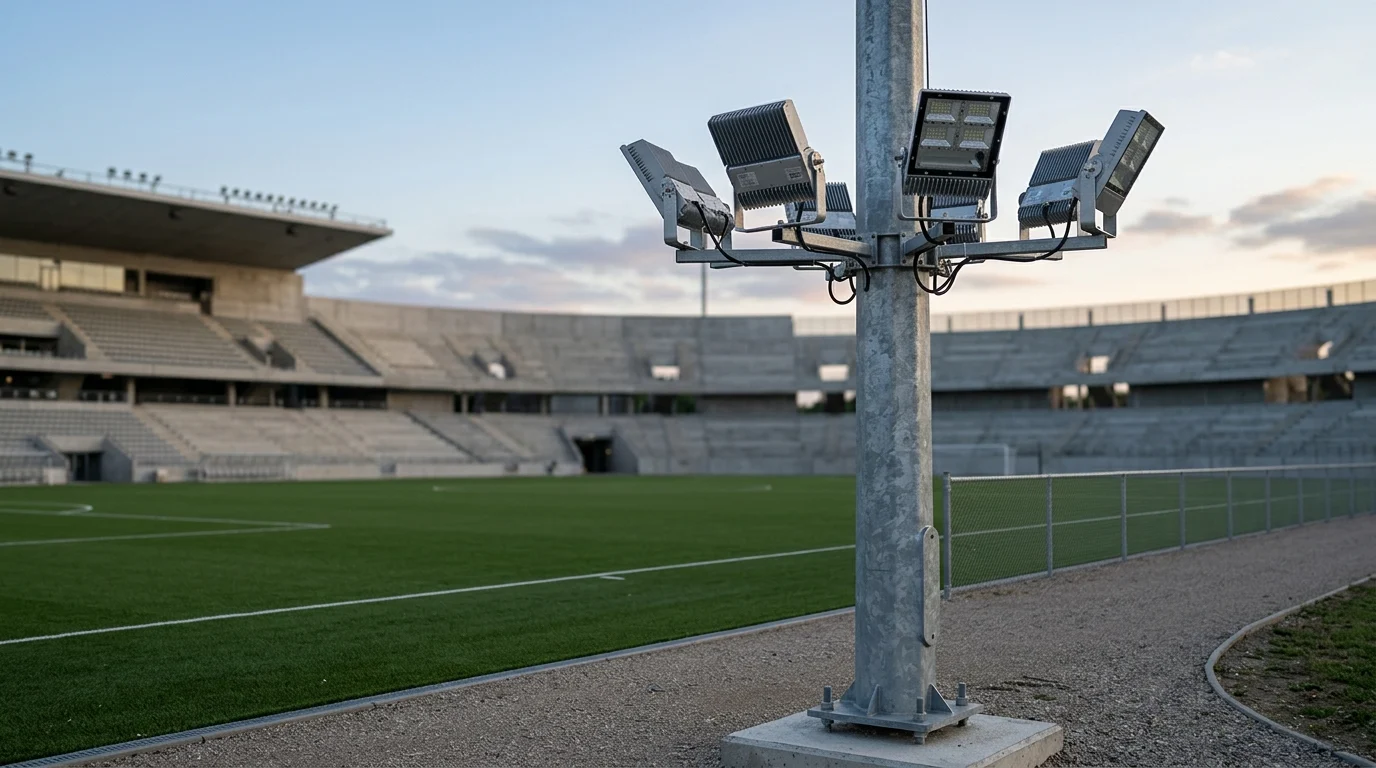
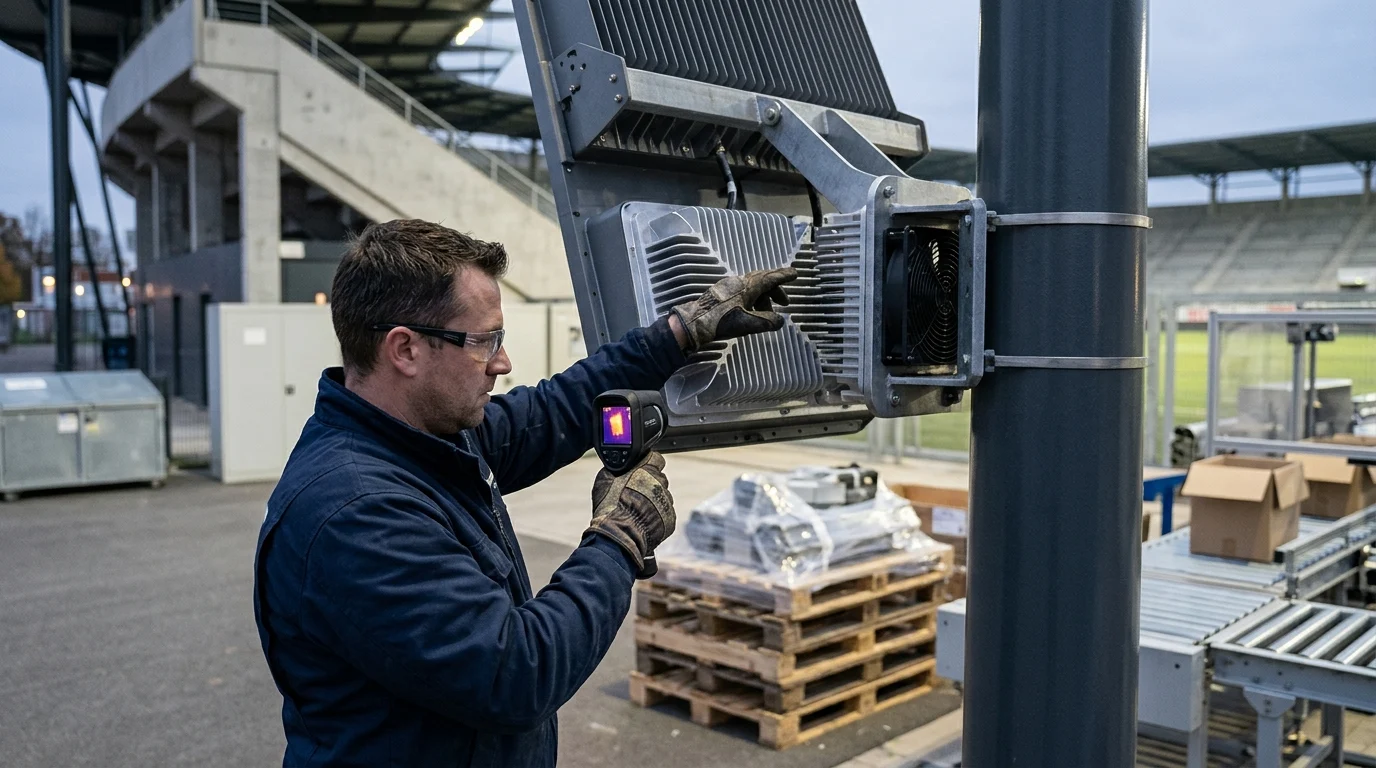
High-lumen output for perimeter applications requires aggressive thermal dissipation strategies, particularly for fixtures drawing between 300W and 800W. Modern engineering protocols increasingly treat the mounting pole and the luminaire housing as a unified thermal ecosystem.
By physically coupling the die-cast aluminum heat sinks of the LED modules to the structural poles, the entire mast acts as an extended thermal dissipator. This integration is vital for maintaining diode junction temperatures (Tⱼ) below the critical 85°C threshold. Keeping temperatures below this limit prevents premature phosphor degradation and color shift, ensuring the fixtures deliver consistent photometric performance in harsh ambient environments reaching up to 50°C.
Key Technical Criteria for Stadium Perimeter Lighting
Specifying perimeter illumination requires balancing stringent photometric targets with robust mechanical resilience. Venue perimeters are exposed to severe environmental stressors, necessitating commercial-grade durability without compromising architectural aesthetics or optical precision.
Optical performance and ingress protection
Optical precision in perimeter zones is heavily governed by the Backlight, Uplight, and Glare (BUG) rating system to prevent light trespass into adjacent residential areas or transit corridors. A strict U0 rating (zero uplight) is standard for compliance with dark-sky ordinances, while advanced polycarbonate lenses ensure up to 93% light transmission without the fragility of glass.
Environmental sealing and impact resistance are equally critical. Stadium perimeter lighting must carry a minimum ingress protection rating of IP66 to withstand high-pressure water jets during facility cleaning and heavy precipitation. Furthermore, fixtures mounted at lower pedestrian levels require an IK08 to IK10 impact resistance rating to survive vandalism and incidental impacts from maintenance equipment.
Material trade-offs in perimeter lighting systems
The structural backbone of the lighting system involves complex material trade-offs affecting thermal conductivity, wind load capacity, and capital expenditure. Engineers must calculate the Effective Projected Area (EPA) to ensure poles can withstand sustained wind speeds, which are often specified between 120 mph and 150 mph under AASHTO guidelines.
| Material | Thermal Conductivity (W/m·K) | Corrosion Resistance | Relative Cost |
|---|---|---|---|
| Die-Cast Aluminum | 90 – 120 | Excellent | High |
| Extruded Aluminum | 150 – 200 | Excellent | Very High |
| Galvanized Steel | 40 – 50 | High (with coating) | Moderate |
Aluminum alloys offer superior thermal integration capabilities for heat dissipation, whereas galvanized steel provides the necessary tensile strength for high-mast applications at a lower price point. Steel structures typically require secondary thermal management systems for the luminaire due to their lower thermal conductivity.
Specification and Selection of Stadium Perimeter Lighting
The procurement and deployment of stadium perimeter lighting systems necessitate a structured engineering approach. Facility owners and specification engineers must align photometric requirements with supply chain realities to ensure seamless project execution and long-term reliability.
Practical specification and procurement steps
The specification process begins with a comprehensive point-by-point photometric study to guarantee minimum illuminance levels, typically ranging from 20 to 50 lux at grade, depending on the venue’s security zoning. Following the optical design, structural engineers must approve the pole and foundation designs based on local soil conditions and the combined EPA of the luminaires and any attached surveillance nodes.
Procurement timelines require strict management. High-performance perimeter poles and integrated LED luminaires are rarely off-the-shelf commodities. Standard lead times range from 8 to 12 weeks, with custom architectural finishes adding up to 4 additional weeks. Minimum Order Quantities (MOQs) for custom extrusions frequently start at 20 to 25 units, requiring precise initial site audits to prevent costly secondary manufacturing runs.
Decision framework for final selection
Final selection frameworks must evaluate the Total Cost of Ownership (TCO) over a 10- to 15-year lifecycle rather than prioritizing initial capital expenditure (CAPEX). A luminaire with a 15% higher upfront cost may feature DALI-2 integration and superior thermal management that extends LED driver life, delaying replacement cycles by five to seven years.
Decision-makers must also mandate comprehensive warranty coverage to mitigate risk. Tier-one manufacturers typically provide a 10-year warranty covering both the LED arrays and the drivers, alongside a 5-year finish warranty against salt-spray corrosion, which is often verified by a 1000-hour ASTM B117 salt fog test. Verifying these stringent metrics ensures the selected system delivers sustained performance, operational efficiency, and uncompromised perimeter security.
Key Takeaways
- The most important conclusions and rationale for Stadium Perimeter Lighting
- Specs, compliance, and risk checks worth validating before you commit
- Practical next steps and caveats readers can apply immediately
Frequently Asked Questions
Why does thermal integration matter in stadium perimeter lighting?
It helps keep LED junction temperature below about 85°C, protecting lumen output, color stability, and service life. Matching the luminaire and pole as one thermal system is especially important for 300W–800W perimeter fixtures.
Which pole material is better for stadium perimeter lighting?
Aluminum offers stronger heat dissipation and corrosion resistance, while galvanized steel gives higher structural strength at lower cost. The right choice depends on wind load, thermal needs, and budget.
What ratings should perimeter fixtures meet?
Specify at least IP66 for weather sealing, IK08 to IK10 for impact resistance, and a U0 uplight rating to control spill light. These are practical baseline targets for stadium perimeter applications.
How much energy can LED stadium perimeter lighting save?
Compared with legacy 1000W metal halide systems, high-output LEDs often cut energy use by 60% to 75%. Adding dimming controls can reduce non-event consumption by another 20% to 30%.
Can Morelux support custom stadium perimeter pole projects?
Yes. Morelux supports custom steel and aluminum pole solutions with technical drawings, engineer assistance, and fast quotes, helping project buyers align thermal, structural, and manufacturing requirements early.