Introduction
Choosing how an aluminum pole is made has direct effects on cost, structural performance, production speed, and design flexibility. The two main methods—spinning and welding—use different equipment, labor inputs, and material handling steps, which can change both the upfront manufacturing expense and the long-term value of the finished pole. This article explains how each process works, where the main cost drivers come from, and why one method may be more suitable than the other depending on volume, geometry, and project requirements. With that context, the comparison in the next section will make it easier to evaluate tradeoffs in a practical, procurement-focused way.
Why the Manufacturing Process Affects Aluminum Pole Cost
The selection of an aluminum pole manufacturing process fundamentally dictates the financial baseline for infrastructure projects. While aluminum is inherently favored for its high strength-to-weight ratio and natural corrosion resistance, the method used to form the pole—spinning or welding—introduces distinct economic variables. Understanding these variables is critical for stakeholders aiming to balance upfront capital expenditures with long-term asset lifecycle costs.
Both spinning and welding require specialized industrial equipment, but they allocate costs differently across tooling, labor, and materials. Consequently, the financial viability of either method depends heavily on production volume, structural specifications, and the geometric complexity required by the end-user.
Cost impact of spun vs welded poles
The cost disparity between spun and welded aluminum poles is primarily driven by tooling amortization and labor intensity. Spun poles require substantial upfront capital for CNC spinning lathes and custom mandrels. Tooling costs for a new, custom spun pole profile can easily range from $150,000 to $250,000. However, once the equipment is operational, the marginal cost per unit drops significantly due to high automation and minimal manual intervention.
Conversely, welded pole manufacturing relies on press brakes and automated or semi-automated welding stations. The initial tooling and fixture investments are comparatively lower, often falling between $20,000 and $40,000 for standard polygonal geometries. Yet, the welded process incurs higher variable costs. Consumables such as shielding gas and filler wire, combined with the skilled labor required for welding and post-weld grinding, elevate the per-unit production cost, making this method more financially viable for lower-volume or highly customized orders.
Commercial factors for fabricators, EPCs, and utilities
For fabricators, Engineering, Procurement, and Construction (EPC) firms, and utility companies, commercial viability extends beyond the factory floor. EPCs must factor in procurement cycles and lead times. Welded poles typically offer shorter lead times—often 8 to 12 weeks—because they utilize standard aluminum sheet stock that is readily available. Custom spun poles, requiring extruded seamless tubes and specific tooling setups, may extend procurement cycles to 16 to 20 weeks.
Utilities also evaluate the total cost of ownership, which includes transportation and installation logistics. Welded poles, particularly those with multi-sided polygonal designs, can sometimes be engineered for slip-joint nesting, drastically reducing freight costs on flatbed trailers. Spun poles are typically shipped as single, fixed-length units, which can cap transportation efficiency and increase logistics overhead for large-scale grid or lighting modernization projects.
Spun vs Welded Aluminum Pole Manufacturing
Transforming raw aluminum into a highly engineered structural pole requires precise mechanical manipulation. The industry relies almost exclusively on two distinct methodologies: rotary spinning and longitudinal welding. Each process leverages different initial forms of raw material and applies divergent mechanical forces to achieve the final tapered structure.
How the spun process forms the pole
The spinning process, also known as metal spinning or flow forming, begins with a seamless extruded aluminum tube, typically cast from 6063 or 6061 alloys. This tube is mounted onto a heavy-duty CNC spinning lathe and rotated at high velocities, frequently exceeding 1,000 RPM.
As the tube spins, a hardened steel roller applies intense localized pressure along the exterior surface. This force plastically deforms the aluminum, drawing it along a mandrel to create a precise taper. During this elongation and tapering phase, the process can induce a reduction in wall thickness of up to 15% to 20%. To restore the necessary structural integrity and mechanical properties after forming, the spun pole is subjected to artificial aging in an oven to achieve a T6 temper, ensuring maximum yield strength.
How the welded process forms the pole
Welded pole manufacturing bypasses the extrusion process, starting instead with flat aluminum plates or sheets, commonly utilizing 5086 or 6061 alloy grades. The plates are precision-cut into trapezoidal blanks using CNC plasma or laser cutting systems. These blanks dictate the final taper and base diameter of the pole.
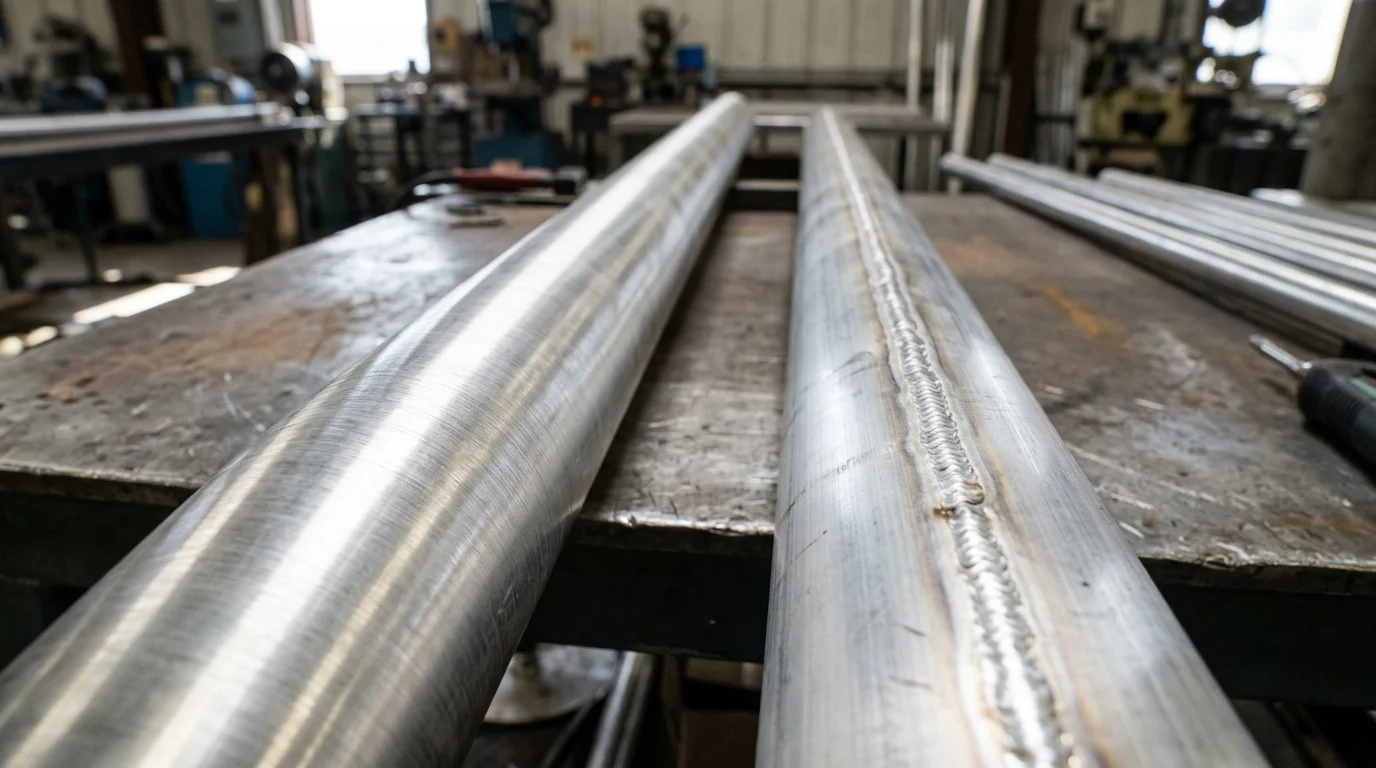
Once cut, the aluminum blanks are transferred to massive hydraulic press brakes, often rated for 400 to 1,000 tons of force, to accommodate wall thicknesses ranging from 0.125 to 0.500 inches. The press brake forms the flat sheet into a multi-sided polygon (such as an octagonal or hexadecagonal profile) or a round-tapered shape. The two edges of the formed sheet are then brought together and fused using longitudinal automated welding—typically gas metal arc welding (GMAW) or gas tungsten arc welding (GTAW). The resulting seam spans the entire length of the pole, integrating the structure into a unified whole.
Performance and Production Comparison
The choice between spinning and welding directly influences the pole’s physical characteristics, mechanical performance, and the manufacturer’s ability to scale production. Engineering teams must weigh aesthetic requirements against structural demands and environmental resilience.
Structural and dimensional differences
Spun poles are characterized by their perfectly round, seamless exterior, making them highly desirable for architectural lighting and urban streetscapes where aesthetics are paramount. The seamless construction ensures uniform load distribution under wind and ice loads. However, the spinning process limits the maximum length of a single-piece pole; spun shafts generally peak at 40 to 50 feet due to lathe bed restrictions.
Welded poles, often featuring a polygonal cross-section, provide a higher section modulus, which increases bending resistance for heavy-duty utility and high-mast applications. Because they can be manufactured in sections and slip-fitted together on-site, welded aluminum poles can easily exceed 100 feet in total height.
| Feature | Spun Aluminum Pole | Welded Aluminum Pole |
|---|---|---|
| Raw Material | Extruded seamless tube | Flat plate / sheet |
| Maximum Single Length | ~40 to 50 feet | Limited only by press brake (often 40-60 ft sections, slip-fitted to 100+ ft) |
| Aesthetic | Seamless, perfectly round | Visible longitudinal weld, often polygonal |
| Cross-Section | Circular | Circular or Polygonal (8, 12, 16-sided) |
Equipment, throughput, and scalability
Production scalability differs significantly between the two methods. The spinning process is highly automated once the initial setup is complete, allowing for rapid throughput of standardized designs. A single operator can oversee multiple CNC lathes, maximizing output per labor hour.
Welded manufacturing requires a more segmented production line. Material must move from cutting to braking and finally to the welding gantry. While modern automated seam welders have accelerated this process, the inherent need to move heavy materials between discrete workstations limits the overall throughput compared to a continuous spinning operation.
Heat-affected zones, residual stress, and corrosion
A critical metallurgical distinction between the two processes is the introduction of a Heat-Affected Zone (HAZ). Longitudinal welding subjects the aluminum to intense thermal cycles, which locally degrades the temper of the alloy. For instance, the yield strength of a 6061-T6 aluminum alloy can drop from approximately 35 ksi down to 20 ksi within the HAZ, necessitating thicker walls or specific engineering compensations to maintain overall structural ratings.
Spun poles do not have a longitudinal HAZ, allowing the material to maintain a consistent temper and strength profile throughout its circumference. Furthermore, the absence of a weld seam eliminates a potential site for galvanic corrosion or micro-cracking over a multi-decade operational lifespan, enhancing the spun pole’s durability in coastal or highly corrosive environments.
Quality Control and Compliance Requirements
Regardless of the manufacturing process, aluminum poles utilized in public infrastructure must adhere to stringent quality control protocols. The transition from raw aluminum to a finished, load-bearing structure requires rigorous inspection at every phase to mitigate failure risks and ensure public safety.
Key production steps from forming to finishing
Quality control begins at material intake, where metallurgical certifications are verified against project specifications. For spun poles, the extrusion is checked for concentricity and grain structure. For welded poles, the flat plates are inspected for surface defects and dimensional accuracy.
Following the forming and welding or spinning stages, poles undergo surface finishing. This often involves rotary sanding to achieve a uniform brushed finish, followed by chemical anodizing or powder coating. During finishing, the surface must be meticulously prepared to ensure optimal adhesion, as coating failures can expose the aluminum to environmental degradation.
Tolerance control, NDT, and weld qualification
Tolerance control is a demanding aspect of aluminum pole production. For spun poles, the primary concern is wall thinning. Technicians utilize ultrasonic thickness gauges to ensure the elongation process does not exceed the industry-standard 10% permissible wall thickness reduction tolerance.
For welded poles, the integrity of the longitudinal seam and the base plate weld is paramount. Non-Destructive Testing (NDT) is heavily utilized. Dye penetrant inspection and ultrasonic testing are standard procedures to detect porosity, lack of fusion, or micro-cracking in the welds. To meet high-volume utility and Department of Transportation standards, facilities must maintain weld defect rates strictly below 1%.
Codes, standards, and project requirements
Compliance with established engineering codes dictates the testing and certification parameters. In North America, aluminum poles must frequently comply with AASHTO LTS-6 (Standard Specifications for Structural Supports for Highway Signs, Luminaires, and Traffic Signals) and ANSI C136 standards for roadway lighting.
Furthermore, all welding procedures and personnel must be qualified under AWS D1.2 (Structural Welding Code – Aluminum). Structural testing often requires poles to demonstrate resilience against severe environmental conditions, including physical wind load ratings verified for basic wind speeds ranging from 120 mph to 150 mph, depending on the geographic deployment zone.
How Buyers Should Choose Between Spun and Welded Poles
Selecting the optimal aluminum pole manufacturing process requires buyers to align their project specifications with the inherent strengths of either spinning or welding. A misaligned procurement strategy can lead to unnecessary capital expenditure, delayed project timelines, or aesthetic compromises.
When spun poles are the better fit
Spun aluminum poles are undeniably the better fit for projects where visual aesthetics and architectural integration are the primary drivers. Municipalities outfitting downtown districts, parks, and residential subdivisions heavily favor the seamless, tapered look of a spun pole.
Financially, spun poles make sense for high-volume, standardized deployments. Because the tooling costs are high, buyers must leverage economies of scale. Consequently, Minimum Order Quantities (MOQs) for custom-spun pole profiles typically start at 50 to 100 units to effectively amortize the initial setup expenses. For off-the-shelf spun designs, MOQs may be lower, but the cost-efficiency still heavily favors bulk procurement.
Supplier selection and decision criteria
When evaluating suppliers, buyers must assess the fabricator’s specific equipment capacities and engineering support. For heavy-duty applications—such as high-mast lighting, heavy traffic signal cantilevers, or cellular antenna mounts—welded poles are generally the superior choice due to their thicker wall capabilities and higher section modulus.
| Project Requirement | Recommended Process | Key Decision Factor / Metric |
|---|---|---|
| Architectural Aesthetics | Spun | Seamless surface, no visible weld lines |
| Extreme Heights (>50 ft) | Welded | Slip-fit multi-section capability |
| Low Volume / Custom Base | Welded | Low tooling cost ($20k-$40k vs $150k+) |
| Corrosive Environments | Spun | No Heat-Affected Zone (HAZ) vulnerability |
Ultimately, supplier selection should hinge on verified AWS D1.2 certifications, NDT capabilities, and logistical proximity. Buyers should demand detailed structural calculations and finite element analysis (FEA) reports from the manufacturer to ensure that whether spun or welded, the aluminum pole will meet the precise wind, ice, and dead load requirements of the installation site.
Key Takeaways
- The most important conclusions and rationale for aluminum pole manufacturing process
- Specs, compliance, and risk checks worth validating before you commit
- Practical next steps and caveats readers can apply immediately
Frequently Asked Questions
Which aluminum pole process is better for large-volume infrastructure orders?
Spinning is usually better for high-volume runs because tooling is expensive upfront, but unit cost drops with automation. It suits standardized roadway or utility projects.
When is a welded aluminum pole the smarter sourcing choice?
Choose welding for lower volumes, faster customization, or polygonal designs. It typically needs less tooling and can shorten procurement time for project-specific poles.
How do lead times compare for spun and welded aluminum poles?
Welded poles often ship faster, commonly in 8–12 weeks. Custom spun poles may take 16–20 weeks because they need seamless tubes and dedicated tooling setup.
Can Morelux support custom aluminum pole drawings and engineering review?
Yes. Morelux provides technical drawings, engineer support, and fast quotations to help project buyers confirm dimensions, loads, finishes, and suitable manufacturing methods.
What should buyers compare besides the pole unit price?
Check tooling cost, freight efficiency, installation handling, finish options, and lifecycle durability. For large projects, total delivered cost matters more than ex-works pole price alone.