Introduction
Smart campuses and parks need infrastructure that does more than light walkways after dark. Smart light poles combine illumination, connectivity, sensing, and power delivery in a single networked asset, helping operators reduce clutter while improving safety, efficiency, and responsiveness. In enclosed environments such as universities, business parks, and industrial sites, these poles can support surveillance, environmental monitoring, Wi-Fi access, and even EV charging from the same footprint. This article explains how the technology works, where it adds the most value, and why it is becoming a practical foundation for safer, more efficient microenvironments.
Why Smart Light Poles Matter in Smart Environments
The transformation of enclosed microenvironments—such as university campuses, corporate business parks, and industrial zones—relies heavily on the strategic consolidation of digital infrastructure. Smart light poles have emerged as the foundational nodes for these localized smart grids, evolving far beyond their traditional illumination mandate to function as the central nervous system of the facility.
By integrating environmental monitoring, surveillance, telecommunications, and power distribution into a single physical asset, facility managers can eliminate redundant infrastructure clutter. This convergence establishes a ubiquitous, highly reliable power and data network across the designated area, enabling seamless facility management and enhanced occupant experiences.
How smart campuses and parks use smart light poles
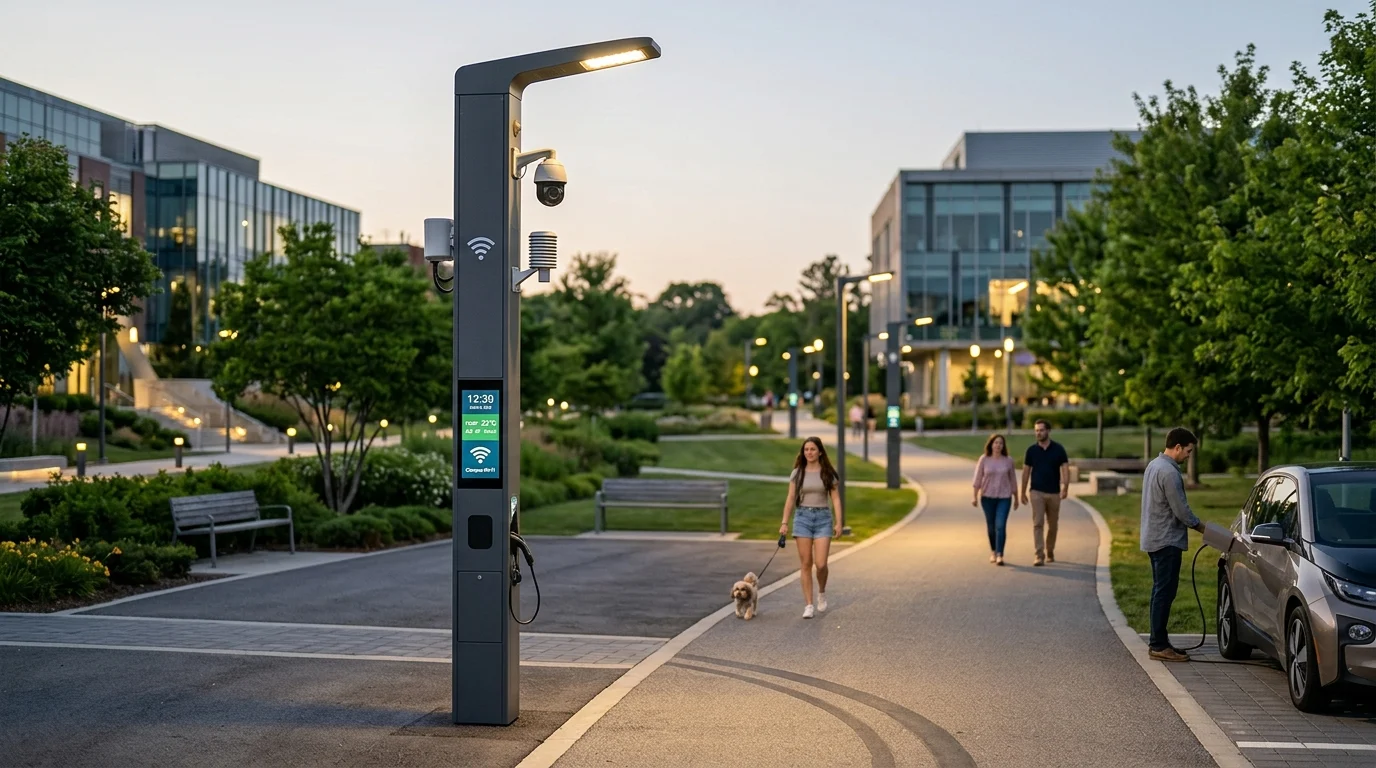
Within smart campuses and corporate parks, smart light poles function as multi-capable Internet of Things (IoT) hubs. Facility operators deploy these assets to provide high-speed public Wi-Fi, support edge-based video analytics for perimeter security, and offer integrated electric vehicle (EV) charging stations. For instance, base-integrated Level 2 AC chargers can deliver up to 22 kW of power, catering directly to the growing EV commuter base without requiring separate charging pedestals.
Furthermore, advanced motion sensors and ambient light detectors enable dynamic dimming capabilities. When integrated with a centralized management platform, this adaptive lighting approach typically reduces campus energy consumption by 60% to 75% compared to legacy high-pressure sodium or unmanaged LED fixtures. The poles can also broadcast emergency public address announcements and display real-time navigation or alert data via integrated LED screens.
What environmental challenges make smart light poles valuable
Microenvironments frequently face spatial constraints, pedestrian safety concerns, and strict aesthetic guidelines that prohibit the haphazard installation of standalone camera masts, weather stations, and cellular antennas. Smart light poles resolve this spatial conflict by centralizing these disparate systems within a single, architecturally cohesive column.
These structures are rigorously engineered to withstand severe environmental stressors. High-grade aluminum or galvanized steel poles are routinely specified to endure wind loads exceeding 150 km/h and extreme temperature fluctuations ranging from -40°C to 55°C. By utilizing existing lighting locations rather than developing new installation sites, campus developers can also reduce civil trenching, concrete pouring, and cabling costs by an estimated 30% to 40%, significantly minimizing disruption to the landscape and daily campus operations.
What Technical Architectures and Functional Configurations Work Best

A successful deployment within a microenvironment requires a robust technical architecture capable of handling diverse data streams, varying power loads, and future hardware upgrades. This architecture is typically divided into the physical hardware layer, the edge computing and gateway layer, and the cloud-based central management system, ensuring a strict separation between power distribution and data telemetry.
What core subsystems, sensors, and communication options are needed
At the hardware level, a modular design is critical to allow for lifecycle upgrades without replacing the entire pole. Core subsystems include the LED luminaire, high-definition PTZ or panoramic cameras, environmental sensors (measuring PM2.5, PM10, CO2, NO2, and ambient noise), digital LED signage, and emergency intercoms. These peripherals are governed by an industrial-grade smart pole gateway.
The gateway serves as the edge computing node, providing local data processing with sub-50 millisecond latency to ensure real-time emergency response, such as instantly illuminating an area when an incident is detected. Communication backhaul is heavily dependent on the site’s bandwidth requirements, utilizing fiber optics, 5G millimeter-wave small cells, or Wi-Fi 6 for high-bandwidth video streams. Concurrently, low-power protocols like LoRaWAN, NB-IoT, or Zigbee handle lightweight sensor telemetry via MQTT or CoAP protocols.
How to compare smart light pole configurations
Evaluating functional configurations requires mapping the hardware capabilities against the specific operational needs of the campus. A corporate park prioritizing security and high-speed connectivity will require a vastly different sensor payload and power infrastructure than an industrial campus focused strictly on air quality compliance and basic illumination.
| Configuration Tier | Connectivity Backhaul | Key Subsystems | Typical Power Load | Estimated Cost Band (USD) |
|---|---|---|---|---|
| Basic | NB-IoT / 4G LTE | Smart LED, CCTV, Emergency Call Button | 150W – 250W | $1,500 – $3,000 |
| Intermediate | 4G / Wi-Fi 6 | Basic + PM2.5 Sensors, Public Audio, Info Screen | 300W – 500W | $3,500 – $6,000 |
| Advanced | 5G Small Cell / Fiber | Intermediate + EV Charging, Edge AI Gateway, V2X | 1,000W – 22,000W+ | $7,000 – $15,000+ |
Selecting the appropriate tier ensures that the campus power distribution network can handle peak loads. Deploying advanced configurations requires careful electrical planning, particularly when integrating EV charging modules or high-output digital displays that drastically alter the thermal and electrical demands of the pole.
How to Evaluate Deployment, Compliance, and ROI

Procuring and installing smart light poles represents a significant capital expenditure requiring alignment between IT, facilities management, and security stakeholders. Procurement officers must rigorously evaluate deployment logistics, strict adherence to international safety standards, and the financial models that justify the long-term investment.
What implementation steps, governance, and interoperability requirements matter
Implementation begins with a comprehensive site audit to assess existing power grid capacity, foundation structural integrity, and fiber optic availability. Governance dictates that hardware must comply with stringent interoperability and safety standards, such as IEEE 2774 for smart street lighting systems or regional equivalents. Physical resilience is non-negotiable; specifications typically mandate an IP66 ingress protection rating against heavy dust and water jets, alongside an IK09 or IK10 impact resistance rating to withstand vandalism or accidental vehicle strikes.
On the software and networking side, interoperability demands the use of open APIs to prevent vendor lock-in. Robust cybersecurity protocols are essential. Deployments must utilize TLS 1.2/1.3 encryption for data in transit and implement edge-level data anonymization for video feeds to ensure compliance with privacy frameworks like GDPR or CCPA, preventing unauthorized access to the broader campus network via compromised edge devices.
How to choose vendors, deployment phases, and ROI criteria
Vendor selection should prioritize manufacturers offering modular, open-architecture systems backed by long-term service level agreements (SLAs).
Key Takeaways
- The most important conclusions and rationale for the application of Smart Light Poles in Smart Campuses/Parks: Creating a Safe and Efficient Microenvironment
- Specs, compliance, and risk checks worth validating before you commit
- Practical next steps and caveats readers can apply immediately
Frequently Asked Questions
What does a smart light pole do in a campus or park?
It combines lighting, CCTV, sensors, Wi-Fi, and emergency communication in one pole. This reduces clutter and creates a shared power/data hub for safer, easier management.
Can smart light poles help reduce energy use?
Yes. With motion sensing and adaptive dimming, they can cut lighting energy use by about 60% to 75% versus unmanaged systems.
What features are most useful for smart campuses and parks?
Common features include LED lighting, cameras, environmental sensors, LED signage, emergency intercoms, Wi-Fi, and EV charging. Choose based on security, connectivity, and sustainability goals.
How do smart light poles improve safety?
They support real-time video monitoring, emergency alerts, instant lighting response, and public address messages. This helps staff react faster to incidents and guide people during emergencies.
Why choose Morelux for a smart pole project?
Morelux offers custom pole solutions, technical drawings, engineer support, and fast quotes. It also manufactures aluminum and steel poles with in-house processing and testing for reliable project delivery.