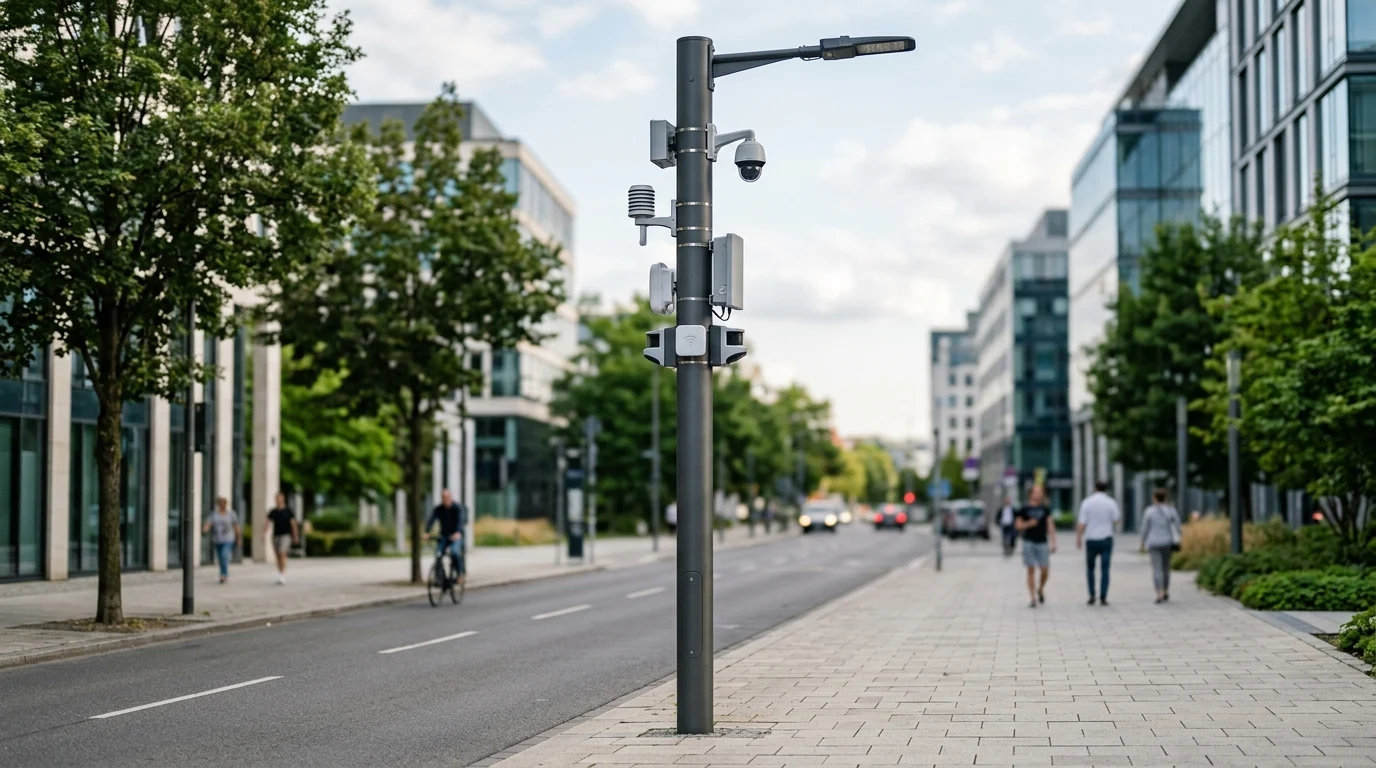
Across modern cities, street poles are evolving from simple lighting assets into connected platforms that support sensing, communications, power distribution, and edge computing in one footprint. This article explains what smart city pole IoT infrastructure includes, why municipalities treat it as a strategic layer for digital services, and how it enables functions such as traffic monitoring, public safety, environmental sensing, and network coverage. By understanding the technical role of these poles and the services they can host, readers will be better prepared to evaluate how existing urban infrastructure can be upgraded to deliver scalable, data-driven operations.
Why Smart City Pole IoT Infrastructure Is Strategic
Urban environments are undergoing a profound digital transformation, transitioning traditional municipal assets into active data nodes. At the core of this shift is smart city pole IoT infrastructure, which leverages existing street lighting grids to deploy dense, distributed sensor networks and communication layers without requiring entirely new real estate footprints. By capitalizing on ubiquitous right-of-way locations, city planners can establish a pervasive digital canopy that enhances operational efficiency and public safety.
How to define smart city pole IoT infrastructure
To accurately define smart city pole IoT infrastructure, one must look beyond standard LED luminaires. Modern intelligent poles are modular, vertically integrated structures equipped with distinct physical, electrical, and digital layers. The physical layer encompasses the structural mast, standardized mounting brackets, and reinforced foundations designed to house edge computing nodes and sensor arrays within weather-sealed enclosures.
Digitally, these poles integrate robust communication modules—ranging from LoRaWAN and NB-IoT for low-bandwidth telemetry to 5G small cells and Wi-Fi 6 for high-throughput connectivity. Crucially, utility-grade smart poles are engineered with specialized power distribution cabinets capable of handling continuous electrical loads between 500W and 2kW per pole. This capacity ensures sufficient energy for concurrent high-demand applications while maintaining local edge processing latency below 10 milliseconds for critical real-time analytics.
Which municipal and commercial services it can support
This robust architecture allows municipalities to support an extensive catalog of municipal and commercial services from a single vertical asset, drastically reducing urban clutter. On the municipal side, environmental sensors monitor air quality metrics like particulate matter (PM2.5/PM10) and volatile organic compounds, while high-definition optical sensors facilitate real-time traffic flow optimization, license plate recognition, and incident detection.
Commercially, the infrastructure unlocks lucrative new revenue streams. Telecommunication providers routinely lease pole space for network densification, generating recurring municipal income. Furthermore, municipal utilities can integrate Level 2 EV charging stations—typically delivering up to 7.2 kW or 22 kW depending on the grid configuration—directly into the pole base. Digital signage and emergency broadcast speakers further transform passive streetlights into interactive civic hubs, maximizing the return on public infrastructure investments.
How Smart City Pole IoT Infrastructure Compares by Architecture

Evaluating the physical and network architecture of intelligent street lighting reveals significant variations in deployment strategies and hardware configurations. System integrators must navigate distinct form factors, meticulously balancing immediate capital constraints against long-term scalability, thermal management, and operational resilience.
Which criteria best evaluate smart city pole IoT options
Selecting the optimal smart city pole IoT infrastructure requires rigorous evaluation against structural, electrical, and network criteria. Engineers must assess the maximum equipment payload, typically requiring support for 50 to 150 kilograms of auxiliary hardware without compromising structural integrity. Wind load ratings are equally critical; coastal or high-wind jurisdictions mandate survival thresholds exceeding 150 mph (241 km/h) with a fully loaded mast. Backhaul capacity dictates whether a pole relies on wireless mesh networking or requires dedicated dark fiber connections. Thermal management is another vital metric, as internalized 5G radios and edge servers generate substantial heat, requiring passive or active cooling mechanisms to maintain optimal operating temperatures.
| Evaluation Criteria | Retrofit Standalone Poles | Purpose-Built Integrated Poles |
|---|---|---|
| Structural Payload | Low (< 20 kg) | High (50 – 150 kg) |
| Backhaul Architecture | Wireless Mesh / LTE | Direct Fiber Optic |
| Power Capacity | Limited (Lighting circuit) | High (Dedicated 2kW+ feeds) |
| Thermal Management | External ambient cooling | Internalized heat sinks |
| Aesthetic Impact | Cluttered (External mounts) | Seamless (Internalized hardware) |
What trade-offs exist between standalone and integrated poles
The architectural trade-offs between retrofitting existing standalone poles and deploying purpose-built integrated poles dictate project economics and deployment viability. Retrofitting involves attaching IoT modules, such as NEMA-socket controllers or external camera brackets, to legacy lighting infrastructure. This approach minimizes initial capital expenditure and accelerates deployment timelines, often costing less than $1,000 per node in hardware and labor. However, retrofits are severely constrained by existing electrical wiring, which is frequently unpowered during daylight hours, and often result in visual clutter that faces community resistance.
Conversely, integrated poles feature internalized wiring, dedicated 24/7 power runs, and modular equipment bays. While the upfront costs are substantially higher—frequently exceeding $5,000 to $8,000 per unit due to complex trenching, fiber laying, and foundation work—they provide superior environmental protection, support high-capacity fiber backhaul, and offer the necessary structural integrity for future technology integrations.
How Cities and Integrators Should Plan Smart City Pole IoT
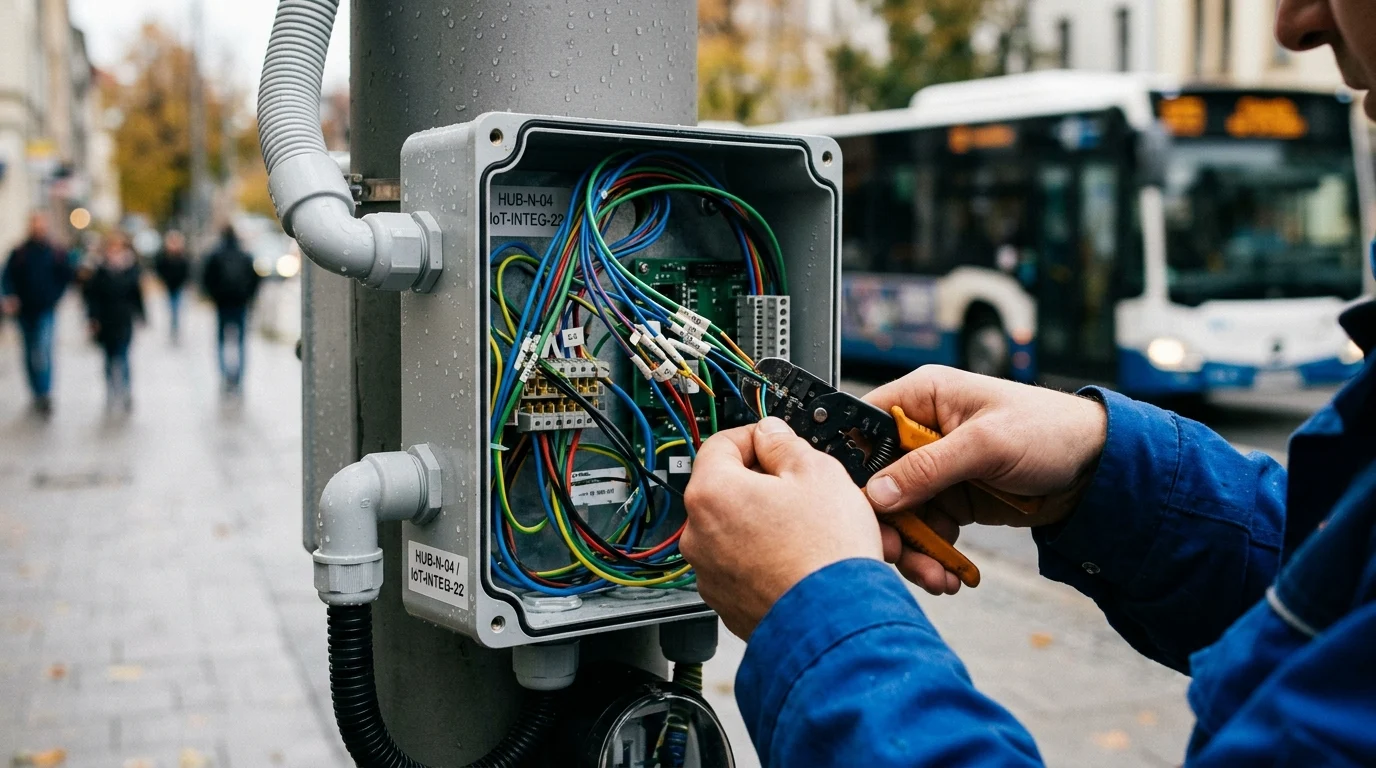
Transitioning from isolated proof-of-concept projects to city-wide intelligent infrastructure requires meticulous strategic planning and cross-departmental coordination. Municipalities and technology integrators must establish rigorous procurement, cybersecurity, and deployment frameworks to mitigate financial and operational risks over the asset’s lifecycle.
Which implementation steps reduce deployment risk
Reducing deployment risk necessitates a phased, data-driven implementation methodology. The process must commence with comprehensive structural and electrical audits of existing right-of-way assets, identifying structural fatigue, grounding issues, or grid capacity limitations. Subsequently, RF propagation mapping ensures optimal placement for wireless communication modules, preventing costly signal dead zones in dense urban canyons.
Integrators should execute structured pilot deployments—typically involving a controlled cluster of 50 to 100 nodes—to validate hardware interoperability, edge computing performance, and backend software integration. Only after achieving a sustained hardware defect rate of less than 0.5% and verifying cybersecurity compliance (such as ISO/IEC 27001 standards) during the pilot phase should cities authorize scaling to deployments encompassing 10,000 or more nodes. This staged approach isolates technical failures and refines installation logistics before massive capital is committed.
Which decision criteria should guide investment
Strategic investment must be guided by total cost of ownership (TCO) and long-term interoperability rather than mere upfront hardware costs.
Key Takeaways
- The most important conclusions and rationale for smart city public IoT infrastructure
- Specs, compliance, and risk checks worth validating before you commit
- Practical next steps and caveats readers can apply immediately
Frequently Asked Questions
What services can smart city pole IoT infrastructure support?
It can support smart lighting, traffic monitoring, air quality sensing, CCTV, Wi-Fi, 5G small cells, EV charging, and emergency broadcast systems from one pole.
How do integrated smart poles differ from retrofit poles?
Integrated poles offer higher payload, cleaner design, 24/7 power, and better thermal control. Retrofit poles are faster and cheaper but have lower capacity and more visible hardware.
What should buyers check when sourcing smart city poles?
Check payload capacity, wind load rating, power availability, enclosure protection, communication compatibility, and foundation design for the planned devices and local site conditions.
Can Morelux customize smart poles for city and infrastructure projects?
Yes. Morelux provides customized steel and aluminum smart poles, technical drawings, engineer support, and manufacturing options to match project equipment, power, and mounting needs.
How quickly can Morelux provide a quote for smart pole projects?
Morelux emphasizes responsive B2B support and can provide fast quotes, often within 24 hours, based on your specifications, quantities, and project requirements.