Introduction
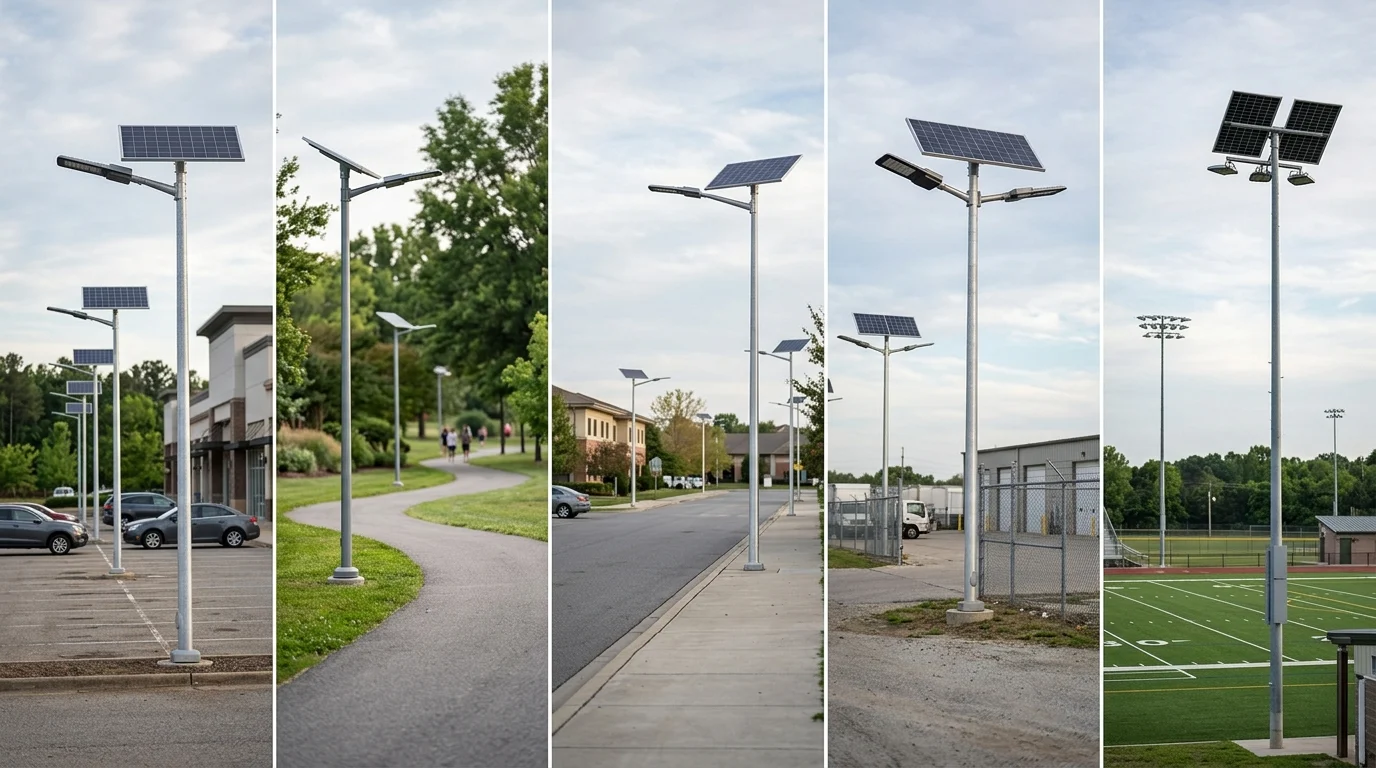
Selecting solar streetlights depends less on the product label and more on where the light will operate. A pathway, a residential road, a factory perimeter, a parking lot, and a football field each demand different brightness levels, pole heights, battery reserves, beam distribution, and control strategies. This guide explains how those five common scenarios change the sizing and specification process, so you can compare options with clearer expectations on safety, visibility, runtime, and cost. By the end, you will know which technical factors matter most in each setting and how to avoid under-lighting, overbuilding, or paying for capacity the site does not need.
Choosing solar streetlights by application
As we design modern infrastructure, the transition to off-grid solar illumination has become an operational imperative rather than just a sustainability initiative. Selecting appropriate solar streetlights requires a nuanced understanding of the environment, as a one-size-fits-all approach inevitably leads to either inadequate illumination or wasted capital.
In our experience analyzing commercial and municipal projects, we consistently encounter five primary deployment scenarios: pedestrian pathways, residential streets, industrial perimeters, expansive parking lots, and high-demand football fields. Each environment dictates distinct photometric requirements, structural constraints, and battery autonomy profiles.
Key use cases from parking lots to football fields
When evaluating these five typical scenarios, we must first establish the baseline illumination requirements. Pedestrian pathways and residential streets generally demand lower intensity, typically requiring an average illuminance of 5 to 15 lux to ensure basic safety and wayfinding without causing light trespass into nearby homes.
Conversely, industrial perimeters and commercial parking lots require heightened visibility for security cameras and vehicular safety, pushing the baseline to 20 to 30 lux. At the extreme end of the spectrum, football fields and outdoor sports arenas demand rigorous performance. These recreational spaces require between 200 and 500 lux, depending on whether the facility is used for amateur practice or televised professional events. Deploying solar lighting in these high-demand arenas pushes the limits of battery storage and solar conversion efficiency.
How to match lighting needs to each scenario
To successfully match lighting needs to each scenario, we must calculate the exact lumen output, mounting height, and optical distribution. For pathways, we typically specify a mounting height of 4 to 6 meters with symmetrical optics to cast a gentle, even glow. Residential streets require 6 to 8-meter poles with Type II distribution to push light along the narrow roadway.
When we transition to parking lots, we elevate the fixtures to 8 to 12 meters, utilizing Type III or Type IV asymmetrical lenses to push light outward and eliminate dark zones between parked vehicles. For football fields, the mounting height jumps significantly to 15 to 25 meters. Here, we must use specialized high-mast solar configurations with narrow beam angles (such as 30° or 60°) to project high-intensity light directly onto the playing surface while strictly controlling spill light.
Comparing specifications and performance
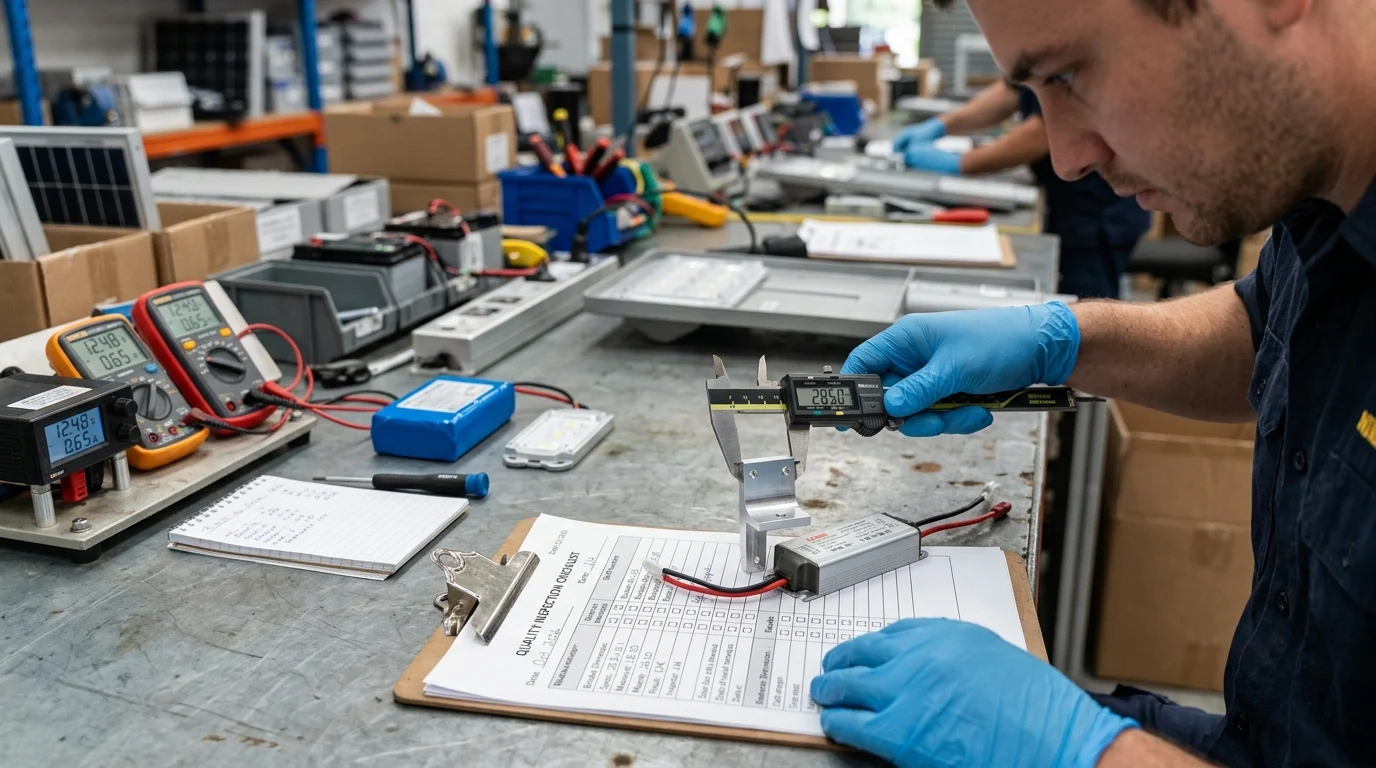
Transitioning from environmental requirements to hardware selection, we must rigorously analyze the internal components of the solar streetlight. The longevity and reliability of an off-grid system depend entirely on the synergy between the photovoltaic panel, the energy storage unit, and the light-emitting diodes.
We have found that relying solely on nominal wattage is a critical error; instead, experts must evaluate component-level efficiency and degradation rates to ensure the system performs reliably through consecutive overcast days.
Core technical factors to evaluate
To establish a baseline for quality, we evaluate three core technical factors: panel efficiency, battery chemistry, and LED efficacy. Monocrystalline solar panels are strictly preferred for high-demand applications due to their 21% to 24% conversion efficiency, which outperforms polycrystalline alternatives.
For energy storage, lithium iron phosphate (LiFePO₄) batteries have become our industry standard. They offer a cycle life exceeding 3,000 cycles at an 80% depth of discharge (DoD), ensuring 7 to 10 years of reliable operation. Furthermore, we must scrutinize LED efficacy. Modern high-performance fixtures should deliver between 170 and 220 lumens per watt (lm/W), allowing us to achieve target lux levels while drawing minimal current from the battery.
| Component | Recommended Specification | Target Metric | Application Focus |
|---|---|---|---|
| Solar Panel | Monocrystalline Silicon | 21% – 24% Efficiency | Fast charging in limited space |
| Battery | LiFePO4 (Lithium Iron Phosphate) | >3,000 cycles (80% DoD) | Long lifecycle, high thermal stability |
| LED Chip | SMD 5050 or SMD 3030 | 170 – 220 lm/W | Maximum brightness per watt |
| Controller | MPPT (Maximum Power Point Tracking) | >99% Tracking Efficiency | Winter/cloudy day optimization |
Decision criteria for parking lots and sports fields
When finalizing decision criteria specifically for parking lots versus sports fields, our focus shifts toward light distribution and glare control. In parking lots, the primary objective is uniformity. We target a uniformity ratio (Emin/Emax) of at least 0.25 to prevent harsh shadows where security risks might hide. Integrated motion sensors (PIR or microwave) are highly effective here, dimming the fixtures to 30% output during vacant hours to conserve battery life.
Sports fields require a completely different approach. Beyond the massive 200+ lux requirement, we must prioritize visual comfort for the athletes. The fixtures must achieve a Unified Glare Rating (UGR) of less than 19. This requires custom louvers and anti-glare shields. Additionally, because sports fields are used continuously for hours without breaks, motion-based dimming is entirely unfeasible. The solar array and battery bank must be dimensioned to sustain 100% output for a minimum of 4 to 6 continuous hours, often necessitating split-type solar streetlights where massive solar panels are mounted independently from the luminaire.
Sourcing and final selection
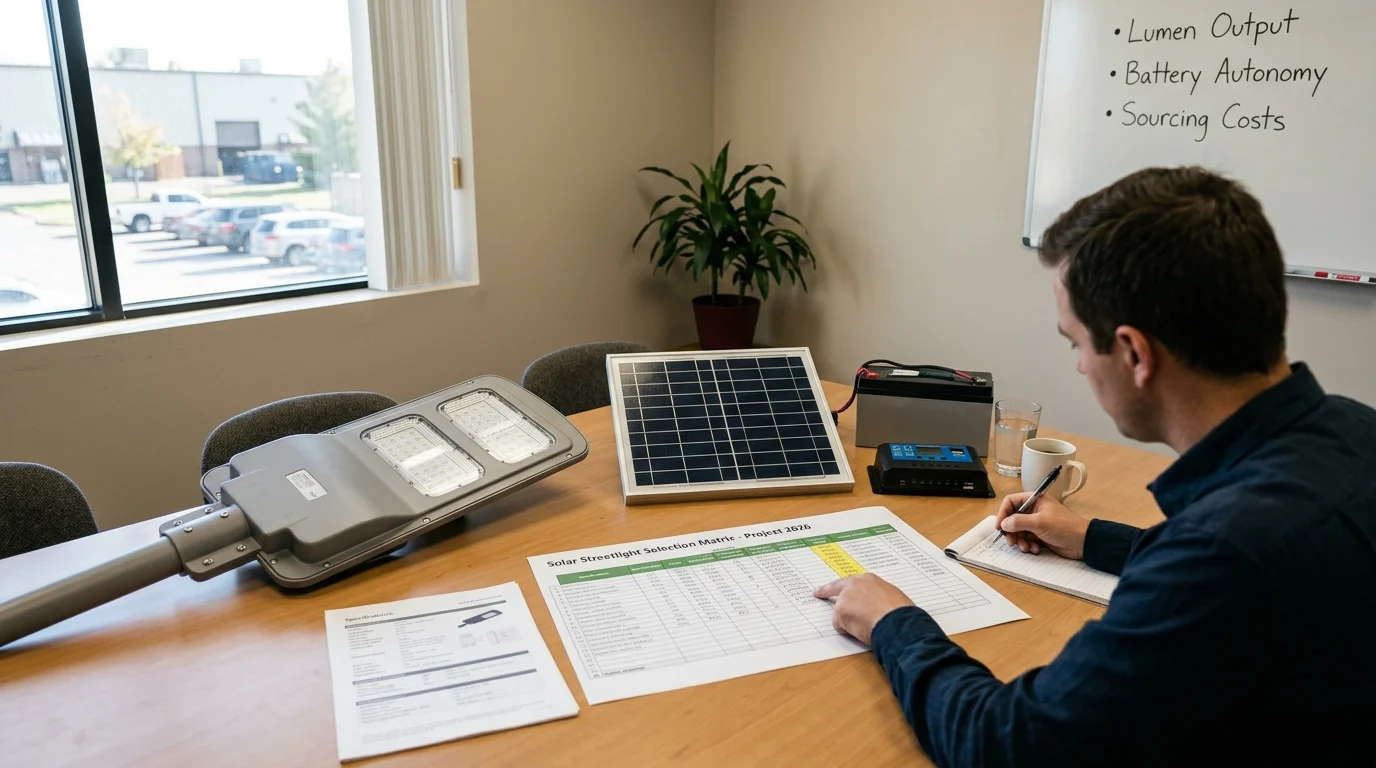
Even with perfectly calculated specifications, the success of a solar lighting project ultimately hinges on procurement execution. The global market is saturated with low-tier assemblers that artificially inflate their specification sheets.
In our procurement practice, we treat supplier validation and rigorous quality control as the final, non-negotiable steps before authorizing a mass rollout.
How to validate suppliers and reduce procurement risk
To validate suppliers and reduce procurement risk, we demand comprehensive documentation and third-party testing data. A reputable manufacturer must provide verifiable ISO 9001, CE, and RoHS certifications, alongside independent IP65 or IP67 ingress protection test reports. We always request IES photometric files to run DIALux simulations; if a supplier cannot provide accurate IES files, they lack the engineering maturity required for complex projects like sports fields.
Furthermore, evaluating their production capacity and commercial terms is essential to ensure they can reliably meet project demands.
Key Takeaways
- The most important conclusions and rationale for From parking lots to football fields: A complete guide to selecting solar streetlights for 5 typical scenarios (2026)
- Specs, compliance, and risk checks worth validating before you commit
- Practical next steps and caveats readers can apply immediately
Frequently Asked Questions
What lux level is typically needed for parking lots?
Most commercial parking lots target about 20–30 lux. Use 8–12 m poles with Type III or Type IV optics to improve visibility and reduce dark zones between vehicles.
Can solar streetlights reliably light a football field?
Yes, but only with high-mast solar systems sized for 200–500 lux, 15–25 m mounting heights, narrow beams, and large battery storage for sustained high output.
Which battery type is best for municipal or commercial solar lighting projects?
LiFePO4 is usually the best choice. It offers over 3,000 cycles at 80% DoD, strong thermal stability, and a practical service life of about 7–10 years.
How should project buyers compare solar streetlight specifications?
Do not compare wattage alone. Check panel efficiency, battery chemistry, LED efficacy, autonomy days, pole height, and optical distribution to match the actual site requirement.
Can Morelux support custom solar pole projects and fast quotations?
Yes. Morelux supports customized pole solutions with technical drawings, engineer assistance, and dependable manufacturing and typically provides quotes within 24 hours for infrastructure projects.