Introduction
Across commercial sites, parking lot lighting is shifting away from steel as owners weigh more than the upfront purchase price. Material choice now affects corrosion resistance, installation speed, structural performance, maintenance cycles, and total lifecycle cost. Aluminum poles are gaining ground because they address many of the practical weaknesses that make steel expensive to own in outdoor environments, especially in wet, coastal, or high-salt locations. This article explains what is driving the change, how aluminum compares with steel in real operating conditions, and which engineering and cost factors matter most when selecting poles for new projects or retrofits.
Why Aluminium Poles Are Replacing Steel in Parking Lot Lighting
Commercial parking lot lighting infrastructure is undergoing a fundamental material shift. For decades, carbon steel dominated the landscape due to its high initial yield strength and low upfront manufacturing costs. However, facility managers, urban planners, and electrical engineers are increasingly recognizing the long-term liabilities associated with ferrous metals in outdoor environments.
The transition to aluminum represents a strategic optimization of lifecycle costs, structural resilience, and installation logistics. As commercial properties prioritize sustainable and low-maintenance assets, heavy legacy materials are rapidly being phased out.
How Parking Lot Lighting Poles Are Defined
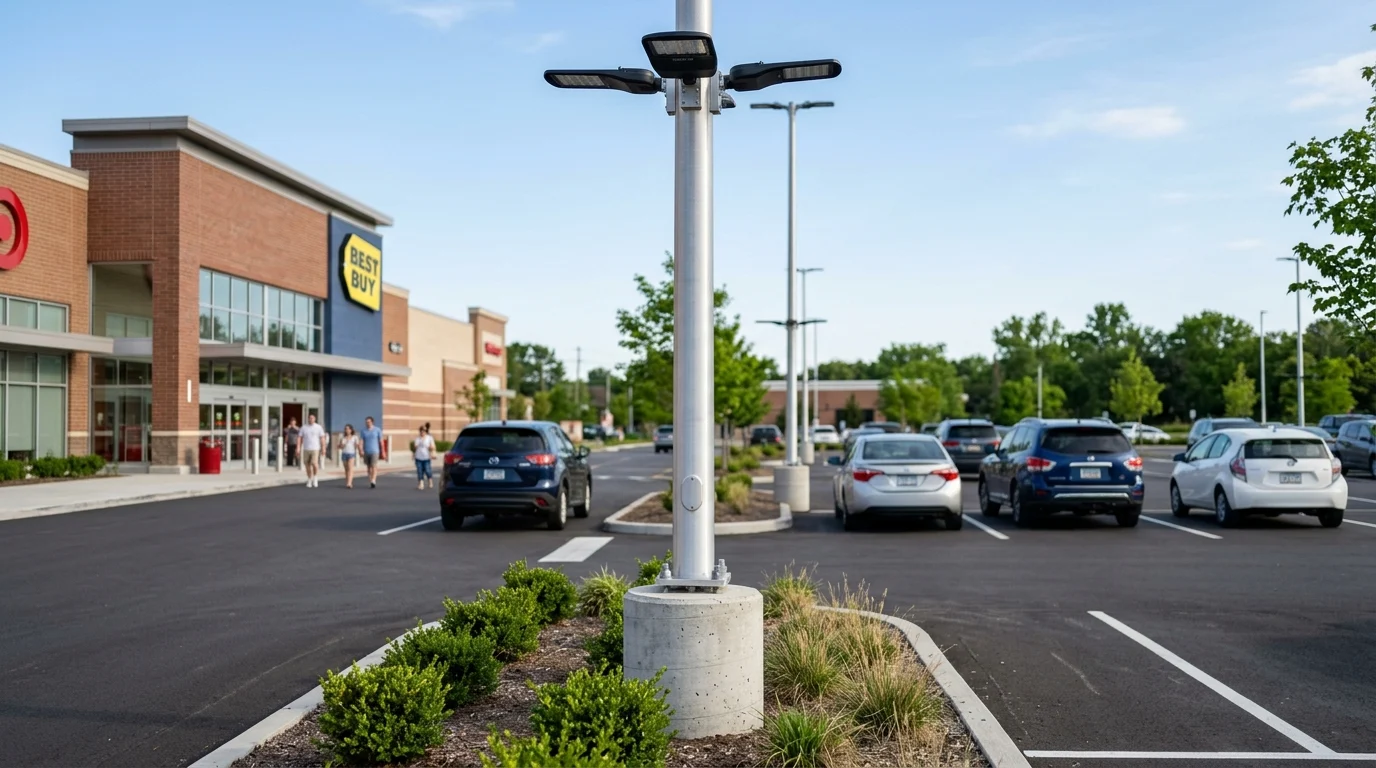
Parking lot lighting poles are structural supports engineered to elevate luminaires to optimal heights, typically ranging from 15 to 40 feet, to achieve uniform photometric distribution. These structures are rigidly defined by their capacity to withstand environmental stressors, calculated primarily through Effective Projected Area (EPA) ratings and local wind load requirements governed by AASHTO standards.
Beyond mere elevation, a modern lighting pole must safely support the weight and aerodynamic drag of LED fixtures, mounting brackets, and security cameras. Engineers specify these poles based on precise deflection limits and vibration parameters, ensuring that the luminaire remains stable during sustained wind events ranging from 90 to 150 mph, depending on the geographic zone.
What Market Forces Are Driving the Shift
Several distinct market forces are accelerating the displacement of steel. The primary driver is the escalating cost of maintenance and asset replacement. Steel poles, even when galvanized or powder-coated, remain highly susceptible to oxidation, particularly in coastal regions or northern climates where de-icing salts are prevalent.
Furthermore, installation economics heavily favor lighter materials. Aluminium poles weigh approximately 30% to 40% less than their exact steel counterparts. This mass reduction lowers freight shipping costs and frequently eliminates the need for heavy-duty cranes during site installation. Contractors can maneuver and erect a standard 20-foot aluminium pole using standard bucket trucks and smaller crews, driving down immediate labor expenditures.
How Aluminium and Steel Compare for Parking Lot Lighting
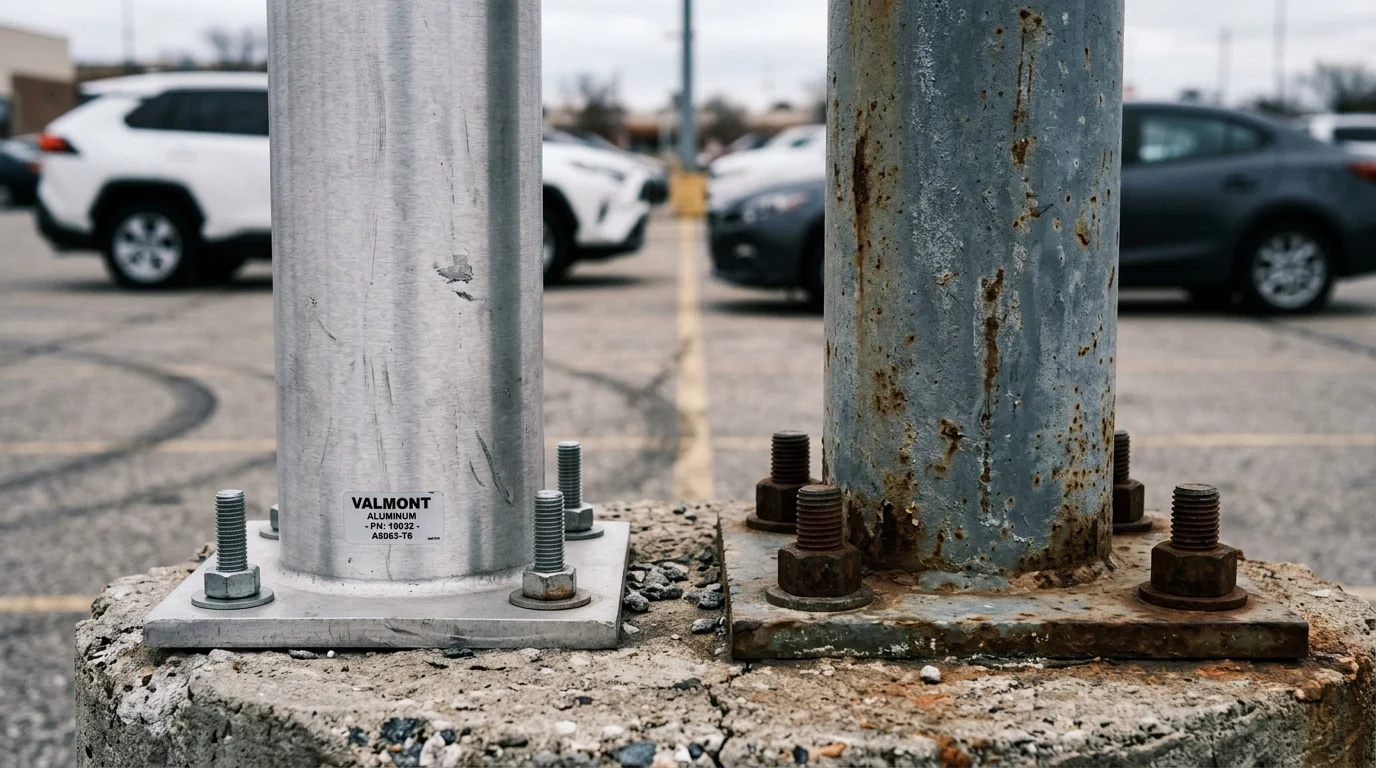
Evaluating the optimal material for commercial exterior lighting requires a rigorous analysis of both metallurgical properties and long-term operational expenditures. While steel and aluminium both serve the fundamental purpose of elevating luminaires, their performance trajectories diverge sharply immediately after installation.
Which Technical and Operational Criteria Matter Most
The primary technical criteria revolve around tensile strength, corrosion resistance, and vibration dampening. Carbon steel typically offers a higher initial yield strength, often exceeding 55,000 psi, which traditionally made it the default choice for exceptionally heavy fixtures or extreme heights. However, this strength relies entirely on the integrity of its protective coating. Once a steel pole’s powder coat is compromised by UV degradation or mechanical impact, rapid oxidation begins, compromising structural integrity.
Conversely, extruded aluminium—commonly utilizing the 6063-T6 architectural alloy—naturally generates a microscopic aluminium oxide layer upon exposure to the atmosphere. This passivation process halts further corrosion without the need for applied coatings. While the yield strength of 6063-T6 is lower (approximately 25,000 to 30,000 psi), engineers compensate by increasing the pole’s wall thickness or base diameter, achieving equivalent structural capacity while maintaining a significantly lower overall weight.
What Comparison Table Supports Specification Decisions
Specification decisions rely heavily on quantifying the total cost of ownership (TCO) rather than merely comparing initial purchase orders. The following matrix outlines the critical operational differences between standard carbon steel and 6063-T6 aluminum lighting poles.
| Performance Metric | Carbon Steel (Galvanized/Coated) | Extruded Aluminium (6063-T6) |
|---|---|---|
| Average Base Weight (20ft pole) | 140 – 180 lbs | 80 – 110 lbs |
| Initial Procurement Cost | Lower (Baseline) | Moderate (+15% to 25%) |
| Corrosion Resistance | Low to Moderate | Exceptional (Natural passivation) |
| Expected Structural Lifespan | 15 – 20 Years | 50+ Years |
| Routine Maintenance Requirement | High (Repainting/Rust mitigation) | Zero to Minimal |
| End-of-Life Recyclability Value | Low | High (Scrap premium) |
How to Specify Aluminium Poles for Parking Lot Lighting
Transitioning to aluminum infrastructure requires precision during the engineering and procurement phases. Because aluminum possesses different deflection characteristics and a different modulus of elasticity compared to steel, buyers cannot simply swap materials interchangeably without validating the structural mathematics against site-specific environmental variables.
What Step-by-Step Process Buyers Should Follow
The specification process must begin with a precise calculation of the luminaire’s Effective Projected Area (EPA) and total weight. Buyers must aggregate the EPA of the LED fixture, the mounting arm, and any auxiliary equipment like sensors or cameras. Next, engineers cross-reference this total EPA against local wind velocity maps, typically utilizing ASCE 7-16 guidelines, which mandate survival at specific 3-second gust speeds—such as 115 mph in standard inland zones and up to 180 mph in hurricane-prone coastal regions.
Once the aerodynamic load is established, buyers select the appropriate pole geometry. Aluminum poles are commonly specified with wall thicknesses ranging from 0.125 inches for light-duty applications up to 0.250 inches or more for maximum load capacities. The final step involves selecting the mounting methodology, such as welded tenons or pre-drilled patterns, and specifying the base plate dimensions to align with the concrete footing anchor bolts.
Why Many Specifications Now Favor Aluminium
Modern commercial lighting specifications increasingly default to aluminum due to its superior lifecycle economics. While the initial capital expenditure for an aluminium pole may run 15% to 25% higher than a comparable steel unit, the total cost of ownership break-even point is typically reached within 5 to 7 years. This accelerated return on investment is driven by the absolute elimination of routine scraping, rust mitigation, and repainting cycles.
Furthermore, as corporate sustainability mandates become stricter, aluminum’s end-of-life profile offers a distinct advantage.
Key Takeaways
- The most important conclusions and rationale for Parking Lot Lighting: Why aluminum poles are replacing steel for Good
- Specs, compliance, and risk checks worth validating before you commit
- Practical next steps and caveats readers can apply immediately
Frequently Asked Questions
Why are aluminum poles becoming the preferred choice for parking lot lighting?
They resist corrosion, weigh 30%–40% less than steel, and usually need far less maintenance. That lowers lifecycle cost for schools, cities, and commercial sites.
Do aluminum poles last longer than steel in outdoor parking lots?
Yes. Aluminum forms a natural oxide layer that protects against rust, especially in coastal or salted environments. Typical service life can exceed 50 years with minimal upkeep.
Can aluminum poles meet wind load and EPA requirements?
Yes, when properly engineered. Pole diameter and wall thickness are selected to match fixture weight, EPA, mounting height, and local AASHTO wind criteria.
How does aluminum help reduce installation costs?
Its lower weight cuts freight costs and often allows smaller crews and standard bucket trucks instead of heavier lifting equipment. That can speed up parking lot projects.
Can Morelux provide custom aluminum parking lot poles for projects?
Yes. Morelux supports project buyers with custom pole options, technical drawings, engineer assistance, and fast 24-hour quotations for infrastructure and commercial lighting projects.