Introduction
Well-planned courtyard lighting does more than brighten paths: it affects safety, visual comfort, architectural emphasis, and the overall character of the landscape after dark. Installing a garden light pole in a residential setting requires more than choosing a fixture and pouring concrete; it involves matching pole height, light output, spacing, foundation stability, wiring, and control options to the scale and function of the space. This article explains the key technical and design considerations behind a successful installation, from illumination performance and glare control to structural support and long-term reliability, so readers can make informed decisions before work begins.
Why Garden Light Pole Installation Matters in Residential Courtyards
Proper garden light pole installation in residential courtyards transcends basic aesthetic enhancements, serving as a critical intersection of landscape architecture, electrical engineering, and structural mechanics. For high-end residential projects, illuminating a courtyard requires precise photometric planning and robust infrastructure to ensure long-term stability and optimal light distribution. Integrating these vertical elements into a curated landscape demands a rigorous approach to scale, proportion, and modern control systems, such as 0-10V dimming or DALI networks, which allow property owners to tailor the nighttime environment with precision.
Installation Scope and Use Cases
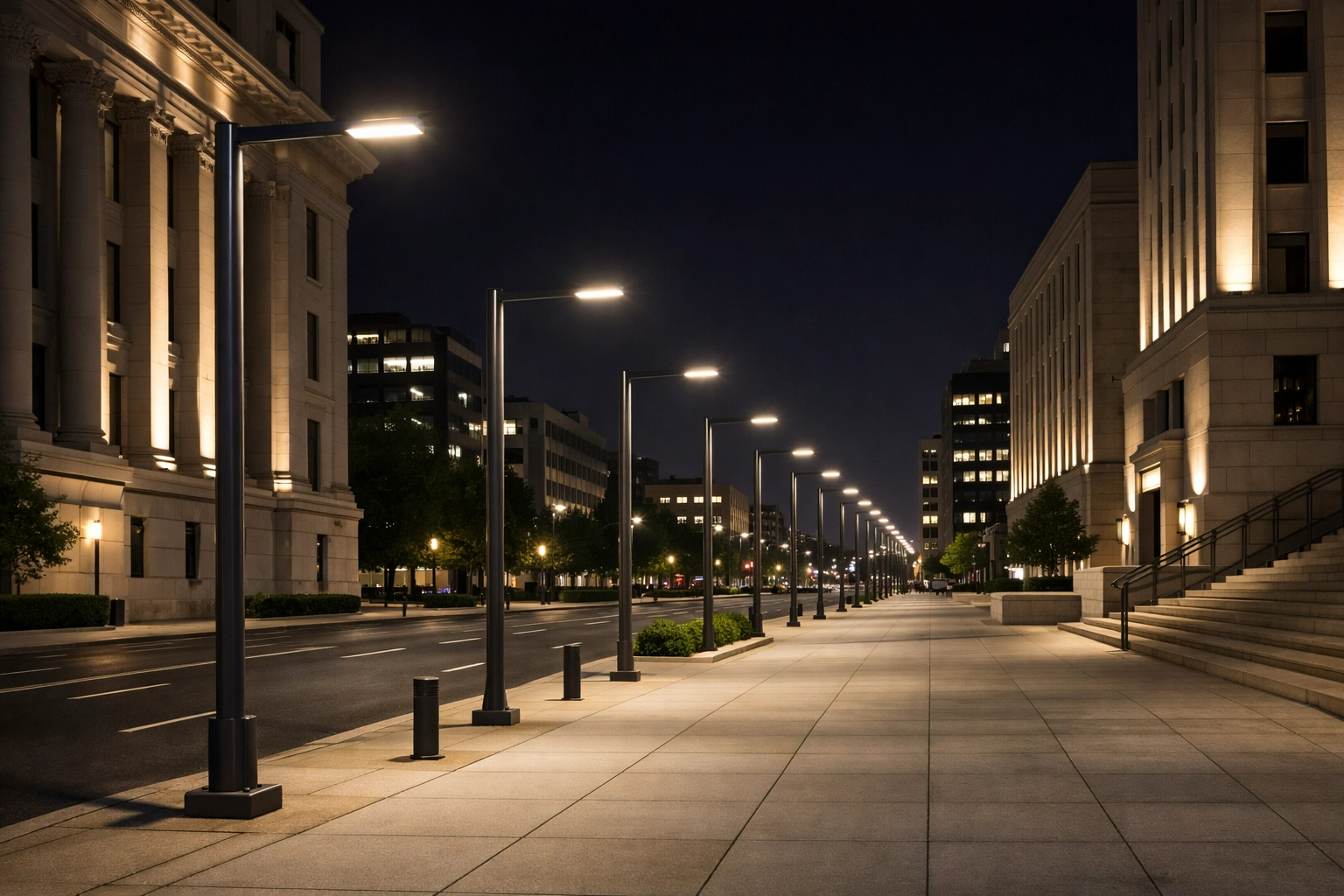
The scope of courtyard lighting extends from ambient pathway illumination to targeted architectural accenting and perimeter security. In residential applications, luminaire mounting heights typically range from 2.5 to 4.0 meters (8 to 13 feet). This specific elevation mitigates glare while providing sufficient light spread, often requiring fixtures with a lumen output between 1,500 and 3,000 lumens. Engineers must calculate the optimal spacing-to-mounting-height ratios to achieve uniform illuminance, generally targeting an average of 1.5 to 3.0 footcandles across primary pedestrian zones. Furthermore, residential installations increasingly mandate warm color temperatures (2700K to 3000K) and strict adherence to Dark Sky compliance, utilizing fixtures with low BUG (Backlight, Uplight, and Glare) ratings to prevent light trespass into adjacent properties or upper-story windows.
Key Project Variables
Several critical variables dictate the engineering approach for residential light poles. Soil bearing capacity directly influences foundation design, often requiring preliminary assessments to determine if the substrate is cohesive clay or loose sand. Local wind load requirements determine the necessary structural rigidity; poles installed in coastal or high-wind zones must often withstand wind speeds of 110 to 130 mph. This requires careful calculation of the luminaire’s Effective Projected Area (EPA) and often dictates an upgrade from standard 11-gauge to thicker 7-gauge tubular steel or aluminum. Additionally, electrical distribution networks must account for voltage drop across expansive courtyards. Industry standards dictate that voltage drop should not exceed 3% at the furthest fixture on a 120V or 240V branch circuit, necessitating precise wire gauge selection based on the total run length and the cumulative amperage of the connected LED load.
Materials, Foundations, and Compliance
Executing a durable courtyard lighting system relies heavily on selecting appropriate structural materials and adhering strictly to local building and electrical codes. The foundation and mounting apparatus form the critical failure points in any exterior lighting array, demanding rigorous specification to withstand environmental degradation factors such as prolonged UV exposure, freeze-thaw cycles, and corrosive soil conditions.
Pole Materials and Mounting Systems
Selecting the correct pole material balances structural integrity, environmental resilience, and project budget. Extruded aluminum, galvanized steel, and fiberglass composites dominate the residential market. Mounting systems typically utilize either direct burial methods or anchor base designs, with the latter providing superior plumb adjustment and long-term stability via concrete footings and leveling nuts. To prevent premature degradation, metal poles require factory-applied thermoset powder coating, typically applied at a minimum thickness of 3 mils, to resist chalking and fading over time.
| Material | Typical Lifespan | Corrosion Resistance | Relative Cost per Pole |
|---|---|---|---|
| Extruded Aluminum | 20-30 Years | High (Naturally Oxidizes) | $300 – $600 |
| Galvanized Steel | 15-25 Years | Moderate (Requires Coating) | $200 – $450 |
| Fiberglass Composite | 30+ Years | Exceptional (Non-metallic) | $400 – $800 |
Code, Drainage, and Safety Requirements
Strict adherence to the National Electrical Code (NEC) or regional equivalents is non-negotiable for exterior electrical infrastructure. Subterranean electrical conduits must meet specific burial depth mandates to prevent accidental severing during future landscaping operations. Standard residential applications require rigid Schedule 40 PVC conduit to be buried at least 18 inches below grade, increasing to 24 inches beneath vehicular driveways. Foundations must be engineered to resist both overturning moments and frost heave. Best practices dictate that concrete cylindrical footings measure 12 to 18 inches in diameter and extend a minimum of 6 inches below the local frost line. Furthermore, grounding arrays must be meticulously installed. Driving a 5/8-inch by 8-foot copper-clad ground rod at the service entrance or individual pole bases is standard practice to achieve a maximum resistance to ground of 25 ohms, ensuring personnel safety and protecting sensitive LED drivers from transient voltage spikes.
Installation Workflow and Contractor Selection
The physical realization of a courtyard lighting plan requires a systematic workflow, transitioning smoothly from raw excavation to precise electrical termination. Selecting a qualified contractor capable of managing these multidisciplinary tasks—encompassing earthwork, concrete pouring, and high-voltage electrical connections—is essential for mitigating risk and ensuring the systemic longevity of the courtyard lighting array.
Practical Installation Steps
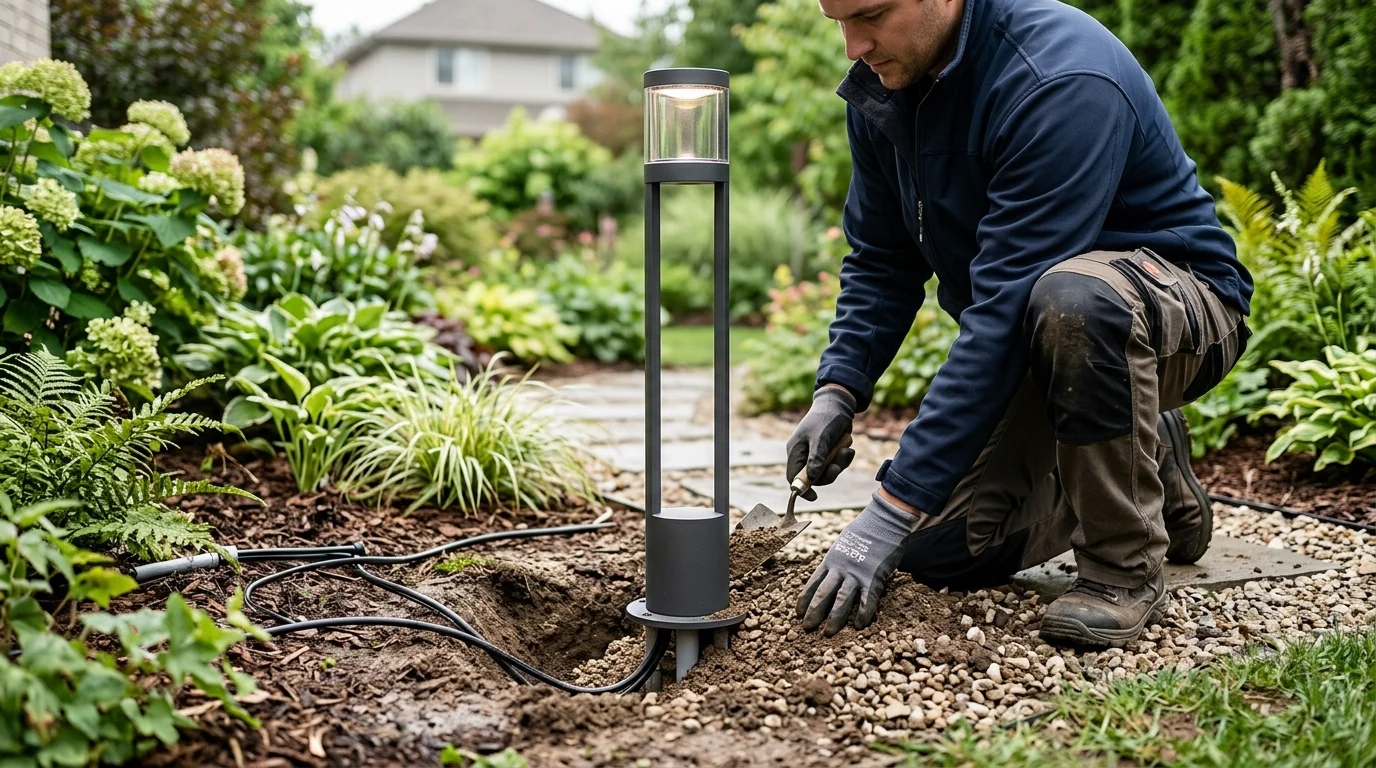
The installation sequence begins with precise trenching and the establishment of concrete forms. Once the conduit is routed into the cylindrical forms, anchor bolt templates are secured to align the hardware with the courtyard’s geometric layout. Concrete typically requires a curing period of 7 to 14 days before it achieves the minimum compressive strength (often 3,000 PSI) necessary to bear the dynamic wind loads of the pole and luminaire. Following the curing phase, electricians pull the specified copper conductors through the conduit network, utilizing appropriate pulling lubricants and leaving adequate service loops at each pole base. The poles are then erected over the anchor bolts, utilizing a dual-nut system to plumb the structure perfectly vertical, compensating for any minor deviations in the concrete surface. Final steps involve terminating the electrical connections, installing weatherproof handhole covers, and applying a protective non-shrink grout pad beneath the base plate to prevent pest intrusion and moisture accumulation.
Comparing Bids and Decision Criteria
Evaluating contractor bids requires looking beyond the bottom-line figure to scrutinize the itemized inclusions and exclusions.
Key Takeaways
- The most important conclusions and rationale for garden light pole installation
- Specs, compliance, and risk checks worth validating before you commit
- Practical next steps and caveats readers can apply immediately
Frequently Asked Questions
What pole height works best for residential courtyard garden lighting?
Most courtyard projects use 2.5 to 4.0 meter poles. This range helps reduce glare while giving even light spread for paths, seating areas, and perimeter zones.
Should I choose aluminum or galvanized steel for a garden light pole?
Aluminum suits corrosion-prone or coastal courtyards. Galvanized steel is often more cost-effective for standard sites. Choose based on wind load, finish needs, and local environment.
What foundation type is recommended for garden light pole installation?
Anchor-base poles with concrete footings are usually preferred. They allow plumb adjustment, solid long-term support, and easier maintenance than direct-buried poles in most residential courtyards.
How can I reduce glare and light trespass in a courtyard?
Use warm 2700K to 3000K fixtures, keep pole heights moderate, and select low-BUG or Dark Sky-compliant luminaires. Proper spacing also helps avoid hot spots and neighbor-facing spill light.
Can Morelux support custom garden light pole projects?
Yes. Morelux can provide customized pole options, technical drawings, engineer support, and fast quotations, helping project buyers source poles matched to courtyard dimensions, loads, and finish requirements.